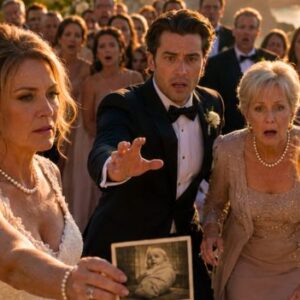
The kiss lasted only six seconds, but by the fourth, Evelyn Vale understood that Marcus wanted the whole world to believe she was already dead.
Cameras exploded in white bursts across the red carpet outside the Halcyon Theatre. Hundreds of voices merged into one restless, electric roar—reporters shouting names, publicists issuing instructions, fans screaming behind velvet barricades.
Above the entrance, twenty-foot letters glowed against the Los Angeles night:
AURORA HOUSE PICTURES PRESENTS
THE GLASS SPARROW
The film was supposed to be Evelyn’s resurrection.
Instead, it had become the stage for her public execution.
She stood alone beneath the lights in a silver gown that flowed around her like liquid moonlight. A string of old pearls rested against her throat—the last piece of jewelry she had not sold when her mother’s company had nearly collapsed.
Her name appeared on every invitation.
Her face filled every poster.
Her money had paid for the theater, the champagne, the lights, the orchestra waiting inside.
Yet when the black SUV stopped at the edge of the carpet, not a single camera remained pointed at her.
The door opened.
Marcus Vale stepped out wearing a midnight-blue tuxedo, his familiar smile perfectly arranged across his handsome face. The smile had sold films, calmed investors, seduced journalists, and once convinced Evelyn that loving him would be the safest decision of her life.
That very morning, he had kissed her forehead in their kitchen.
“Tonight belongs to you,” he had whispered.
Now he turned back toward the SUV and extended his hand.
Lila Hart emerged.
The twenty-seven-year-old actress wore white.
Not ivory. Not cream.
White.
Her gown was sculpted and flawless, its long train spilling onto the carpet behind her. Diamonds glittered at her ears. Her dark hair was pinned into an elegant knot, revealing the smooth line of her neck.
She looked less like a guest than a bride.
Lila paused for the cameras, then slipped her hand through Marcus’s arm.
For one moment, the entire carpet seemed to inhale.
Marcus looked toward Evelyn.
Their eyes met.
There was no apology in his face.
Only calculation.
Then Lila leaned toward him.
Marcus placed one hand against her waist.
And beneath the enormous illuminated title of Evelyn’s film, her husband kissed the actress who had replaced her in seventeen scenes.
One second.
Two.
Three.
By the fourth second, reporters stopped shouting.
By the fifth, Evelyn heard someone behind her whisper, “Oh my God.”
By the sixth, every camera in Hollywood had captured the image Marcus wanted: the aging actress abandoned at her own premiere while her younger replacement claimed both her role and her husband.
When Marcus and Lila separated, the silence broke.
Questions flew from every direction.
“Marcus! How long has this been going on?”
“Lila, are you and Marcus officially together?”
“Evelyn, did you know?”
“Is your marriage over?”
“Was Lila cast because of the affair?”
A publicist named Simon rushed toward Evelyn, his face pale.
“There’s a side entrance,” he whispered. “We can get you inside without—”
Evelyn did not move.
She touched the pearls around her neck.
The gesture steadied her.
Those pearls had belonged to her mother, Celeste Shaw, who had worn them to every Aurora House premiere for thirty years. Celeste had once told her that pearls were created because a living thing refused to surrender to an irritation.
Pain enters. Beauty forms around it.
Evelyn had believed that when she was a child.
Tonight, she finally understood it.
A reporter pushed through the crowd and thrust a microphone toward her.
“How does it feel watching the actress replacing you arrive with your husband?”
Marcus turned slightly.
He was watching her carefully now.
Waiting for tears.
Waiting for fury.
Waiting for Evelyn Vale—the once-famous actress branded “unstable” by anonymous studio sources—to collapse beneath the lights.
She gave him none of it.
Evelyn smiled.
“I feel curious.”
A nervous laugh rippled through the crowd.
Lila tilted her head.
“Curious about what?”
Evelyn looked directly into her eyes.
“How you really got the role.”
Lila’s smile vanished.
Marcus’s hand tightened around her waist.
For the first time that evening, genuine fear passed across his face.
It was gone almost instantly.
But Evelyn saw it.
She had spent twenty years learning how to read the smallest movement on a screen. A tightened jaw. A delayed blink. A breath drawn too quickly.
Marcus recovered his smile.
“Not tonight, Evelyn.”
“Why not?”
“This is a celebration.”
“No,” she said softly. “This is a premiere.”
The theater doors opened behind her.
A deep chime sounded from inside.
Evelyn turned away from them and walked toward the entrance.
The photographers shouted after her, but she did not look back.
Marcus followed.
So did Lila.
And then, carrying the scent of perfume, electricity, and scandal, the entire crowd poured into the dark.
Three years earlier, Evelyn had been standing barefoot in her mother’s study when Marcus first told her that Aurora House Pictures was dying.
Rain struck the windows. Boxes covered the floor. Her mother’s funeral flowers had begun to wilt in the hallway.
Celeste Shaw had been dead for twelve days.
The official cause was cardiac arrest, though Evelyn privately believed grief had killed her before her heart stopped. The newspapers had spent the previous month accusing Celeste of overseeing the largest accounting fraud in independent film history.
Thirty-one million dollars had vanished.
Investors filed lawsuits.
Banks froze Aurora House’s assets.
Actors walked away from contracts.
Celeste denied everything until the morning she collapsed in her office.
Evelyn found her beside the desk, one hand pressed to her chest, the strand of pearls broken across the carpet.
Marcus had arrived before the ambulance.
He had held Evelyn while paramedics worked.
He had arranged the funeral.
He had handled the lawyers.
And two weeks later, he stood in Celeste’s study with a stack of financial reports.
“The banks will liquidate the company,” he said. “Unless we give them a reason not to.”
Evelyn stared at the figures without understanding them.
“I’m an actress.”
“You’re Celeste Shaw’s daughter.”
“That doesn’t make me a producer.”
“It makes you the only person investors might still trust.”
She looked at him.
“Do you trust me?”
Marcus cupped her face in his hands.
“More than anyone.”
That sentence cost her nearly everything.
Evelyn mortgaged the house her mother had left her. She sold two cars, a collection of antique gowns, and almost every piece of family jewelry.
She stopped acting because studio executives no longer wanted to insure a woman attached to a fraud investigation.
She spent eighteen months in courtrooms.
She read contracts until the words blurred.
She learned the language of completion bonds, foreign pre-sales, distribution guarantees, bridge financing, and debt restructuring.
She learned to smile while men half her age explained her own company to her.
And whenever she nearly broke, Marcus stood beside her.
He became chief executive producer.
He negotiated with creditors.
He praised her courage in interviews.
The press called him “the husband who saved a fallen star.”
Evelyn was grateful.
So grateful that she did not ask why every rescue gave Marcus more authority.
So grateful that she did not notice how often documents arrived after midnight, already marked where she should sign.
So grateful that when Aurora House finally stabilized, Marcus controlled nearly every department except one.
Creative approval.
Celeste’s original bylaws granted final creative authority to the company’s chairperson.
That title belonged to Evelyn.
The Glass Sparrow was the first film she approved herself.
She found the script in a stack of rejected submissions. It told the story of two women—a celebrated singer and an ambitious understudy—who were manipulated into destroying each other by the same charming conductor.
Evelyn read it in one night.
By sunrise, she knew she had to play the singer.
“This is your comeback,” Marcus said when she showed him the script.
She searched his face.
“You think I can do it?”
He kissed her.
“I think you were born for it.”
Production began six months later.
At first, everything felt like a miracle.
Evelyn stepped onto the set and remembered who she had been before courtrooms and debt notices. Under the heat of the lights, she became fearless again.
The crew applauded after her first scene.
The director cried after her monologue in the empty concert hall.
Even Marcus appeared moved.
Then Lila Hart arrived.
She had originally been cast in a minor supporting role, but her audition was remarkable. She possessed a quiet intensity that made the camera lean toward her.
Evelyn liked her immediately.
She invited Lila to rehearsals.
She offered notes.
She defended her when the studio wanted to cut her scenes.
“You don’t have to be kind to me,” Lila said one evening.
They were sitting alone on the edge of the soundstage, still wearing their costumes.
“I’m not being kind.”
“What are you being?”
“Accurate. You’re good.”
Lila studied her.
“People said you’d hate me.”
Evelyn laughed.
“People say actresses hate every woman younger than they are. It saves them from having to imagine that we might actually have more interesting feelings.”
Lila smiled.
For a few months, they were close.
Then the rumors began.
Anonymous stories appeared online claiming Evelyn forgot lines, arrived late, and suffered emotional outbursts.
None of it was true.
But the stories were specific enough to sound true.
Marcus advised her not to respond.
“Attention feeds gossip,” he said.
Soon afterward, the insurers demanded additional coverage.
Then Evelyn’s scenes began changing.
A close-up disappeared.
A duet was rewritten as Lila’s solo.
A confrontation that formed the emotional center of the script was postponed, then quietly removed from the schedule.
Evelyn confronted the director.
He looked embarrassed.
“Marcus said the international distributors requested revisions.”
“Marcus doesn’t have creative approval.”
“He said you agreed.”
“I didn’t.”
That night, Evelyn asked her husband whether he was replacing her.
Marcus stared at her as though she had accused him of murder.
“After everything I’ve done for you?”
“That isn’t an answer.”
He walked to the bar and poured a drink.
“You’re exhausted. The pressure is affecting you.”
“Do not tell me how I feel.”
“I’m trying to protect you.”
“From what?”
He turned.
“From becoming your mother.”
The words struck with surgical precision.
Evelyn stopped breathing.
Marcus’s expression softened immediately.
“I’m sorry.”
But something had already shifted.
For the first time, she saw that his tenderness was not the opposite of cruelty.
It was the instrument that made cruelty possible.
The Halcyon Theatre held more than two thousand people, and every seat was occupied.
Actors, financiers, critics, directors, influencers, journalists, and studio executives filled the room. The air glittered with diamonds and expectation.
Evelyn took her seat in the center of the front row.
Marcus sat on her right.
Lila sat on his right.
A perfect arrangement for the photographs.
The lights dimmed.
Marcus leaned close.
“You should have taken the side entrance.”
“So should you.”
His smile remained fixed.
“Whatever performance you’re planning, think carefully.”
Evelyn looked toward the screen.
“I’ve thought about nothing else for months.”
The Aurora House logo appeared: a golden sun rising behind the silhouette of an old mansion.
Applause filled the room.
Then the screen went black.
A woman’s voice spoke from the darkness.
It was Evelyn’s voice.
“Every betrayal begins with a story the victim desperately wants to believe.”
Marcus stiffened.
The image appeared.
Not the opening of The Glass Sparrow.
Instead, the audience saw Evelyn’s kitchen, recorded from a hidden angle.
A date appeared in the corner.
SIX MONTHS EARLIER.
On-screen, Marcus stood beside the marble counter, speaking into his phone.
“She’ll sign after the insurance review,” he said. “Once she’s declared unfit, the board can remove her.”
A man’s voice answered through the speaker.
“And the girl?”
“Lila thinks she’s getting the lead.”
Beside Marcus, the real Lila went utterly still.
The recording continued.
“She’s ambitious,” Marcus said. “Ambitious people are easy. You make them believe betrayal was their idea.”
Gasps rose throughout the theater.
Marcus stood.
“Turn this off.”
No one moved.
He looked toward the projection booth.
“Turn it off!”
The screen changed.
Another recording.
Marcus in his office, sliding a contract toward Lila.
“You’ll have top billing,” he told her.
“What happens to Evelyn?”
“She’ll be cared for.”
“That isn’t what I asked.”
Marcus leaned back.
“Evelyn is ill.”
“She doesn’t seem ill.”
“You haven’t seen her at home.”
On-screen, Lila looked uncertain.
Marcus lowered his voice.
“She throws things. She disappears for hours. Sometimes she doesn’t remember conversations.”
“That’s not true,” someone whispered in the audience.
Marcus stepped into the aisle.
“This footage is illegally obtained and deliberately edited.”
Evelyn remained seated.
“You might want to stay,” she said. “Your best scene is coming.”
He glared at her.
“What have you done?”
She met his eyes.
“I made a movie.”
The theater doors closed.
Not dramatically.
Quietly.
Yet the sound of the locks engaging seemed to move through the room like distant thunder.
Marcus turned to Lila.
“Come with me.”
Lila did not move.
“Lila.”
She looked at him.
For a second, her face revealed something Evelyn had never seen there before—not guilt, not fear, but sorrow.
“I told you she knew,” Lila said.
Marcus’s expression changed.
The next clip appeared.
Lila was standing in Evelyn’s dressing room three months earlier.
Her face was wet with tears.
“I thought you knew,” she said on-screen.
Evelyn sat before the mirror, half her stage makeup removed.
“Knew what?”
“He told me your marriage had been over for a year.”
The audience murmured.
“He said the public announcement had to wait until after production,” Lila continued. “He said you wanted me to take more scenes because the insurers didn’t trust your health.”
Evelyn’s recorded face remained calm.
“Did he ask you to sleep with him?”
Lila flinched.
“He never said it like that.”
“They rarely do.”
“I swear I didn’t know.”
“Not at first,” Evelyn said. “But you know now.”
Lila lowered her eyes.
“Yes.”
“What else did he ask you to do?”
A long silence followed.
Then Lila reached into her bag and removed a small black drive.
“He asked me to copy files from your office.”
The real Marcus stared at her.
“You recorded that?”
Lila turned toward him.
“No.”
Evelyn answered for her.
“I did.”
Marcus looked back toward the screen.
The footage showed Evelyn taking the drive.
“What’s on it?” she asked.
“Contracts. Medical reports. Emails.”
“My medical reports?”
“They’re fake.”
Evelyn inserted the drive into a laptop.
Documents appeared.
Psychiatric evaluations from doctors Evelyn had never met.
Witness statements describing violent behavior that had never occurred.
Board resolutions allowing Marcus to assume temporary control if Evelyn were declared mentally incompetent.
Then came the bank transfers.
Small at first.
Then larger.
Money moving from Aurora House accounts into shell companies.
The dates went back three years.
All the way to the original fraud scandal.
A sound escaped Evelyn in the recording.
Not a cry.
Something quieter.
More wounded.
Lila sat beside her.
“What is it?”
Evelyn pointed at the screen.
“That account.”
“What about it?”
“My mother was accused of transferring eleven million dollars into it.”
Lila stared.
“The company was opened by Marcus.”
“No.” Evelyn’s voice trembled. “It was opened by someone using his middle name and his first business address.”
The audience turned toward Marcus as one.
His face had lost all color.
The footage cut to black.
Words appeared across the screen:
THE FRAUD THAT DESTROYED CELESTE SHAW WAS CREATED BY MARCUS VALE.
Chaos erupted.
Reporters reached for phones.
Executives whispered frantically.
Someone shouted for security.
Marcus stepped toward Evelyn.
“You have no idea what you’re doing.”
She rose from her seat.
“No. For three years, I had no idea what I was doing.”
His voice dropped.
“You’ll destroy the company.”
“You already tried.”
“I saved that company.”
“You set the fire and sold me the water.”
A tremor moved through his face.
Then he laughed.
It was not the warm, controlled laugh the public knew.
This one was thin and ugly.
“You think a few edited recordings will save you?”
“No.”
Evelyn touched her pearls.
“That will.”
She unclasped the necklace.
At the center of the clasp was a tiny golden cylinder no larger than a grain of rice.
Marcus stared at it.
For the first time that night, his composure disappeared completely.
“No,” he whispered.
Evelyn held it up beneath the aisle light.
“My mother designed the original corporate seal herself. Every transfer of controlling interest requires authorization from the chairperson and verification through the founder’s key.”
Lila looked at the pearls.
“The key was in the necklace?”
“All these years.”
Marcus shook his head.
“You sold the founder’s jewelry.”
“Everything except this.”
“You signed the transfer documents.”
“I signed papers you placed in front of me. But without the founder’s key, none of them transferred voting control.”
The screen displayed page after page of corporate filings.
Across each appeared the same red word:
INVALID.
A lawyer seated near the aisle stood.
“My firm verified the bylaws and filed an injunction this afternoon,” he announced. “Mr. Vale has never held controlling authority over Aurora House Pictures.”
Cameras swung toward Marcus.
His eyes darted through the room.
“You planned this,” he said to Evelyn.
“Yes.”
“How long?”
She thought of the first anonymous article. The deleted scene. The forged medical report. The night she had discovered a lipstick stain on Marcus’s shirt and felt, beneath the heartbreak, an unexpected flicker of relief.
“Long enough to stop loving the man you pretended to be.”
His face hardened.
“You needed me.”
“I did.”
“You would have lost everything.”
“I nearly did.”
“I made you relevant again.”
Evelyn looked around the packed theater.
“No, Marcus. You made the oldest mistake in Hollywood.”
His lips tightened.
“You believed your own publicity.”
Applause broke out somewhere in the balcony.
It spread uncertainly, then grew.
Marcus raised his voice over it.
“This is defamation!”
The screen came alive again.
A final recording began.
Celeste Shaw’s study appeared.
The timestamp showed a date three years earlier—two days before her death.
Marcus entered the room.
Celeste stood by the window wearing the same pearls now held in Evelyn’s hand.
“You’ve been moving money through the production accounts,” Celeste said.
Marcus closed the door behind him.
“You’re confused.”
“I have copies.”
“Then you know how bad it looks.”
“For you.”
“For the company.”
Celeste’s eyes narrowed.
“You framed my chief accountant.”
“He was stealing.”
“He discovered you were stealing.”
Marcus moved closer.
“Think carefully, Celeste.”
“I have.”
“You expose me, Aurora House collapses.”
“Then I’ll rebuild it.”
“You’re not young enough to rebuild.”
“No,” she said. “But my daughter is.”
The footage froze.
Evelyn stared at her mother’s face.
She had seen the recording before, yet the sight still opened something raw inside her.
For three years, she had believed Celeste died ashamed.
Now the whole world could see that she had died fighting.
The clip continued.
Marcus noticed something on Celeste’s desk.
A small camera.
His expression changed.
He reached for it.
The screen shook.
Celeste shouted.
There was the sound of breaking glass.
Then darkness.
The audience fell silent.
Evelyn turned toward Marcus.
“What happened after the camera fell?”
His face revealed nothing.
But Lila stood.
“Tell them.”
Marcus looked at her.
“Sit down.”
“Tell them what you did.”
“I said sit down.”
Lila stepped into the aisle.
“You didn’t just frame her.”
A security officer moved closer.
Marcus backed away.
“She had a heart condition,” he said.
Evelyn’s body went cold.
It was the first time he had mentioned it publicly.
Celeste’s heart condition had never appeared in the press.
Never appeared in the court filings.
Only family knew.
“You frightened her,” Evelyn said.
Marcus said nothing.
“You threatened me, didn’t you?”
His silence answered.
“You told her you would destroy me.”
“She was already dying.”
Evelyn heard several people gasp.
Marcus seemed to realize what he had said.
But it was too late.
Lila’s voice was barely above a whisper.
“You took her medication.”
He turned on her.
“You know nothing.”
“I found the bottle in your private safe.”
“You broke into my house.”
“Our house,” Evelyn said.
Marcus looked between them.
Then understanding arrived.
The kiss.
The carpet.
Lila’s white gown.
The public humiliation.
He had thought it was his masterpiece.
Now he understood that every detail had been placed around him.
“You set me up,” he said.
Lila’s eyes shone.
“You told me ambitious people were easy.”
A tear slipped down her cheek.
“You never considered that ashamed people can become brave.”
Marcus lunged toward Evelyn.
Security reached him before he took two steps.
The room erupted.
He fought as three officers restrained him.
“This company is mine!” he shouted. “That film is mine! Everything she has is because of me!”
Evelyn watched him struggle beneath the enormous screen.
“No,” she said.
The theater quieted enough for her voice to carry.
“Everything I lost was because of you.”
The officers pulled Marcus toward the exit.
He twisted around.
“You’ll never recover from this scandal!”
Evelyn looked up at the screen.
“I’m counting on it.”
The lights went out.
Complete darkness covered the theater.
Then orchestral music began.
Soft strings.
A single piano.
The actual opening image of The Glass Sparrow appeared.
Evelyn stood alone on a stage, playing the once-celebrated singer the world believed had lost her voice.
On-screen, she raised her head toward an empty auditorium.
Then she began to sing.
The performance was not technically perfect.
It was something rarer.
It was true.
In the front row, Lila covered her mouth.
“They kept your scenes,” she whispered.
Evelyn looked at her.
“Not all of them.”
“But Marcus ordered the reshoots.”
“I ordered a second editing team.”
Lila stared at the screen as her own character appeared beside Evelyn’s.
Not a replacement.
Not an enemy.
An equal.
The scenes Marcus had cut were restored. The confrontations were sharper. The emotional stakes were deeper.
And as the fictional conductor manipulated the two women against each other, the story gained a terrible new meaning.
On-screen, Evelyn’s character discovered the deception.
She turned to Lila’s character and said, “He survived by making each of us believe the other woman was the cage.”
Lila began to cry.
Evelyn reached for her hand.
For two hours, the theater remained utterly still.
When the final scene ended, the fictional women stood together before a ruined concert hall while the man who had controlled them listened from outside, unable to enter.
The screen faded to black.
Then came the final credit:
A FILM BY EVELYN SHAW VALE
Below it appeared another line:
DEDICATED TO CELESTE SHAW, WHO LEFT HER DAUGHTER A KEY AND TAUGHT HER HOW TO USE IT.
The audience rose.
The applause was not polite.
It struck the walls like a storm.
Evelyn remained seated for several seconds.
She had imagined this moment during sleepless nights. She had imagined triumph, vindication, the satisfaction of watching Marcus exposed.
But what she felt was not triumph.
It was grief finally given somewhere to go.
She pressed the pearls to her lips.
“I’m sorry it took me so long, Mom,” she whispered.
Lila squeezed her hand.
“She knew you’d find it.”
Evelyn turned.
“What?”
Lila’s face changed.
There was something she had not yet said.
Something that frightened her.
“Lila?”
Lila reached into the hidden pocket of her gown and removed a small envelope.
The paper was yellowed at the edges.
Evelyn recognized her mother’s handwriting immediately.
Her name was written across the front.
EVELYN.
Her hands began to shake.
“Where did you get this?”
“My father gave it to me.”
“Your father?”
Lila took a breath.
“Daniel Hart.”
The name struck Evelyn with the force of a physical blow.
Daniel Hart had been Aurora House’s chief accountant.
The man accused of helping Celeste steal thirty-one million dollars.
The man who disappeared before the investigation ended.
“He’s alive?” Evelyn whispered.
Lila nodded.
“He went into hiding after Marcus threatened him. He spent years collecting evidence, but he was afraid no one would believe him.”
“Why didn’t he come to me?”
“He thought you were working with Marcus.”
Evelyn looked at the envelope.
“And my mother?”
“She gave him that letter the day before she died. She told him to protect it until he knew you were ready to see the truth.”
Evelyn opened it.
Inside was a single page.
My dearest Evelyn,
If you are reading this, then Marcus has already tried to take from you what he took from me.
Do not blame yourself for loving him. Some people spend their lives learning how to resemble shelter.
The founder’s key will protect the company, but it cannot protect your heart. For that, you must trust what I spent too many years forgetting: no one who truly loves you will require you to become smaller so that they can feel powerful.
There is one more truth.
Evelyn paused.
The next line blurred through her tears.
She wiped them away and continued.
Daniel Hart is not merely my accountant.
He is the father of your sister.
Evelyn stopped breathing.
Slowly, she raised her eyes.
Lila was crying openly now.
“My mother and Daniel never married,” she said. “I grew up using her surname. I didn’t know Celeste was my mother until my father told me last year.”
The noise of the theater receded.
Evelyn stared at Lila—the shape of her eyes, the stubborn lift of her chin, the way she pressed her thumb against her palm when frightened.
Celeste had done the same thing.
“You knew?” Evelyn asked.
“Not when I auditioned.”
“But before Marcus—”
“Yes.”
“Why didn’t you tell me?”
“I thought you’d hate me.”
“For existing?”
“For being proof that your mother had another life.”
Evelyn looked down at the letter.
The final paragraph waited.
I failed both of my daughters in different ways. I gave Evelyn my name but too much responsibility. I gave Lila my blood but not enough courage to claim her. If life is kinder than I deserve, perhaps one day you will stand beside each other—not as rivals, not as replacements, but as sisters.
Evelyn closed her eyes.
Every choice of the past year shifted into new alignment.
Her instinctive affection for Lila.
Her mother’s insistence that Evelyn read The Glass Sparrow.
The story of two women tricked into believing there was room for only one.
Even the title carried a hidden memory.
When Evelyn was six, Celeste had given her a glass sparrow after returning from a film festival.
“It looks fragile,” Celeste had told her, “but glass survives fire better than people think.”
Evelyn looked at Lila.
“Did Marcus know?”
“No.”
A broken laugh escaped Evelyn.
“So the one thing he never discovered was the one thing he was most afraid of.”
“What?”
“That neither of us needed him.”
Lila lowered her eyes.
“I kissed him.”
“Yes.”
“I know it was part of the plan, but I still did it in front of you.”
“Yes.”
“I’m sorry.”
Evelyn studied her for a long moment.
Then she stood.
Lila rose too.
The audience was still applauding, unaware of the quieter drama unfolding between them.
Evelyn reached up and removed the strand of pearls from her own neck.
She placed it around Lila’s.
Lila touched them in shock.
“I can’t take these.”
“You’re not taking them.”
Evelyn fastened the clasp.
“You’re inheriting them.”
Lila’s face crumpled.
Evelyn pulled her into an embrace.
At first, Lila stood rigid.
Then she wrapped both arms around Evelyn and held on as though making up for every year they had not known each other.
Around them, cameras flashed.
But this time, the image they captured was not one Marcus had designed.
It belonged entirely to them.
Six months later, Marcus Vale pleaded guilty to fraud, conspiracy, evidence tampering, and negligent homicide.
His confession came after Daniel Hart emerged with thirteen years of records.
Aurora House recovered most of the stolen money.
The anonymous journalists who had described Evelyn as unstable revealed that their stories had come from a public-relations firm secretly paid by Marcus.
Three doctors lost their licenses over the forged psychiatric evaluations.
The Glass Sparrow became the most successful film in Aurora House history.
Critics called Evelyn’s performance “the resurrection of a major artist.”
Lila received equal praise.
But the review Evelyn kept framed in her office contained only one sentence:
“The film understands that the opposite of betrayal is not revenge, but recognition.”
On the anniversary of Celeste’s death, Evelyn and Lila stood together in the old Aurora House courtyard.
The studio had been restored.
Fresh white paint covered the walls. New productions filled the soundstages. Young filmmakers hurried across the lot carrying scripts, coffee, costumes, and impossible hopes.
At the center of the courtyard stood a new bronze plaque.
THE CELESTE SHAW STAGE
FOR THE WOMEN WHO WERE TOLD THERE WAS ROOM FOR ONLY ONE
Daniel stood nearby, older and thinner than Evelyn remembered, but no longer hiding.
He watched his daughters with an expression shaped equally by pride and regret.
Lila touched the pearls around her neck.
“Are you sure you don’t want them back?”
Evelyn smiled.
“I kept the key.”
From her pocket, she removed the small golden cylinder.
Lila laughed.
“Of course you did.”
They walked toward Stage Four, where their next film was beginning production.
This one told the story of two sisters who inherited a haunted theater.
Lila would direct.
Evelyn would star.
Above the stage entrance, an assistant had taped a handwritten sign:
WELCOME BACK, MS. SHAW.
Evelyn stopped.
For most of her life, she had used Marcus’s surname because he convinced her it sounded stronger on a marquee.
She had filed the paperwork that morning.
Vale was gone.
Not erased.
Transformed into evidence of a life she had survived.
She touched the name on the sign.
Lila waited beside her.
“You ready?”
Evelyn looked through the open stage doors.
Lights glowed inside.
A camera waited.
Dozens of faces turned toward her—not with pity, not with suspicion, but with expectation.
Three years ago, she had believed losing everything meant reaching the end of her story.
She understood now that endings were often only moments when someone else stopped controlling the narrative.
Evelyn stepped onto the stage.
The crew fell silent.
The director called for places.
Lila moved behind the camera and smiled.
“Whenever you’re ready,” she said.
Evelyn stood in the light her husband had tried to steal, wearing her mother’s name and carrying nothing that belonged to fear.
She took a breath.
Then she looked directly into the lens.
“I’ve been ready for years.”
The camera began to roll.
And this time, no one could cut her from the film.