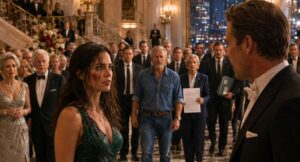
**The slap echoed like a verdict across the crystal-lit ballroom.**
For one extraordinary second, the world did not move.
Five hundred guests stood beneath chandeliers bright enough to imitate daylight, their jeweled throats and polished cuff links gleaming in the frozen silence. The orchestra’s final note trembled above the dance floor, thin and unfinished. A waiter stopped with a silver tray tilted in his hands. A senator’s wife lifted her fingers to her mouth. Somewhere near the champagne fountain, a glass slipped and shattered.
My cheek burned.
The taste of blood mingled with the champagne Randolph Prescott had thrown into my face moments before striking me. It was metallic, bitter, and strangely clarifying.
Randolph stood inches away, breathing hard, his handsome features rearranged by rage. The ballroom lights glittered in his eyes, making them appear almost beautiful.
That was the most dangerous thing about him.
Even at his ugliest, the world had trained itself to admire him.
“Look at her,” he said, turning toward the guests. “Still pretending she belongs here.”
A few people laughed.
Not because the joke was funny.
Because Randolph Prescott had laughed first.
Power always taught people when to laugh, when to look away, and when to call cruelty sophistication.
I touched my lower lip. Blood stained my fingertip.
Randolph saw it and smiled.
“You should be grateful,” he continued. “Five years ago, you were balancing invoices in a windowless office. Then I married you. I gave you a name, a home, a life people would kill for.”
“A life people have killed for,” I said.
His smile flickered.
Only for a moment.
Then he leaned closer, lowering his voice. “Do not start speaking in riddles, Mara. You’re not clever enough to frighten me.”
That almost made me laugh.
For five years, I had corrected the company’s cash-flow projections while Randolph took credit. I had prevented three acquisitions from collapsing, renegotiated debts he did not understand, and quietly stopped Prescott Holdings from violating banking covenants that would have destroyed it.
At dinner parties, he introduced me as his “little numbers girl.”
In board meetings, he repeated my conclusions in a deeper voice.
And in private, whenever my usefulness reminded him of his inadequacy, he punished me for it.
Tonight’s gala was supposed to celebrate the hundredth anniversary of Prescott Holdings.
Instead, Randolph had spent the evening flirting openly with the daughter of a foreign minister, insulting my dress, and telling anyone who listened that I possessed “all the warmth of an accountant’s spreadsheet.”
An hour earlier, as we sat beneath the gold-leaf ceiling, he had looked at me and said, “You know what your problem is?”
“I suspect you’re about to tell me.”
“You always look as though you’re calculating something.”
I had smiled.
**I was.**
Every offshore transfer.
Every falsified ledger.
Every shell company disguised as a charitable foundation.
Every politician who received consulting fees for services never performed.
Every employee whose pension had been raided to cover Randolph’s gambling losses.
For five years, I had studied every crack in the Prescott empire.
And tonight, at last, they had handed me the hammer.
I removed my phone from my clutch.
Randolph’s laughter returned. “What are you going to do? Call the police?”
“No.”
I tapped a number I had memorized as a child.
My father answered on the first ring.
“Mara?”
His voice was rough and familiar, carrying memories of oil-stained hands, burnt coffee, and the small repair shop where I had grown up.
I looked directly at Randolph.
“Dad,” I said, my voice unnervingly calm. “Come get me.”
Silence filled the line.
My father understood what those words meant.
We had agreed on them years ago.
Not because I expected to be struck in public, but because men like Randolph often revealed themselves only when they believed no consequences remained.
“Are you certain?” my father asked.
I looked around the ballroom.
At the executives whose bonuses I had protected.
At the women who had watched Randolph humiliate me and then turned toward the dance floor.
At the members of the Prescott board who knew I had saved the company and still referred to me as “Randolph’s practical little wife.”
“Yes,” I said.
Then I added the words that would end an empire.
**“Bring everything they never saw coming.”**
I lowered the phone.
Randolph stared at me for half a second before throwing back his head and laughing.
“Your father?” he said. “You called your father?”
The ballroom joined him cautiously.
Randolph stepped onto the raised edge of the dance floor and spread his arms.
“Ladies and gentlemen, we are about to be rescued by Silas Vale, proprietor of the most unsuccessful truck garage in the state.”
More laughter.
“Perhaps he’ll arrive in that rusted pickup of his,” Randolph continued. “The one that sounds like a washing machine full of nails.”
I wiped the blood from my lip.
“You should have looked more closely at the truck.”
Randolph’s father emerged from the crowd.
Augustus Prescott was seventy-one, silver-haired and broad-shouldered, with the weary grandeur of a deposed king. He had spent four decades appearing on magazine covers beneath headlines about discipline, vision, and legacy.
Tonight, he looked older than I had ever seen him.
“Mara,” Augustus said quietly, “you should leave.”
Randolph turned toward him. “This has nothing to do with you.”
“It has everything to do with me.”
Something passed between them.
Fear, perhaps.
Or recognition.
Randolph did not notice. He rarely noticed anything that was not reflected in a mirror.
His mother did.
Celeste Prescott sat near the center of the ballroom beneath an enormous oil portrait of herself.
She was sixty-eight and almost unnaturally elegant, dressed in pale silver with diamonds at her throat. Her white-blond hair framed a face the newspapers called timeless. For three decades, she had chaired hospitals, opened museums, funded shelters, and posed beside children whose names she never remembered.
She had not moved when Randolph struck me.
She had merely lifted her champagne glass and watched.
Now her gaze shifted from Augustus to me.
A small movement.
A small suspicion.
Then the ballroom doors groaned open.
The laughter died first.
Randolph’s smile followed.
My father stepped into the light.
He wore the same faded blue work shirt he had worn that morning. The cuffs were rolled above his wrists. A streak of grease marked one sleeve.
But the watch beneath that sleeve was worth more than Randolph’s mansion.
Behind him came twelve people in dark suits, each carrying a sealed black folder. Some wore federal identification badges. Others carried court orders, forensic drives, and evidence cases.
At the center walked a woman with silver hair and the expression of someone arriving to collect a debt.
I recognized her immediately.
Justice Miriam Quill had spent twenty-eight years on the federal bench. She had dismantled monopolies, imprisoned governors, and once forced a banking dynasty to repay every cent stolen from three generations of farmers.
She had retired two years earlier.
Or so the public believed.
Randolph gripped his champagne glass.
“Who let you in?”
My father glanced at me before answering.
**“The same person who owns this building.”**
A murmur moved through the ballroom.
Randolph laughed, but the sound cracked in the middle.
“This building belongs to Prescott Holdings.”
Justice Quill opened her folder.
“It belonged to Prescott Holdings until 4:17 this afternoon.”
She placed a document on the nearest table.
The Prescott crest stared upward from the page like a tombstone.
“Following the acceleration of secured debt, material breaches of fiduciary duty, and emergency findings issued by the court,” she said, “this property is now under receivership.”
Augustus closed his eyes.
Celeste did not move.
My father crossed the marble floor and stopped beside me.
For the first time that night, my control nearly broke.
His fingers trembled as they touched my bruised cheek.
Not the tremor of an old man.
The tremor of a father imagining every moment that had led to this one.
“I should have come sooner,” he whispered.
“You came when I called.”
“I should never have let you stay.”
“I chose to stay.”
Pain moved across his face.
Then he turned toward the room.
The mechanic disappeared.
In his place stood the man Randolph had never bothered to see.
“Effective immediately,” my father announced, “all Prescott operating accounts, subsidiary accounts, trusts, and charitable foundations are frozen.”
Someone dropped another glass.
This time, no one laughed.
A banker near the eastern doors slipped his phone into his pocket and began moving toward the exit.
Two federal agents stepped into his path.
“Remain in the room, please.”
The doors locked.
Augustus pushed through the crowd, his face red with an emotion I could not yet name.
“You cannot freeze my company.”
I looked at him.
For five years, I had wondered what I would feel when this moment came.
Triumph?
Revenge?
Relief?
Instead, I felt only exhaustion.
“It was never your company,” I said.
I lifted my phone and tapped the screen.
Every chandelier went dark.
Gasps swept through the ballroom.
Then the walls illuminated.
The gold draperies became projection screens. The portraits vanished beneath columns of numbers. Bank transfers, forged signatures, shell corporations, property deeds, encrypted messages, and photographs surrounded the guests.
Five years of secrets turned the ballroom into an exhibit.
A map appeared, connecting Prescott subsidiaries to accounts in Zurich, Singapore, Malta, and the Cayman Islands.
Then came the recordings.
Randolph’s voice filled the room.
*The pension fund is just dormant capital.*
A second clip followed.
*Those factory workers won’t know the difference. Half of them can barely read a pay stub.*
Then another.
*Pay the inspector. If he won’t take it, find someone with photographs of his daughter.*
Randolph’s face drained of color.
His champagne glass slid from his hand and struck the marble.
“You recorded me?”
“No,” I said.
I looked past him.
**“Your father did.”**
The room turned toward Augustus.
He stood perfectly still.
Then, with slow precision, he removed his cuff links and placed them on a table.
Randolph stared at him.
“You?”
Augustus looked at his son, and something inside him seemed to collapse.
“I gave you every chance to stop.”
“You betrayed me.”
“I documented you.”
“You’re my father.”
“Yes,” Augustus said. “That is why it took me so long.”
Randolph crossed the floor and grabbed his father’s lapels.
Agents moved forward, but Augustus raised one hand.
“No,” he said. “Let him look at me.”
Randolph’s breathing became ragged.
“You weak, senile coward.”
Augustus did not defend himself.
“You taught me this,” Randolph hissed. “You taught me that winning was the only thing that mattered.”
“No,” Augustus said. “I taught you what I had been taught. That was my failure.”
Randolph released him with a shove.
“You think confessing makes you noble?”
“No.”
“Then what does it make you?”
Augustus looked toward the financial records burning across the walls.
“A witness.”
My father opened the final black folder.
Inside was a photograph of two young men standing in front of an unfinished warehouse.
One was Augustus.
The other was my father.
The date printed in the corner was thirty-two years old.
Across the bottom, someone had written three words in red ink.
**SHE MUST NEVER KNOW.**
I looked at my father.
He was not watching Randolph.
He was looking at me.
And for the first time that night, fear entered his eyes.
“Dad?” I whispered.
His gaze shifted briefly toward Celeste.
Then back to me.
The movement was almost imperceptible.
But I understood.
The message was not what everyone thought.
Not yet.
Celeste rose gracefully from her chair.
“What a fascinating performance,” she said.
Her voice carried across the ballroom without effort.
The projections painted shifting numbers across her silver gown.
She walked toward the photograph.
“Thirty-two years,” she murmured. “How sentimental.”
Augustus’s face tightened.
Celeste picked up the photograph.
“Silas Vale and my husband. Partners.”
Randolph turned toward her. “You knew?”
“Of course I knew.”
The response came too quickly.
My father’s hand closed around mine.
Celeste examined the red writing.
“She must never know,” she read. “Obviously, they meant Mara.”
“No,” I said.
Celeste looked at me.
I tasted blood again.
**“They meant you.”**
The silence changed.
Before, it had been shock.
Now it became danger.
Randolph shook his head. “What is she talking about?”
Celeste smiled.
Not the gracious smile from magazine covers.
Not the soft expression she wore at children’s hospitals.
This smile was small, private, and empty.
Augustus spoke first.
“Prescott Holdings began with three people.”
One of the ballroom screens changed.
An old partnership agreement appeared.
Silas Vale.
Augustus Prescott.
Celeste Armand.
“My father and Augustus designed the logistics network,” I said. “But Celeste designed the financial structure.”
Randolph looked between them. “So?”
“So she discovered something,” my father said. “Companies do not need to be profitable to make their owners rich. They only need to move money.”
The screens displayed early ledgers.
Shipping invoices doubled and tripled.
Nonexistent cargo.
Phantom warehouses.
Insurance claims filed for goods that had never existed.
“Celeste wanted to expand,” Augustus said. “Political payments. Smuggling routes. Pension theft. Anyone who resisted became a liability.”
Celeste sighed.
“You always did make business sound so vulgar, Augustus.”
“You ordered a warehouse foreman killed.”
“He threatened six thousand jobs.”
“You had him thrown from a bridge.”
“I preserved the company.”
Randolph stared at his mother.
For the first time, I saw a child beneath the cruelty. A frightened boy discovering that the monster under his bed had been the person who tucked him in.
“You told me Dad built all this,” he said.
Celeste turned to him.
“Your father liked magazine covers.”
Augustus flinched.
“Your mother built the empire,” I said. “Your father spent thirty-two years pretending he controlled it.”
“That’s impossible.”
“Is it?”
Another recording began.
Celeste’s voice filled the room.
Calm. Cultured. Unmistakable.
*Augustus is useful because men prefer fearing other men.*
A second recording followed.
*Randolph can sign the pension transfer. If anyone investigates, an ambitious son stealing from his father is a story the public will understand.*
Randolph staggered backward.
His mother watched him without expression.
“You were going to blame me.”
“I was going to protect what I built.”
“I’m your son.”
“You are an appetite wearing a dinner jacket.”
The cruelty of it struck even me.
Randolph had humiliated, threatened, and struck me. He had destroyed careers for sport.
Yet in that moment, I understood what had made him.
Not an excuse.
An origin.
Celeste had fed his worst instincts because they made him noisy. Predictable. Useful.
He had believed himself the heir.
He had always been the decoy.
Justice Quill stepped forward.
“Celeste Prescott, you are being detained pending charges including conspiracy, money laundering, obstruction of justice, bribery, wire fraud, pension theft, and solicitation of murder.”
A federal marshal approached.
Celeste’s smile returned.
“Am I?”
Her right thumb pressed against the emerald ring on her finger.
My father’s face changed.
“Mara!”
The screens went black.
Emergency lights flashed red.
A mechanical sound thundered behind the walls as steel shutters descended over the ballroom windows.
Guests screamed.
Justice Quill shouted orders.
Celeste moved with startling speed, seizing a champagne bottle and smashing it against the table. She pressed the jagged glass to the throat of the foreign minister’s daughter.
“Open the west corridor,” she said.
The young woman whimpered.
Randolph stood motionless.
“Mother…”
Celeste did not look at him.
“Open it.”
A security officer near the wall hesitated.
Celeste tightened her grip. A thin line of blood appeared on the hostage’s neck.
“Now.”
The officer entered a code.
A section of the ballroom wall opened, revealing a service passage.
Celeste dragged the young woman toward it.
My father stepped in front of me.
“Stay back.”
But I had not spent five years waiting to stand behind anyone.
“White Orchard,” I called.
Celeste stopped.
The words struck her more effectively than a bullet.
Slowly, she turned.
“How do you know that name?”
“Your emergency protocol,” I said. “The system that destroys the company archives, transfers the reserve funds, and sends copies of your private insurance files to three foreign attorneys.”
Her eyes narrowed.
“That information existed only on an isolated server.”
“In the lake house.”
“No one entered that room.”
“I didn’t need to.”
I reached beneath my dress and removed a thin gold chain.
A tiny black key hung from it.
Celeste’s composure cracked.
“Where did you get that?”
“From the silver music box in your bedroom.”
For the first time, true rage transformed her face.
Three years earlier, Celeste had invited me to the family’s lake estate after Augustus suffered what she called a mild stroke.
While helping her dress for dinner, I had heard a melody playing from a music box near her bed.
My mother used to hum the same melody.
Not because it was rare.
Because it followed a mathematical pattern—seven notes repeated in intervals that corresponded to prime numbers.
My father had taught it to her.
That evening, I discovered the music box opened only when its keys were pressed in that sequence.
Inside had been a black access key.
I had photographed it, replaced it, and spent eighteen months reconstructing the encrypted system it controlled.
Celeste gave a low laugh.
“So it was you.”
“It was always me.”
“You kept the company alive.”
“I kept the employees paid while I found the evidence.”
“You advised Randolph on the Port Mercer acquisition.”
“I delayed it until your bribery agreements were signed.”
“You stopped the bank from calling our debt.”
“Until my father acquired enough of it to control the default.”
Celeste studied me with something almost like admiration.
“I underestimated you.”
“No,” I said. “You made the same mistake your son did.”
Her gaze sharpened.
“You thought being quiet meant being weak.”
The steel shutters began rising.
Light returned to the ballroom.
Celeste looked toward her emerald ring.
Nothing happened.
“White Orchard is dead,” I said. “The money never left.”
For the first time, panic entered her eyes.
“Where is it?”
“Safe.”
“You have no idea what you’ve done. Governments depend on those accounts. Ministers, judges, security services—”
“Every transfer was copied to the court.”
“They will destroy you.”
“They will have to stand in line.”
Celeste’s hostage suddenly drove her heel down onto Celeste’s foot.
The older woman recoiled.
Federal marshals surged forward.
Celeste released the broken bottle and reached inside her gown.
Augustus shouted.
A gun flashed beneath the red emergency lights.
Randolph moved.
He did not think.
He threw himself between his mother and me.
The gunshot cracked through the ballroom.
Randolph spun and fell.
Celeste stared at him.
Not with grief.
With irritation.
That was the moment Randolph finally understood her.
His mother stepped around his body and raised the gun again.
My father lunged toward me.
But Augustus reached Celeste first.
He struck her wrist. The second shot tore into the ceiling, raining plaster and crystal over the dance floor.
Agents drove Celeste to the ground.
Even pinned beneath three marshals, she did not scream.
She looked only at me.
“You think this has a happy ending?” she asked.
I knelt beside Randolph.
Blood spread across his white dinner jacket.
His eyes found mine.
“Mara…”
“Do not move.”
He laughed weakly, then winced.
“I suppose your father’s truck has an ambulance in it.”
“It does, actually.”
“I always hated that truck.”
“I know.”
His fingers closed around my wrist.
“I’m sorry.”
The apology was small.
Far too small for five years.
But it was real.
Perhaps the first real thing he had given me.
“I loved you,” he whispered.
Part of me wanted to lie.
Instead, I touched his hand.
“I loved who I thought you could become.”
His eyes filled with tears.
“Is that enough?”
“No.”
He closed his eyes.
I thought he had died.
Then the paramedics reached us.
They cut open his jacket, pressed gauze to the wound, and lifted him onto a stretcher.
As they carried him away, Randolph’s hand slipped from mine.
I watched until the ballroom doors closed behind him.
Then I turned toward my father.
The photograph remained on the table between us.
**SHE MUST NEVER KNOW.**
“You knew about Celeste all these years,” I said.
“Yes.”
“You let me marry her son.”
“No.” His voice broke. “I begged you not to.”
“But you never told me why.”
“If Celeste learned you knew the truth, she would have killed you.”
“She nearly did anyway.”
“I know.”
“That is not an answer.”
My father looked suddenly older than his seventy years.
“Thirty-two years ago, Augustus came to me with evidence of the first murders. We planned to expose her. Before we could, Celeste discovered someone had copied the ledgers.”
He touched the edge of the photograph.
“She did not know whether it was Augustus or me. So we made an agreement. I would leave the company and disappear into an ordinary life. Augustus would remain beside her, pretending loyalty. We wrote the warning on the photograph before dividing the evidence.”
“And my mother?”
Pain crossed his face.
The ballroom seemed to recede around us.
“Celeste suspected her.”
My chest tightened.
My mother had died when I was six.
A winter highway.
A truck that crossed the median.
An accident, I had always been told.
“No,” I whispered.
My father’s silence answered me.
Celeste, still restrained across the ballroom, smiled.
“She had lovely eyes,” she said.
My father moved toward her with murder in his face.
I caught his arm.
“Dad.”
“She ordered it.”
Celeste’s smile widened.
“She married a man who mistook patience for courage.”
My father shook beneath my hand.
All my life, I had believed he repaired engines because he lacked ambition.
Now I understood.
He had spent thirty-two years building a trap.
Every modest investment.
Every anonymous debt purchase.
Every silent partnership.
Every year beneath Celeste’s notice.
My mother had not died because my father was weak.
My father had survived because he intended to finish what she began.
“You should have told me,” I said.
“Yes.”
“I would have understood.”
“No parent should ask a child to understand that.”
“I wasn’t a child forever.”
“To me, you were.”
The anger inside me remained.
So did the love.
Some wounds did not cancel each other. They simply learned to occupy the same heart.
Augustus approached us.
His cheek was cut from falling crystal. His hands were empty.
“I am sorry, Mara.”
I looked at him.
“For which part?”
“All of it.”
“You protected Celeste.”
“I feared her.”
“You helped build the system.”
“Yes.”
“You let your son become her shield.”
His gaze moved toward the doors through which Randolph had been carried.
“Yes.”
“Will you testify?”
“Until there is nothing left to tell.”
Justice Quill joined us.
“There is one matter remaining.”
She opened another document.
Celeste laughed from the floor.
“Oh, let me guess. Silas becomes king.”
My father looked at her.
“No.”
Justice Quill placed the document beside the photograph.
It was a trust instrument dated thirty-two years earlier.
The original name read VALE-PRESCOTT EMPLOYEE SECURITY TRUST.
Augustus stared at it.
“I thought Celeste destroyed this.”
“She destroyed a copy,” my father said.
Justice Quill turned to the final page.
The trust had been funded through the original partnership shares, warehouse deeds, patent royalties, and an insurance settlement Celeste had secretly redirected into her first offshore company.
Over three decades, those assets had grown.
Through shell acquisitions, debt purchases, and legal claims, the trust now held controlling interests in nearly every legitimate Prescott subsidiary.
I read the beneficiary clause twice.
Then a third time.
The trust did not belong to my father.
It did not belong to Augustus.
And it did not belong to me.
It belonged to every current and retired employee whose pension, wages, or benefits had been stolen by Prescott Holdings.
Eighteen thousand four hundred and twelve people.
Warehouse crews.
Drivers.
Engineers.
Clerks.
Factory workers.
Families Celeste had considered too powerless to matter.
“The company will be restructured,” Justice Quill said. “After restitution and court supervision, voting control will pass to the employee trust.”
Celeste stopped smiling.
My father looked at her across the ruined ballroom.
**“You were right about one thing. Companies do not have to be profitable to make their owners rich.”**
He placed his hand over the trust document.
**“But you were wrong about who the owners were.”**
Outside, sirens filled the night.
One by one, the ballroom doors opened.
Guests were interviewed and released. Executives were escorted away. Bankers surrendered phones. Board members began revising their memories before investigators even questioned them.
Celeste was led out in handcuffs.
She paused beside me.
“You are more like me than you realize,” she whispered.
For years afterward, I would remember the confidence in her voice.
She expected the words to poison me.
Instead, I leaned closer.
“No,” I said. “I learned everything from you.”
Her eyes glinted.
“Exactly.”
“I learned what power looks like when it has no purpose beyond itself.”
The marshals pulled her toward the doors.
“You will become me,” she called back. “They all do.”
I watched her leave.
Then I looked around the ballroom at the shattered crystal, the blood on the marble, and the company records still glowing across the walls.
“No,” I said quietly.
**“That is the one acquisition I refuse.”**
—
Randolph survived.
The bullet missed his heart by less than an inch.
He spent three weeks in the hospital and another four months recovering under federal guard.
When he was strong enough, he pleaded guilty to fraud, bribery, conspiracy, and theft. His cooperation reduced his sentence, though not enough to spare him from prison.
He signed the divorce papers without contest.
On the final page, beneath his signature, he wrote one sentence.
*I finally read this one.*
I laughed when I saw it.
Then I cried.
Not because I wanted him back.
Because grief did not always mourn a person.
Sometimes it mourned the future that person had repeatedly chosen to destroy.
Augustus testified for eleven days.
His evidence connected Celeste to fourteen deaths, six attempted murders, twenty-three public officials, and an international network of bribery that reached farther than any of us had imagined.
He was sentenced for his own crimes.
Before entering prison, he transferred every personal asset he possessed into the employee restitution fund.
The gesture did not erase what he had done.
He knew that.
For once, he did not ask forgiveness to function as an eraser.
He simply accepted the cost.
Celeste’s trial lasted eight months.
She never expressed regret.
On the day she received multiple life sentences, she wore pale silver and smiled at the cameras.
But when the judge ordered the liquidation of her private foundation, her composure finally broke.
Not because she had lost her freedom.
Because she had lost control of the story.
The Prescott name disappeared from the company six months later.
Employees voted on a new one.
They chose Vale Meridian Cooperative.
I objected to the first word.
They overruled me.
My father pretended not to be pleased, though he polished his old watch three times before the unveiling ceremony.
As for the ballroom, we stripped away the Prescott portraits.
The marble was repaired.
The chandeliers were restored.
But the faint mark where Randolph’s champagne glass had shattered was deliberately left untouched.
The building became the cooperative’s public headquarters and employee training center.
Beneath that mark, a small brass plaque was installed.
It did not mention Celeste.
It did not mention Randolph.
It contained only seven words:
**WHAT IS HIDDEN STILL BELONGS TO THE TRUTH.**
On the first anniversary of the gala, my father and I stood alone in the ballroom.
Sunlight streamed through the windows Celeste had once sealed. Dust turned lazily in the beams. Somewhere downstairs, new employees were laughing during orientation.
My father wore his faded blue work shirt.
“You could buy a new one,” I said.
“I have twelve identical shirts.”
“That is worse.”
He smiled.
For a while, neither of us spoke.
Then he handed me the old photograph.
The red words had faded at the edges.
“She must never know,” I read.
“I thought secrecy would protect you,” he said.
“It protected Celeste too.”
“Yes.”
He did not argue.
That was how I knew he had changed.
I turned the photograph over.
There was writing on the back.
I had never noticed it before.
A line in my mother’s handwriting.
My breath caught.
*Secrets survive by convincing good people that silence is the same as safety.*
Below it was a date.
The day before she died.
My father looked away.
“She knew?”
“She knew enough.”
“And she left this for me?”
“For both of us.”
I traced the letters with my thumb.
For decades, my father had believed the photograph represented his greatest failure.
But my mother had transformed it.
She had taken their warning and answered it.
The final message had never been **She must never know.**
The final message was that I should.
I walked to the center of the ballroom, where I had once stood with blood in my mouth while five hundred people laughed.
The room no longer felt enormous.
It no longer belonged to ghosts.
My father joined me beneath the chandeliers.
“What happens now?” he asked.
I thought of the employees receiving restored pensions.
Of Augustus learning to tell the truth without expecting absolution.
Of Randolph reading documents before signing them.
Of Celeste sitting in a locked room, unable to order the world into silence.
And of my mother, who had understood that truth was not merely something uncovered.
It was something inherited.
I slipped the photograph into my pocket.
“Now,” I said, “we open the doors.”
Together, we crossed the ballroom.
My father reached for one handle.
I reached for the other.
Then we pulled.
Morning flooded in.
Voices rose from the hallway. Hundreds of them—workers, families, trainees, people whose names had once existed only as numbers in stolen accounts.
They entered the room laughing.
Not because power had instructed them to.
Not because someone else had become the joke.
They laughed because the building belonged to them.
My father squeezed my hand.
The bruise on my cheek had faded long ago.
The memory remained, but it no longer burned.
That night had begun with a slap that sounded like a verdict.
I understood now that it had been something else.
**It had been the sound of a locked empire cracking open.**
And as the sunlight spread across the restored marble, illuminating every face that Celeste Prescott had believed would never matter, I finally heard the sound that followed.
Not breaking glass.
Not a gunshot.
Not applause for another powerful man.
**It was eighteen thousand people discovering that the future had remembered their names.**