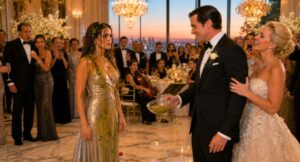
“Tell me,” my ex-husband whispered with a cruel smile, “do leftovers still taste as good the second time around?”
Before I could answer, Damian Cole lifted a crystal bowl from the buffet table and poured its contents over my head.
Cold vinaigrette slid through my hair, down my face, over my lips, and across the silver silk dress I had spent two hours convincing myself I was brave enough to wear. Oil clung to my eyelashes. Herbs stuck to my cheek. A single cherry tomato rolled from my shoulder, bounced once against the polished marble floor, and came to rest beside my heel like a tiny red period at the end of my dignity.
The dining hall of Damian’s Beverly Hills mansion went silent.
Not quiet.
**Silent.**
The kind of silence that makes every chandelier prism seem too loud, every breath an accusation.
Around me, Beverly Hills royalty froze beneath the golden lights. Producers, investors, heirs, actresses, surgeons, gallery owners—people who could bankrupt a person with a whisper—stood with champagne glasses halfway to their mouths. Some looked away. Some stared with open hunger. Some did the worst thing of all: they reached for their phones slowly, almost tenderly, as though my humiliation deserved perfect lighting.
Then the bride laughed.
Not a nervous laugh.
Not the brittle little sound people make when cruelty happens too quickly for manners to catch up.
**She laughed like she had been waiting all night for this.**
Serena Voss—Damian’s new wife, or so the ivory wedding invitations had declared in looping gold calligraphy—leaned into his arm and laughed until the diamond on her finger flashed like a small captured star.
Damian raised her hand proudly.
“Now this,” he announced, his voice carrying across the room with theatrical ease, “is what an upgrade looks like.”
A few guests smiled because they were cowards. A few whispered because they were honest. Someone near the orchestra muttered my name with pity.
Ava.
Poor Ava Cole.
Former wife. Former muse. Former useful connection.
**Leftovers.**
Months earlier, that word would have ruined me. It would have burrowed under my ribs and lived there. After the divorce, after the headlines, after Damian’s interviews about “outgrowing the past,” after watching the man I had once loved stand in magazine spreads beside the woman he had chosen to replace me, I had become fluent in the language of small deaths.
But standing there with salad dressing dripping from my chin, I did not break.
I looked at the bride’s hand.
And everything inside me went still.
Because I recognized the diamond.
It was not from Cartier. It was not from Graff. It was not something Damian could have simply bought with his borrowed glamour and newly inflated bank accounts.
**That diamond belonged in my family vault.**
It had a faint blue mark hidden near the setting, a tiny crescent cut so delicately into the metal that most people would mistake it for a flaw. My grandfather had engraved it himself before he died. He had called it the Seraphine Stone and told me once, when I was seven years old and still believed adults told the truth, that some diamonds did not shine because they reflected light.
“They shine,” he had said, tapping my nose, “because they remember fire.”
The Seraphine Stone was supposed to remain locked away forever.
Only three living people knew its vault code.
My father.
Our family attorney.
And me.
The laughter blurred. The guests dissolved into color. Damian’s smirk faded to the edge of my vision.
Slowly, I reached for a linen napkin. I wiped my face with steady hands. Oil smeared across the white cloth like gold blood.
Damian leaned closer, delighted by my quiet.
“What’s wrong, Ava?” he murmured. “No speech? You always loved speeches.”
I smiled faintly.
Not for him.
For the truth, which had just entered the room wearing a bridal gown.
With my other hand, I slipped my phone from my clutch. I did not unlock the screen where anyone could see. I pressed the emergency contact I had sworn never to use unless something from the vault was compromised.
One ring.
Two.
A click.
My father’s voice answered, low and alert. “Ava?”
I said only three words.
**“Seraphine is here.”**
Then I hung up.
Damian kept smiling. Serena kept laughing. The guests kept pretending they were not witnessing a crime wrapped in satin and cruelty.
For twelve minutes, nothing happened.
Twelve minutes is a lifetime when you are standing in a ruined dress under a chandelier while people decide whether your pain is entertainment. My scalp chilled. My pulse slowed. Somewhere behind me, a violinist cleared his throat. The caterers hovered near the doorway like ghosts too embarrassed to haunt.
Damian finally grew bored of my silence. He kissed Serena’s temple and said, “Ladies and gentlemen, please enjoy dessert. Ava has always had a gift for making exits dramatic, but tonight belongs to my wife.”
His wife.
The word pricked something old in me.
I remembered the first time Damian had called me that. We had been standing in the rain outside a courthouse because he said churches made love feel like a business contract. He had held my face in both hands and promised that no room would ever make me feel small again.
I had believed him.
That was before I understood that some men do not love women.
**They love being chosen by women who make them feel larger than they are.**
The mansion doors opened.
The music stopped.
Every head turned.
Two uniformed officers entered first, their black shoes striking the marble with blunt authority. Behind them came my father, Victor Laurent, in a charcoal suit and no overcoat despite the cold January night. He did not look at me first. He did not look at Damian.
He looked at the diamond.
And for the first time in my life, I saw fear on my father’s face.
Not surprise. Not anger.
**Fear.**
Damian’s wineglass trembled.
Serena’s laughter died in her throat.
My father walked through the parting crowd as though the room had become a courtroom and every guest a witness. He stopped six feet from the bride and stared at her hand.
The lead officer held out his palm.
“Ma’am,” he said carefully, “the ring.”
Serena took one step back. Her heels clicked against the marble.
The diamond flashed again under the chandelier. The blue crescent burned for a split second, unmistakable now, as if the stone itself had decided to testify.
Damian grabbed Serena’s wrist. “Give it to them,” he hissed.
But she did not look at him.
She looked at my father.
Her face had changed completely. Gone was the victorious bride, the polished social weapon, the woman who had laughed while oil dripped down my face. In her place stood someone younger and older at once, someone carved by grief and sharpened by waiting.
My father swallowed.
“Where did you get it, Lydia?”
The name cracked through the room.
Lydia.
Not Serena.
The bride’s eyes filled with tears, but they were not frightened tears. They were furious.
“You have no right to say my name,” she whispered.
The room erupted in whispers.
Damian’s face went pale. “What is this?” he snapped, but his voice had thinned. “Serena, what is he talking about?”
She ignored him.
The officer stepped closer. “The ring, ma’am.”
For one breath, no one moved.
Then Lydia slowly slid the diamond from her finger.
But instead of handing it over, she turned it upside down and pressed something hidden beneath the setting.
A soft click echoed through the hall.
My father lunged forward.
“Don’t!”
Too late.
**The diamond opened.**
The top of the ring lifted like the lid of a tiny coffin, and inside, folded so small it seemed impossible, lay a photograph.
Lydia took it out with shaking fingers.
The officer did not stop her.
Even Damian seemed frozen by the terrible intimacy of the moment.
Lydia unfolded the photograph once. Twice. A third time.
It was old, the colors faded, the edges worn soft as cloth. At first I saw only a woman in a hospital bed, dark-haired and exhausted, smiling with the kind of fragile joy that looks almost painful.
Then I saw the babies.
Two newborn girls wrapped in matching white blankets.
Behind the woman stood my grandfather, Gideon Laurent, his large hand resting protectively on her shoulder. On the back wall, blurred but visible, hung a paper sign with the date.
June 14.
My birthday.
My knees weakened.
Lydia turned the photograph around so everyone could see the writing on the back. It was my grandfather’s handwriting, unmistakable with its severe slant and dramatic loops.
**For Ava and Lydia, my two granddaughters. If this photograph is ever needed, then Victor has lied. The Seraphine Stone belongs to the child he erased.**
The room disappeared.
For a moment, I heard only the wet sound of vinaigrette dripping from the ends of my hair.
Ava and Lydia.
My two granddaughters.
The child he erased.
I looked at my father.
He closed his eyes.
And in that small surrender, my entire childhood collapsed.
I had been raised as Victor Laurent’s only daughter. My mother, Mara, had died giving birth to me, I was told. There had been complications. No photographs survived because grief had made my father destroy them. No baby clothes remained because the past was too painful. No stories were told because love, according to Victor, was sometimes most dignified in silence.
Whenever I asked about her, he would kiss my forehead and say, “Your mother gave me you. That was enough.”
I used to think that sentence was romantic.
Now I understood it was a locked door.
Lydia stared at me across the marble floor. For the first time, she looked at me not as a rival, not as an enemy, not as the woman she had helped humiliate.
She looked at me like a mirror she had been taught to hate.
Damian backed away from her. “You told me your name was Serena.”
“You told me Ava deserved to suffer,” Lydia said without looking at him. “We all lied, apparently.”
His jaw clenched.
Ah.
There it was.
The first loose thread.
I stepped forward. Dressing squelched softly in my shoes. “What did Damian tell you?”
Lydia’s mouth twisted. “That you knew. That all of you knew. That you grew up with my name in your father’s mouth and my inheritance in your closet.”
“I didn’t know you existed.”
Her eyes flickered.
I held her gaze because she deserved that much truth, even if it tore me open to give it. “I swear to you, I didn’t know.”
Damian gave a short laugh. “This is absurd. Ava, you’re being dramatic. Victor, handle this. Your daughter is having some kind of breakdown at my wedding.”
My father turned to him slowly.
“Your wedding,” Victor said, voice hollow, “to my daughter.”
The words landed like a gunshot.
Someone gasped.
Damian’s mouth opened.
Lydia flinched.
I did not.
Some part of me had already understood before the sentence was spoken. The photograph had done what blood sometimes does when truth arrives late—it had made recognition unbearable.
Lydia had my mother’s mouth.
My grandfather’s eyes.
My anger.
Damian looked around at the guests, calculating how to survive the room. I knew that expression. I had once mistaken it for intelligence. It was only appetite wearing a suit.
“This is a private family matter,” he said sharply. “Everyone should leave.”
“No,” I said.
My voice surprised me. It was calm. Clear. Stronger than the chandelier above us.
“No one leaves.”
Damian turned on me. “You don’t get to give orders in my house.”
I smiled, and this time I let him see the blade in it.
“Your house?”
His face changed.
There are moments when a lie hears footsteps.
The officer beside my father looked at him. “Mr. Cole, we also need to discuss the pending report of stolen property from the Laurent private vault.”
Damian spread his hands. “I didn’t steal anything. My wife’s ring—”
“Was taken from my vault three weeks ago,” my father interrupted.
Lydia’s head snapped toward Damian.
He lifted both palms. “I bought it.”
“From whom?” I asked.
“An estate broker.”
“Name?”
His lips pressed together.
The officer’s gaze sharpened.
Lydia stared at him in horror. “You said it was mine.”
Damian’s eyes flashed. “It was supposed to be. You said the ring would prove who you were.”
“I said the ring held proof.” Lydia’s voice shook. “I told you my mother’s letter said the Seraphine Stone carried the truth. I never asked you to steal it.”
My father inhaled sharply at the mention of my mother.
The room had become ravenous now. Phones were fully raised. The society guests who had minutes earlier treated my humiliation like a spectacle were watching something far more expensive burn.
Damian’s charm began to peel.
“You were grateful enough when I gave it to you,” he snapped at Lydia.
“You gave me my own name like it was a wedding gift.”
His face hardened.
And then, because men like Damian cannot resist the need to wound when cornered, he looked at me and said, “Do you want to know the funniest part, Ava? I found her before your father did.”
The air tightened.
I glanced at Lydia.
She looked sick.
Damian smiled, but there was no elegance left in it. “A private investigator sent me the report months ago. I was looking into Victor’s assets after the divorce. I thought maybe there was money hidden somewhere.” He shrugged, almost proudly. “Instead, I found a missing daughter.”
Lydia whispered, “You said you found me by accident.”
“I did.” He looked at her with contempt. “A very profitable accident.”
My stomach turned.
The officer took a step closer.
Damian did not notice. He was performing again, addicted to the room.
“You think I wanted to marry some waitress from Santa Barbara with a tragic childhood and a box of dead mother’s letters? Please. But then she told me about the ring. About the trust. About old Gideon Laurent’s obsession with bloodlines and daughters.” He pointed at my father. “Victor buried a daughter because he didn’t want to split the empire. Ava here grew up thinking she was special. Lydia grew up thinking she was abandoned. And me?”
He laughed softly.
“I saw balance.”
**The room went colder than the vinaigrette on my skin.**
Lydia removed the veil from her hair as though it had become a net. “You never loved me.”
Damian looked almost offended by the simplicity of the accusation. “Love is what people call leverage when they’re embarrassed to admit they need something.”
The slap came before anyone could stop it.
Lydia’s hand cracked across Damian’s face so hard champagne spilled from a nearby glass.
He grabbed her wrist.
The officer grabbed his.
In the same instant, my father said, “Let her go.”
Damian stared at him, then at me, then at the guests filming him, and suddenly understood that the empire he had tried to enter was closing around him like a trap.
“You can’t arrest me for a family misunderstanding,” he said.
The officer’s expression did not change. “We can arrest you for possession of stolen property, conspiracy to commit fraud, and assault witnessed by approximately eighty people.” He glanced at my ruined dress. “Possibly more, pending statements.”
For one wild second, Damian looked at me as though I might save him.
That almost made me laugh.
Once, I had saved him from embarrassment at dinners when he forgot names. I had smoothed over insults he called jokes. I had lent him my father’s lawyers, my grandfather’s reputation, my patience, my youth. I had mistaken endurance for devotion until there was nothing left of me that did not ache.
Now he stood before me with a red mark on his cheek and panic in his eyes, and I felt something unexpected.
Not revenge.
Not triumph.
**Relief.**
I did not love him anymore.
Not even enough to hate him.
The officer turned Damian around.
The cuffs clicked.
The sound was small, almost delicate.
But it changed everything.
As they led him through the dining hall, Damian twisted back toward me. “You think you won? You’re standing there covered in salad at my wedding.”
I wiped one last drop from my chin.
“Leftovers,” I said, “are still food, Damian. You were always just hunger.”
His face twisted.
Then the doors closed behind him.
No one applauded. Real life rarely knows when to clap.
The guests stared at me, at Lydia, at my father, at the open ring in the officer’s evidence bag.
My father looked suddenly old.
“Ava,” he said.
I stepped back from him.
It hurt him. I saw that. Once, that would have mattered more than my own pain.
Not tonight.
“Don’t say my name like you own it,” I said.
His mouth trembled.
Lydia stood beside me, though not too close. We were not sisters yet. Blood is not a bridge by itself. Sometimes it is only a river, deep and dark, daring you to cross.
The officer asked for statements. The guests were dismissed in clusters. The caterers began cleaning the marble around us with quiet, efficient shame. Someone brought me a towel. Someone else brought Lydia water. The chandelier continued to glitter as if wealth had no obligation to recognize catastrophe.
In Damian’s study, away from the last murmurs of the party, the truth finally came out.
Not all at once.
Truth rarely arrives as a confession. It leaks.
My father sat behind Damian’s mahogany desk and stared at his hands. Lydia remained near the window, arms wrapped around herself. I sat across from him in a robe borrowed from the guest suite, my ruined silver dress folded in a plastic garment bag beside me like evidence of a woman I had outgrown.
“Tell us,” I said.
My father looked at Lydia. “Your mother was going to leave me.”
Lydia did not blink.
He swallowed. “Mara found out I had been using Laurent money to cover losses. Not theft at first. Loans. Temporary transfers. I was young and arrogant and certain I could fix anything before anyone noticed.”
“You mean before Grandfather noticed,” I said.
His jaw tightened. “Yes.”
The old photograph lay on the desk between us.
“My father changed the trust after you were born,” Victor continued. “Both of you. He believed daughters protected legacy better than sons. He wrote that the Laurent estate, the voting shares, the vault collection—everything—would pass equally to Ava and Lydia when you turned thirty, provided both daughters were living.”
Lydia gave a bitter laugh. “Convenient that one of us stopped living on paper.”
My father closed his eyes.
“Mara threatened to expose me. She took Lydia and left the hospital before the paperwork was complete. My father helped her. He hid the photograph in the ring because he didn’t trust me. Then he died before he could force the truth into the open.”
“And you let me think my mother was dead,” I said.
He opened his eyes. They were wet. “I was afraid she would take you too.”
There it was—the smallest, ugliest human thing beneath the grand architecture of betrayal.
Fear.
Not strategy. Not justice. Not even hatred.
A man afraid of losing everything had made himself the center of everyone else’s life.
“So you punished a baby,” Lydia said.
“I searched for you.”
Her laugh was sharp enough to draw blood. “No, Victor. You searched for the problem. Not the daughter.”
He flinched.
I asked the question I had been dreading. “Is she alive?”
My father looked down.
The room held its breath.
“I don’t know,” he whispered.
Lydia’s face crumpled before she could stop it. “She died two years ago.”
The words struck me strangely. How do you grieve a mother twice—once as a childhood myth, once as a real woman you never got to meet?
Lydia pulled a folded envelope from inside her bridal clutch. The paper was worn at the creases.
“She left me letters,” she said. “Not enough. Never enough. She told me my sister was loved. She told me not to hate you.” Her eyes found mine. “I hated you anyway.”
“I would have hated me too.”
That broke something in her.
She sat down abruptly, pressing her hand to her mouth.
“I laughed,” she said. “When he poured that over you. I laughed because I thought you were finally feeling one inch of what I felt every birthday when my mother cried over a cake with two candles and only one daughter at the table.”
My chest tightened.
“I’m sorry,” she whispered.
The words were raw, stripped of pride.
I looked at her: this woman in a wedding gown she had worn like armor, this stranger with my blood and my mother’s grief folded inside her.
“I’m sorry too,” I said. “Not for what I did. For what was done to us.”
My father covered his face.
For the first time in my life, I did not go to comfort him.
Three weeks later, Damian’s mansion no longer belonged to Damian.
That was not poetry. It was paperwork.
The down payment had been traced to funds moved through a shell company tied to the stolen Laurent vault collection. Damian had not merely taken the Seraphine Stone. He had used my father’s panic, Lydia’s longing, and my divorce settlement as pieces on a board he thought he controlled.
He had courted Lydia with lies. He had invited me to the wedding to complete the humiliation. He had planned to leak the videos, paint me as unstable, pressure my father into burying the ring theft, and then use Lydia’s identity to challenge the trust from inside the family.
It was, in its own vile way, almost brilliant.
Except Damian had misunderstood one thing.
**The Laurent trust did not unlock for a husband.**
It did not unlock for a father.
It did not unlock for the loudest man in the room.
It unlocked only when both daughters stood together before the original trustee and claimed each other by name.
My grandfather, dead twenty-three years, had planned better than any living man suspected.
The final hearing took place in a quiet downtown office with no chandeliers, no champagne, no phones lifted for sport. Lydia wore a navy dress and no ring. I wore white, not because I was pure or reborn or any other nonsense people attach to colors, but because I wanted to see a stain coming.
My father signed his resignation from Laurent Holdings.
His hand shook.
“I loved you, Ava,” he said.
“I know,” I replied.
That was the tragedy. He had loved me.
Just not enough to tell the truth.
He turned to Lydia. “I don’t expect forgiveness.”
“Good,” she said.
Then, after a long moment, she added, “But I expect honesty. Start there.”
He nodded.
It was not absolution. It was not a happy family portrait. It was a door left unlocked, which was more mercy than any of us had expected to offer.
The attorney placed two documents before us. Lydia looked at me.
I looked at her.
My whole life, I had been taught that inheritance was marble, diamonds, oil portraits, names engraved above doors.
But standing beside Lydia, I understood that inheritance could also be a scar.
A song half-remembered.
A birthday cake with two candles.
A photograph hidden inside a diamond because one old man had loved two babies enough to distrust his own son.
The attorney cleared his throat. “Please state your names.”
Lydia’s fingers found mine under the table.
They were cold.
I held on.
“My name is Ava Mara Laurent,” I said.
Lydia inhaled shakily.
“My name is Lydia Mara Laurent,” she said.
The attorney nodded.
The trust opened.
Outside, rain began to fall over Los Angeles—not dramatic rain, not movie rain, just a soft silver washing of the streets. Lydia and I stood beneath the awning afterward, watching water gather along the curb.
“I used to imagine meeting you,” she said.
“What happened in the fantasy?”
“I was taller.”
I laughed before I could stop myself.
She smiled, and for one second I saw what we might have looked like as girls—two dark-haired children running barefoot through some safer version of the world.
Then she reached into her bag and pulled out a small cassette tape.
“My mother recorded this,” she said. “For both of us.”
We sat in my car and listened.
At first there was only static. Then a woman’s voice, soft and trembling, filled the space between us.
“My Ava. My Lydia. If you are hearing this together, then the truth has found its way home.”
Lydia began to cry silently.
I did too.
Mara’s voice hummed a melody I knew.
I had heard it in dreams all my life.
Not from a nanny. Not from imagination.
From the first days before memory, when my mother must have held me close and sung the same song to both of us.
**The lullaby was real.**
That was the twist that undid me most.
Not the trust. Not the ring. Not Damian’s arrest. Not my father’s lies.
A song.
A tiny mercy that had survived everything.
Six months later, the Beverly Hills mansion reopened under a new name.
The Seraphine House.
Lydia wanted to sell it at first. I did too. The place smelled, in memory, like vinaigrette and cruelty. But then we stood in the dining hall beneath the chandelier and imagined something else.
Not parties for people who laughed at pain.
Not rooms where women were measured as upgrades, leftovers, trophies, mistakes.
We turned it into a foundation for women rebuilding their lives after financial abuse, family estrangement, and public scandal. Lydia insisted the kitchen be painted yellow because her mother had once told her grief hated sunlight. I insisted the marble floor stay exactly as it was.
On opening night, a young woman asked why there was a tiny red tomato painted near the entrance, almost hidden beside the baseboard.
Lydia looked at me.
I looked at her.
“An inside joke,” I said.
“No,” Lydia corrected gently. “A reminder.”
Of what falls.
Of what stains.
Of what does not end you.
Damian sent one letter from prison.
I did not open it.
Lydia did, with my permission. She read the first line, snorted, and dropped it into the shredder.
“What did it say?” I asked.
She smiled.
“He wanted to know whether we ever thought about him.”
I looked around the sunlit hall, at the women laughing near the yellow kitchen, at my sister arranging flowers beneath our mother’s photograph, at the Seraphine Stone sealed in a museum case with its tiny blue crescent shining like remembered fire.
“No,” I said. “Not really.”
That night, after everyone left, Lydia and I carried two slices of cake onto the balcony. The city glittered below us, shameless and beautiful.
She lifted her fork. “To leftovers.”
I groaned. “Absolutely not.”
“To second servings?”
“Worse.”
She grinned. “To sisters, then.”
That one I allowed.
We ate cake under the California stars, shoulder to shoulder, two women who had been separated by lies, reunited by a diamond, and freed by the one thing no vault could hold forever.
**The truth.**
And for the first time in my life, my birthday no longer felt like a locked room.
It felt like a door opening.
Wide enough for two.