
PART 1: THE SLAP
The moment my husband slapped me in front of his entire family, I stopped being his wife.
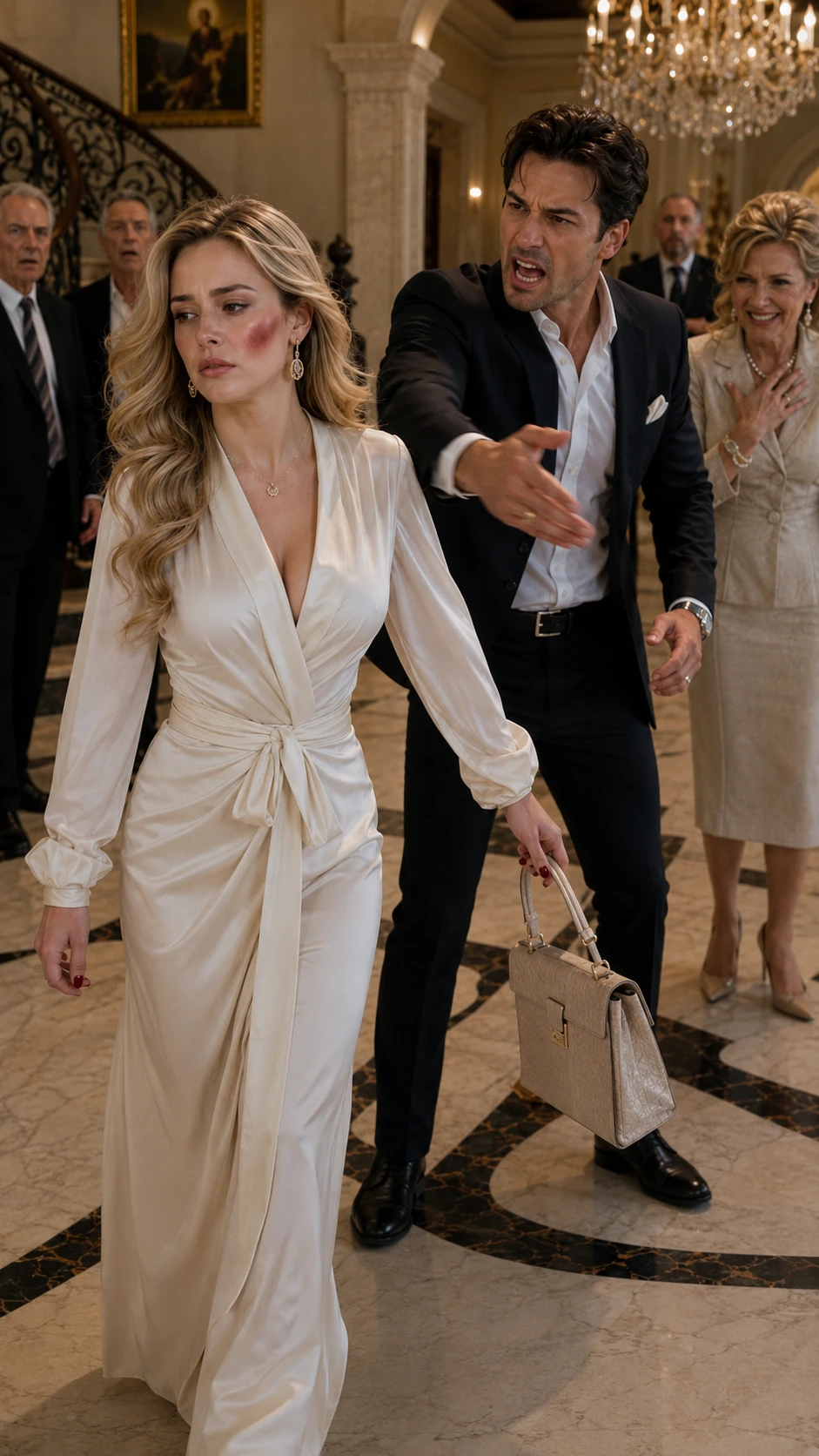
His palm struck the left side of my face so hard that my head snapped sideways. My wedding ring cut into my palm as my fingers closed instinctively, and for several seconds, the marble foyer fell completely silent.
No one moved.
No one gasped.
No one asked whether I was all right.
I stared at the crystal chandelier hanging above us, watching its lights blur through the sudden tears in my eyes. Beyond it stood the sweeping staircase, the hand-carved railing, and the imported Italian tile I had selected three years earlier.
Every detail in that mansion had passed through my hands.
The warm ivory walls.
The antique console table.
The stained-glass panels beside the front doors.
Even the chandelier above my head had been chosen from a private showroom in Milan because I had imagined it glowing over a home filled with laughter.
Instead, it illuminated my humiliation.
Then my mother-in-law smiled.
It was a small smile, almost delicate. Anyone who did not know Evelyn Brooks would have missed it.
I knew exactly what it meant.
She believed she had finally won.
“Get out of my house!” Daniel shouted.
My husband stood in front of me with his chest rising and falling, his right hand still half-raised. There was no shock in his expression. No immediate regret.
Only contempt.
“You don’t raise your voice at my mother in her own house,” he said.
Her own house.
The words hurt almost as much as the slap.
My eyes drifted toward the family portrait above the fireplace.
Daniel stood proudly in the center, wearing the charcoal suit I had bought him for our third anniversary. Evelyn stood at his side in a pale blue gown, one jeweled hand resting possessively on his arm.
I had been placed slightly behind them.
I remembered the photographer asking me to move forward.
Evelyn had laughed and said, “Emily is more comfortable in the background.”
So I had smiled like a guest in the home I had secretly paid for.
Around us, six members of Daniel’s family sat frozen in the drawing room. His aunt Patricia stared into her teacup. His cousin Mark shifted uncomfortably in his chair. His sister, Caroline, looked at the floor.
None of them defended me.
Evelyn lifted a silk handkerchief to her perfectly dry eyes.
“I only told her she should be grateful,” she said, her voice trembling with theatrical pain. “Some women marry into wealth and immediately forget their place.”
“My place?” I asked quietly.
Daniel stepped closer.
“Don’t start another argument.”
But the argument had started long before that afternoon.
It had started with the first Sunday dinner after our wedding, when Evelyn examined my dress and asked whether I had bought it from a discount rack.
It had continued at charity galas, where she introduced me as “Daniel’s little project.”
It followed me through birthdays, holidays, and family vacations.
Every insult was delivered with a smile.
Every cruel remark could be dismissed as a joke.
Whenever I objected, Daniel told me I was too sensitive.
“She’s from another generation,” he would say.
“She doesn’t mean anything by it.”
“Let it go for my sake.”
So I let things go.
I let them go until there was almost nothing left of me.
That afternoon, Evelyn had crossed a line she could never erase.
We had gathered for her birthday lunch. I had arranged the flowers, approved the menu, and instructed the staff to prepare her favorite lemon cake. Evelyn arrived forty minutes late and complained that the champagne was not cold enough.
During dessert, Caroline mentioned that she was pregnant with her second child.
Everyone congratulated her.
I did too.
Then Evelyn turned toward me.
“Some women understand their duty to a family,” she said.
The room became quiet.
Daniel looked down at his phone.
I placed my fork beside my plate. “What is that supposed to mean?”
Evelyn leaned back in her chair.
“It means my son deserves children.”
Daniel muttered, “Mom.”
But there was no warning in his voice.
Only mild embarrassment.
Evelyn continued.
“Three years of marriage, and what have you given him? No child. No proper support. No respect for his family.”
My throat tightened.
She knew about the two miscarriages.
Daniel had told her despite promising me that he would not.
She knew about the nights I had sat on the bathroom floor with blood on my clothes and grief lodged so deeply inside my chest that breathing felt impossible.
She knew, and she used it anyway.
“I think that’s enough,” I said.
“No,” Evelyn replied. “Someone needs to say it. You live in my son’s house. You wear clothes bought with his money. You travel because of his success. Yet you behave as though you are better than us.”
I looked at Daniel.
He remained silent.
“Tell her to stop,” I said.
He frowned. “Emily, don’t make a scene.”
Something inside me cracked.
Not loudly.
Not dramatically.
It was more like a final thread snapping after carrying too much weight for too long.
“She called me barren,” I said. “And you’re worried that I’m making a scene?”
Evelyn pressed a hand to her chest.
“How dare you speak to me like that?”
Then I laughed.
Nothing was funny.
I laughed because I finally understood exactly who they were.
I had spent years trying to earn kindness from people who considered my silence an obligation. I had mistaken endurance for love and humiliation for compromise.
Evelyn stood so quickly that her chair scraped across the floor.
“She disrespected me in my own home!”
Daniel crossed the room before I could speak.
His hand struck my face.
And then he told me to leave.
“Pack whatever cheap clothes you brought into this marriage,” Evelyn sneered. “Leave the jewelry. Leave the car. Leave everything my son paid for.”
I turned toward her.
My cheek burned, but my thoughts had become strangely clear.
I looked at the silk dress she wore, the diamond bracelet on her wrist, and the designer handbag resting beside her chair.
I thought about her private driver.
Her spa membership.
The luxury vacations.
The suite in Paris she had stayed in the previous spring.
Every month, Evelyn proudly spent the $10,000 she believed Daniel generously gave her.
What she did not know was that every dollar came from me.
The money left one of my personal investment accounts, passed through Daniel’s business, and arrived in Evelyn’s account under his name.
Daniel knew.
It had been his idea.
“My mother needs to believe I can take care of her,” he had said when we first arranged it. “It’s a matter of pride.”
I had agreed because I loved him.
I told myself the route did not matter. The money helped someone he cared about, and his dignity seemed important to him.
I never imagined he would use my money to build the illusion that I depended on him.
The mansion did not belong to Daniel either.
It had never belonged to him.
Years earlier, I had purchased it through a holding company under my complete ownership. Daniel believed the company belonged to one of his investors.
He had never bothered to ask questions.
He simply enjoyed living there.
Daniel stepped closer, still furious.
“Why are you standing here?”
I picked up my purse from the console table.
My hands were no longer shaking.
“Because,” I said, “I wanted to remember this moment exactly as it happened.”
Evelyn laughed.
“For what? Your diary?”
I looked directly into Daniel’s eyes.
I memorized the arrogance on his face.
I memorized the way he stood between me and the staircase as though he had the right to deny me access to my own bedroom.
I memorized the silence of every relative who had watched him strike me.
“No,” I said softly. “For court.”
The color shifted slightly in Daniel’s face.
Before he could respond, I opened the front door and walked outside.
The afternoon air hit my burning cheek.
Behind me, Daniel shouted my name, but I did not turn around.
I crossed the circular driveway, climbed into the back seat of the waiting car, and closed the door.
My driver, Marcus, looked at me through the mirror.
His eyes widened when he saw my face.
“Mrs. Brooks—”
“Emily,” I said. “Please call me Emily.”
He hesitated. “Are you hurt?”
“Yes.”
It was the first honest answer I had given anyone in years.
I took out my phone.
There were already three messages from Daniel.
You embarrassed me.
You owe my mother an apology.
Then:
Don’t come back until you’re ready to behave like my wife.
I read the final message twice.
Then I called Grace Miller, the attorney who had handled the purchase of the mansion and the creation of my holding company.
She answered on the second ring.
“Emily?”
“I need you to file for divorce.”
There was a pause.
Grace had known me for nearly a decade. She knew I did not make impulsive decisions.
“Are you safe?” she asked.
“Yes.”
“Did something happen?”
I touched my cheek.
“My husband hit me in front of his family and threw me out of my house.”
“Your house,” she repeated.
“My house.”
Grace’s voice changed. It became calm, precise, and professional.
“Take photographs of your face and hand immediately. Do not delete any messages. Do not speak to him by phone unless necessary. Where are you going?”
“To the Meridian Hotel.”
“I’ll meet you there.”
I looked back through the window.
The mansion stood behind tall iron gates, glowing in the late afternoon sun.
For three years, I had believed keeping the truth hidden was an act of love.
Now the truth was the only thing protecting me.
“Grace,” I said before ending the call.
“Yes?”
“Stop the monthly transfer to Evelyn.”
There was another pause.
“Immediately?”
“Immediately.”
“And the house?”
I watched the gates close behind us.
“Prepare formal notice for Daniel and his mother to vacate.”
That evening, while Evelyn celebrated what she believed was her victory, the first $10,000 transfer failed.
By morning, they would begin to discover what they had actually thrown away.
PART 2: EVERYTHING HE CALLED HIS
The bruise darkened overnight.
By sunrise, the left side of my face had turned purple beneath the eye and red along the cheekbone. The cut in my palm had stopped bleeding, but my wedding ring sat on the hotel nightstand beside a folded hand towel stained with a single brown drop.
Grace arrived before midnight with a legal pad, two phones, and the expression of a woman preparing for war.
She did not offer empty sympathy.
She photographed my face.
She photographed my hand.
She saved screenshots of Daniel’s messages and asked me to describe the slap three times, recording every detail while my memory was fresh.
When I began apologizing for crying, she put down her pen.
“Do not apologize for reacting to violence,” she said.
That sentence almost broke me.
Daniel had trained me to apologize for everything.
For being upset.
For speaking at the wrong time.
For refusing invitations.
For working too much.
For working too little.
For earning more than he did.
Especially for earning more than he did.
I had met Daniel five years earlier at a fundraising dinner for a children’s hospital. He was charming without appearing rehearsed, confident without seeming arrogant.
At least that was what I believed then.
I had built a financial technology company in my twenties and sold a controlling share before my thirty-third birthday. The sale gave me more money than I could reasonably spend, but I rarely discussed it.
My father had been an accountant who distrusted flashy displays of wealth. He taught me that money was most useful when it created freedom, not attention.
Daniel seemed to admire that.
He told me he loved how “normal” I was.
He said his family had old money but complicated expectations. He described Evelyn as proud, demanding, and deeply concerned with appearances.
I did not realize that most of the Brooks family wealth existed only in stories Evelyn repeated at dinner.
Their name still opened doors, but the fortune behind it had been shrinking for decades.
Daniel’s consulting company looked successful from the outside. The office occupied an impressive address. He drove an expensive car. His clients attended the right clubs.
But six months after we became engaged, he admitted that the business was struggling.
“I only need temporary support,” he said.
I gave it to him.
Not because he demanded it.
Because I believed we were building a life together.
I invested in his company. I paid off several urgent debts. I introduced him to two clients who kept the business functioning through a difficult year.
Daniel promised he would repay me.
Eventually, he stopped mentioning repayment.
The mansion appeared during that same period.
I had seen it while driving through Westbridge with a real estate agent. It had been empty for nearly two years after a failed renovation.
I loved the high windows and quiet gardens.
Daniel loved what the address represented.
He wanted the house, but he could not afford the down payment, much less the restoration.
When I suggested buying it myself, his expression tightened.
“My family would never respect me if they thought my wife bought our home.”
I should have heard the warning in that sentence.
Instead, I tried to protect his pride.
Grace created Hawthorne Residential Holdings, and the company purchased the property entirely with my funds. The title remained in the company’s name, and I held one hundred percent of its ownership.
Daniel was told that a private investor connected to his business had purchased the mansion and was allowing us to occupy it under a long-term arrangement.
He accepted the explanation without asking to review a single document.
He wanted the appearance of ownership more than ownership itself.
Within months, he began calling it his house.
Eventually, so did everyone else.
Evelyn moved into the east wing after claiming that the apartment Daniel rented for her was unsafe. Her “temporary stay” became permanent.
Then came the allowance.
Daniel called me from his office one afternoon and explained that Evelyn’s remaining trust income had declined.
“She needs ten thousand a month to maintain her lifestyle,” he said.
I thought he was joking.
He was not.
“That is more than many families earn in several months,” I replied.
“She has obligations.”
“What obligations?”
“Committees. Events. Staff. Appearances.”
I should have refused.
Instead, I agreed to cover the amount for six months while Daniel stabilized his company.
Six months became three years.
Every month, Daniel’s assistant sent a discreet request to my financial manager. The money passed through Daniel’s company and then went to Evelyn.
“Please don’t tell her it comes from you,” Daniel said. “It would humiliate her.”
I protected Evelyn from humiliation while she spent years humiliating me.
The morning after the slap, my phone began vibrating at seven twenty-three.
Daniel called four times.
I did not answer.
At seven forty, he sent a message.
Mom’s transfer didn’t arrive. Fix it.
Not Are you all right?
Not I’m sorry.
Not even We need to talk.
Just an order.
I showed the message to Grace.
She raised one eyebrow. “Save it.”
Another message followed.
The bank says the payment was canceled. This isn’t the time for games.
Then Evelyn called.
I let the call go to voicemail.
Her message was twelve seconds long.
“Emily, whatever childish tantrum you are having, you will not involve me in it. Restore my allowance before noon.”
Grace listened without changing expression.
“Would you like me to respond?”
“No.”
At eight fifteen, Daniel finally sent the message I had expected.
You can come home after you apologize to my mother. We’ll discuss your behavior privately.
I stared at the screen.
I had spent the night wondering whether he would regret hitting me once the anger faded.
The answer was in front of me.
He regretted only the inconvenience.
I typed slowly.
You struck me in front of six witnesses. Do you deny that?
The typing indicator appeared immediately.
Then disappeared.
It returned.
Finally, his response arrived.
You provoked a situation and I reacted. Stop trying to make this something it isn’t.
Grace leaned closer.
“Save that one twice.”
I did.
Daniel called again.
This time I answered and placed the phone on speaker while Grace recorded notes.
“Where are you?” he demanded.
“Somewhere safe.”
“Don’t be dramatic.”
“You hit me.”
“You humiliated my mother.”
“She called me barren and useless.”
“She was emotional.”
“And I wasn’t allowed to be?”
He exhaled sharply.
“Emily, this is exactly the problem. You always need to turn everything into a moral argument.”
“You struck your wife.”
“You laughed in my mother’s face.”
The certainty in his voice frightened me more than shouting would have.
He truly believed the two actions belonged on the same scale.
“Restore the transfer,” he said. “Then come home, and we’ll handle this like adults.”
“Your mother’s allowance is over.”
Silence.
When he spoke again, his voice was lower.
“You don’t get to decide that.”
“It comes from my account.”
“It passes through my company.”
“Passing through your company does not make it yours.”
“That money was part of our marriage.”
“No, Daniel. It was part of the performance.”
He was quiet for several seconds.
Then he said, “Be very careful.”
Grace looked at me and shook her head, warning me not to respond emotionally.
“Is that a threat?” I asked.
“It’s advice. You have no idea what you’re doing. The cars, the cards, the house—everything is tied to me. If you push this, you will walk away with nothing.”
I looked around the hotel suite.
My laptop rested open beside folders containing the ownership records of the house he was standing inside.
“You’re right about one thing,” I said. “One of us is going to walk away from that house with nothing.”
I ended the call.
For the first time since the slap, I felt something other than grief.
I felt awake.
During the next two days, Grace and I worked through every financial connection between Daniel and me.
The black sedan he drove was leased by my investment company.
The second car used by Evelyn’s driver was also leased by my company.
The family’s travel account was mine.
The household staff were paid by Hawthorne Residential Holdings.
The property taxes, insurance, maintenance, utilities, and security contracts were all paid through entities I controlled.
Daniel paid for groceries occasionally.
He also paid for wine when guests were watching.
That was enough to convince himself that he was the provider.
I did not cancel everything immediately.
Grace warned me not to act recklessly or appear vindictive.
We separated what belonged to the household from what funded Evelyn’s personal luxuries. Her spa membership, driver, clothing account, and travel arrangements ended first.
The household staff remained paid.
I would not punish employees for Daniel’s behavior.
On the third morning, Grace placed two folders in front of me.
The first contained the divorce petition.
The second contained formal notice requiring Daniel and Evelyn to vacate the mansion.
“How long?” I asked.
“The notice gives them the period required under the occupancy arrangement. We are not going to drag them onto the street tomorrow. We are going to do this properly.”
I nodded.
Part of me hated that they would remain in my house even one more night.
Another part of me was grateful for the delay.
I needed time to understand that the marriage I thought I had was already gone.
Grace closed the folder.
“There is one question you need to answer before we serve these.”
“What question?”
“Do you want the house back because you love it, or because you want them to lose it?”
I looked down at the papers.
“I don’t know.”
“Find out. Revenge can begin a legal battle, but it should not decide how you live afterward.”
That afternoon, Daniel sent flowers to the hotel.
White roses.
The card contained one sentence.
Come home before this gets uglier.
There was no apology.
I placed the card inside the evidence folder.
Then I signed the divorce petition.
Grace gathered the documents and stood.
“When do you want him served?”
I thought of Evelyn’s smile.
I thought of Daniel’s raised hand.
I thought of the portrait above my fireplace, showing me standing behind people who believed they owned everything I had given them.
“Sunday,” I said.
Daniel’s family gathered for lunch every Sunday.
Grace understood immediately.
“You’re certain?”
“They wanted witnesses when they threw me out.”
I handed her the signed papers.
“They can have witnesses when I take my house back.”
PART 3: THE OWNER AT THE DOOR
One week after Daniel threw me out, I returned to the mansion.
I wore a navy suit with a high collar that partly concealed the fading bruise on my cheek. I did not wear my wedding ring.
Grace sat beside me in the car. In the vehicle behind us were a process server and the property manager for Hawthorne Residential Holdings.
The same iron gates that had opened automatically for me for years remained closed.
Daniel had removed my access from the security system.
I almost laughed.
He had locked the owner out.
The property manager entered an override code, and the gates slowly opened.
Several cars filled the circular driveway.
Sunday lunch had begun.
Through the tall windows, I could see movement in the drawing room. Evelyn had invited more relatives than usual. She probably wanted an audience for the story of how she had defended her son from his ungrateful wife.
My hands tightened around my purse.
Grace noticed.
“We can turn around,” she said.
“No.”
“You do not need a dramatic confrontation for the documents to be valid.”
“I know.”
“Then why go inside?”
“Because I left that house believing I was powerless. I need to return knowing I’m not.”
Grace studied me for a moment.
Then she opened her door.
Marcus met us at the front steps. He had refused Daniel’s demand that he continue driving Evelyn after her private service was canceled.
“Are you ready?” he asked.
“No,” I admitted.
But I walked forward anyway.
The front doors opened before we reached them.
Daniel stood in the entrance.
He looked tired. His jaw was unshaven, and his shirt collar was open. For a fraction of a second, I saw relief in his face.
Then he noticed Grace and the two people behind us.
His expression hardened.
“What are you doing here?”
“I came to collect some personal belongings and deliver documents.”
“You were told not to come back until you apologized.”
Grace stepped forward.
“Mr. Brooks, I’m Grace Miller, counsel for Emily Carter.”
Daniel glanced at me.
“Carter?”
“My legal name,” I said. “I never changed it.”
He knew that.
He simply hated being reminded.
Behind him, Evelyn entered the foyer wearing a cream-colored dress and the pearls I had given her for Christmas.
When she saw me, she stopped.
The smile that spread across her face was almost triumphant.
“So you’ve finally come to your senses.”
“No,” I said. “I’ve finally stopped ignoring them.”
Voices drifted from the drawing room. One by one, Daniel’s relatives appeared behind Evelyn.
Aunt Patricia.
Caroline.
Mark.
Two cousins I barely knew.
The same people who had watched Daniel slap me now watched me return.
Evelyn’s gaze moved to Grace.
“Who is this?”
“My attorney.”
Her smile faltered.
Daniel lowered his voice.
“Emily, don’t do this here.”
“Why not? You did.”
The process server stepped forward and asked Daniel to confirm his identity.
Daniel refused at first, but everyone in the room had already heard his name.
The server handed him the divorce papers.
For a moment, Daniel simply stared at them.
Then he looked at me.
“You filed?”
“Yes.”
“Over one argument?”
“Over three years of contempt and one act of violence.”
“You cannot end a marriage because of one mistake.”
“A mistake is forgetting an anniversary. You hit me and blamed me for it.”
Evelyn pushed past him.
“This is ridiculous. She is trying to frighten you.”
The process server held out another envelope.
“Evelyn Brooks?”
She drew back. “What is that?”
“Formal notice concerning your occupancy of the property.”
Evelyn looked from the envelope to me.
“My occupancy?”
The property manager opened his folder.
“This residence is owned by Hawthorne Residential Holdings. The company has terminated the occupancy arrangement under which Mr. Brooks and Mrs. Evelyn Brooks reside here.”
Daniel gave a short, disbelieving laugh.
“Call the investor.”
The property manager remained expressionless.
“I represent the owner.”
“Then call him.”
“The owner is present.”
Daniel looked around the foyer as though expecting a man in an expensive suit to step forward.
No one moved.
Grace turned slightly toward me.
Daniel followed her gaze.
The confusion in his face lasted several seconds.
Then it changed to suspicion.
“No,” he said.
I said nothing.
Evelyn looked irritated.
“What are you talking about?”
Grace spoke calmly.
“Emily Carter is the sole owner of Hawthorne Residential Holdings.”
The foyer became silent for the second time in one week.
This silence felt different.
After the slap, the silence had belonged to Daniel.
Now it belonged to the truth.
Evelyn shook her head.
“That’s impossible.”
“It is documented,” Grace said.
Daniel stared at me.
“You bought this house?”
“Yes.”
“When?”
“Before we moved in.”
“With what money?”
“My money.”
His voice rose.
“You told me an investor bought it.”
“You told me your family would never respect you if they knew your wife had purchased the home. I protected your pride.”
“This is my house.”
“No, Daniel. You called it your house.”
“I renovated it.”
“I paid for the renovation.”
“I chose the contractor.”
“After I purchased the property.”
He looked around as if the walls themselves had betrayed him.
Evelyn laughed sharply.
“This is some legal trick. Daniel has lived here for years. He is her husband. She cannot simply steal his home.”
“I am not stealing anything,” I said. “I am reclaiming property I own.”
“You ungrateful little—”
Daniel raised a hand toward his mother.
“Stop.”
It was the first time I had ever heard him silence her.
Evelyn’s mouth fell open.
He turned back to me.
“You planned this.”
“I purchased the house before our marriage.”
“You let me believe—”
“I let you believe exactly what you wanted to believe.”
His face reddened.
“You wanted everyone to think it was yours. You never asked who paid the taxes. You never asked who signed the insurance documents. You never asked why no deed had your name on it.”
“You deceived me.”
The hypocrisy was almost breathtaking.
“You took my money every month, passed it through your company, and told your mother it came from you.”
Aunt Patricia looked up sharply.
Evelyn’s expression froze.
“What money?” she asked.
Daniel said, “Not now.”
I kept my eyes on him.
“For three years, you accepted ten thousand dollars from my account every month. You transferred it to Evelyn and allowed her to believe you were supporting her.”
Evelyn turned toward her son.
“Daniel?”
“It was temporary,” he said.
“Temporary?” I repeated. “Thirty-six months is not temporary.”
Evelyn’s face lost color.
“My allowance came from her?”
Daniel stepped toward me.
“You had no right to tell her.”
“I had every right. It was my money.”
The relatives behind them began exchanging glances.
Evelyn looked at me as though I had stripped the clothes from her body.
“You did that to humiliate me.”
“No. I did it because Daniel asked me to protect your pride.”
“You’re lying.”
“I have every transfer.”
Daniel’s voice became cold.
“Get out.”
The words echoed through the foyer.
For a moment, no one seemed to understand the absurdity.
Then I looked around at the home he had ordered me to leave twice.
“I am not the one required to go.”
The property manager handed him the notice.
Daniel tore it in half.
The manager did not react.
“That was a copy,” he said. “Your attorney will receive another.”
Daniel dropped the pieces onto the marble floor.
“You think a few corporate papers will take my home away from me?”
I stepped closer.
The bruise on my face was visible now. I saw his eyes flick toward it.
For the first time, shame appeared in his expression.
It lasted less than a second.
“You took the home away from yourself,” I said.
I walked past him toward the staircase.
He grabbed my wrist.
Grace immediately said, “Release her.”
Daniel’s fingers tightened before he seemed to realize everyone was watching.
He let go.
I looked down at the red marks forming on my skin.
“Do not touch me again.”
He stepped back.
I climbed the stairs alone.
The bedroom looked almost exactly as I had left it, except my clothes had been pulled from the closet and thrown across the bed.
Some dresses lay on the floor.
My jewelry boxes were open.
I stood in the doorway, taking in the destruction.
Daniel had not packed my belongings.
He had punished them.
Grace joined me.
“Photograph everything,” she said.
I did.
In the bathroom, my perfume bottles had been swept into a sink. One had shattered, filling the room with the scent Daniel once said reminded him of our honeymoon.
I looked at the broken glass and felt grief rise inside me.
Not because of the perfume.
Because I remembered the man he had pretended to be.
Or perhaps the man I had needed him to be.
I packed only what mattered.
My mother’s watch.
My father’s letters.
A framed photograph of my parents.
A small wooden box containing the first contract from the company I built.
I left the expensive clothes.
I left the shoes.
I left every gift Daniel had ever given me.
When I returned downstairs, Evelyn stood near the fireplace, clutching the notice.
Her anger had changed to fear.
“Where am I supposed to go?” she demanded.
“I don’t know.”
“This is my home.”
“No. It was a privilege you mistook for a possession.”
Daniel moved between us.
“We’ll challenge this.”
“You should.”
He seemed surprised.
“I want every document examined,” I continued. “Every payment. Every account. Every transfer.”
His expression tightened.
For the first time, I saw that he understood the danger.
The house was only the beginning.
The financial records would reveal how much of his carefully constructed success had depended on me.
As Grace and I walked toward the door, Daniel called my name.
I turned.
His relatives stood behind him beneath the portrait in which I had been placed at the back.
He held the divorce papers in one hand and the occupancy notice in the other.
“You’re going to regret this,” he said.
I looked at my fading bruise reflected in the mirror beside the door.
“No,” I replied. “I regret everything before this.”
We left the mansion.
By evening, Daniel had hired an attorney.
By the following morning, he had filed papers claiming that the mansion was part of the marital estate and that my financial support had been voluntary gifts.
His message to me contained only six words.
You won’t take everything from me.
I read it once before forwarding it to Grace.
Then I opened the oldest folder in my financial archive.
Inside were Daniel’s original written requests for money, his promises of repayment, and one message repeated month after month:
Please send Mom’s allowance through the company. She can never know it comes from you.
Daniel wanted a battle over the truth.
I had three years of his own words ready to fight him.
PART 4: THE TRUTH IN THE RECORDS
Daniel arrived at the first major hearing wearing the same charcoal suit from the family portrait.
I noticed immediately.
Perhaps he believed the suit made him look powerful.
Perhaps it was one of the few things in his closet he knew he had paid for himself.
Evelyn sat behind him in a dark dress, her lips pressed into a thin line. Her pearls were gone. So was the diamond bracelet.
I sat beside Grace with folders stacked neatly in front of us.
My bruise had faded to a pale yellow shadow that makeup could almost conceal.
I did not conceal it.
Daniel’s attorney argued first.
He described the mansion as the marital home Daniel and I had “built together.” He suggested that Hawthorne Residential Holdings was merely a legal device I was using to deprive my husband of his rights.
He referred to Daniel as a successful businessman who had supported his wife and mother for years.
I watched Daniel listen to the story without blinking.
He had told the lie so often that it no longer sounded like a lie to him.
Then Grace stood.
She did not raise her voice.
She presented the purchase documents showing that Hawthorne Residential Holdings acquired the property before Daniel and I married.
She presented records tracing the purchase price to assets I held before the marriage.
She presented renovation invoices paid through my company.
She presented property tax records, insurance payments, household payroll, maintenance expenses, and utility accounts.
Daniel’s name appeared nowhere.
His attorney objected repeatedly, but the documents remained.
Then came the financial transfers.
Month by month, Grace showed money leaving my personal investment account and entering Daniel’s business.
Within twenty-four hours, the same amount left his company and entered Evelyn’s account.
Ten thousand dollars.
Every month.
For three years.
Daniel’s attorney called them gifts to the marriage.
Grace produced Daniel’s messages.
I’ll repay you once the next contract closes.
I need help covering payroll again.
Please send Mom’s allowance through the company.
She can never know it comes from you.
I need her to believe I’m handling it.
The courtroom was so quiet that I could hear pages turning at the clerk’s desk.
Daniel stared straight ahead.
Evelyn sat behind him, reading every projected message.
I wondered which truth hurt her more—that the money came from me or that her son had lied to her for years.
When Daniel was questioned about the allowance, he tried to minimize it.
“Emily agreed to help,” he said.
“Did your mother know the funds originated from Emily?” Grace asked.
“No.”
“Why not?”
“My mother is proud.”
“And Emily was not?”
He looked at me.
“That’s different.”
“How?”
Daniel hesitated.
Grace waited.
Finally, he said, “Emily had more money.”
The answer settled over the room.
To Daniel, my wealth meant I could not be humiliated.
My success meant I did not need protection.
Because I could afford the house, the cars, the allowances, and the vacations, he believed I should also afford the insults.
Grace continued.
“Did you represent to your mother and extended family that you owned the mansion?”
“I lived there with my wife.”
“That was not my question.”
Daniel’s jaw tightened.
“Yes.”
“Did you know whether your name appeared on the title?”
“I assumed the investor had arranged it.”
“Did you ever ask to see the ownership documents?”
“No.”
“Did you make mortgage payments?”
“There was no mortgage.”
“Did you pay the purchase price?”
“No.”
“Did you reimburse Emily?”
“No.”
“Did you contribute to the renovation expenses?”
“I supervised parts of the work.”
“That was also not my question.”
“No,” he said.
Grace paused before moving to the subject of the slap.
“On the afternoon Emily left the mansion, did you strike her?”
Daniel shifted in his chair.
“She was behaving aggressively toward my mother.”
“Did you strike her?”
“It was an emotional situation.”
“Did you strike her?”
“Yes.”
The word hit me almost as hard as his hand had.
Not because I doubted what happened.
Because he admitted it with the same irritation he might have used to acknowledge breaking a glass.
“Did Emily strike you first?”
“No.”
“Did she threaten you?”
“No.”
“Did she threaten your mother?”
“No.”
“What did she do immediately before you struck her?”
Daniel looked toward Evelyn.
“She laughed.”
Grace remained silent for a moment.
Then she returned to our table.
There was nothing else to ask.
A laugh.
That was his justification.
Not danger.
Not self-defense.
Not confusion.
My refusal to remain obedient had been enough.
The judge did not decide every issue that day. The divorce, business claims, and final financial division would take time.
But the ownership records were clear.
The court found no basis to treat the mansion as Daniel’s property merely because he had lived there and represented himself as its owner.
The occupancy termination remained valid.
Daniel and Evelyn were ordered to leave by the established deadline and prohibited from removing property belonging to the holding company.
Temporary orders also limited Daniel’s access to accounts funded solely by me.
The moment the decision was announced, Evelyn made a small sound behind him.
Daniel did not turn toward her.
Outside the courtroom, reporters were not waiting. There were no cameras, no crowd, and no dramatic public spectacle.
The destruction of Daniel’s illusion happened quietly.
That made it feel more real.
He caught up with me near the elevators.
“Emily.”
Grace moved between us, but I shook my head.
“I’ll speak to him.”
She stayed close.
Daniel looked thinner than he had two weeks earlier. His confidence had cracked, revealing exhaustion underneath.
“You didn’t have to bring the messages into court,” he said.
“They were evidence.”
“You humiliated me.”
I stared at him.
“You slapped me in front of your family.”
“That was private.”
I almost laughed again.
Of course.
My humiliation was private because it protected him.
His humiliation was unforgivable because it exposed him.
“You still don’t understand what you did,” I said.
“I lost my temper.”
“No. You made a choice.”
“I was under pressure.”
“So was I.”
“My mother was attacking you. You were attacking her. Everyone was shouting.”
“I never touched anyone.”
He rubbed a hand across his face.
“I said I made a mistake.”
“You have not apologized.”
“I’m standing here, aren’t I?”
“That is not an apology.”
His expression hardened.
“What do you want me to say?”
“I don’t want you to say anything because a judge ruled against you. I wanted you to care when I was bleeding in the foyer.”
For a second, his eyes softened.
Then he looked past me toward Grace and the waiting elevator.
“What happens to my company?”
“That depends on how much of it can survive without my money.”
“You would destroy my business?”
“I’m no longer funding it.”
“That is the same thing.”
“No, Daniel. The fact that you cannot tell the difference is the problem.”
The elevator doors opened.
Before I stepped inside, he said, “My mother has nowhere suitable to go.”
I turned back.
“Your mother received three hundred and sixty thousand dollars from me over three years.”
His eyes flickered.
“She spent it.”
“That was her choice.”
“She thought the money would continue.”
“So did you.”
The elevator doors closed between us.
That evening, Evelyn called from a number I did not recognize.
I answered only because I thought it might concern the house.
Her voice was quiet.
“I saw the messages.”
I said nothing.
“All those years,” she continued. “Daniel told me he was supporting you.”
“He knew that wasn’t true.”
“Why did you let him lie?”
It was the first question she had ever asked me that did not sound like an accusation.
“Because he said the truth would humiliate you.”
She gave a bitter laugh.
“So you pitied me.”
“No. I loved your son.”
“And now?”
I looked out the hotel window at the city lights.
“Now I believe him.”
“What does that mean?”
“For years, Daniel showed me who he became whenever protecting me required something from him. I kept believing his excuses instead.”
Evelyn was silent.
Then she said, “You enjoyed this.”
“The court?”
“Exposing us.”
“No.”
“You expect me to believe that?”
“I expected it to make me feel powerful. Mostly, it made me feel tired.”
Her voice sharpened.
“You took everything.”
I closed my eyes.
“No, Evelyn. I stopped giving everything.”
She hung up.
The final day of their occupancy approached.
Daniel’s attorney asked twice for extensions.
Both requests were denied.
On the evening before they were required to leave, Daniel sent me a photograph of the empty drawing room.
The family portrait still hung above the fireplace.
Below the photograph, he wrote:
Come home tonight. We can still fix this before it is too late.
I stared at the image for a long time.
Then I enlarged the photograph.
My painted figure stood behind Daniel and Evelyn, smiling faintly from the background of my own life.
I typed a response.
There is no home to return to.
Then I called the property manager.
“Tomorrow,” I said, “the first thing I want removed is that portrait.”
PART 5: THE HOUSE I TOOK BACK
Rain fell on the morning Daniel left the mansion.
I arrived shortly after nine with Grace, the property manager, and an inventory team. Two moving trucks stood near the east entrance.
The front doors were open.
For the first time since I had purchased the house, it looked abandoned.
Protective sheets covered some of the furniture. Boxes lined the walls. The chandelier glowed above a foyer filled with footprints and packing tape.
Evelyn stood beside six suitcases, directing movers with the same sharp authority she had once used with my staff.
Her cream-colored handbag hung from her arm.
When she saw me, she stopped speaking.
Her face looked older.
Not poorer.
Not ruined.
Just older.
Without the mansion and driver and carefully arranged background, she looked like an ordinary frightened woman standing among boxes.
For one dangerous moment, I felt sorry for her.
Then I remembered the smile after Daniel slapped me.
Compassion did not require surrender.
“You came to watch,” she said.
“I came to inspect my property.”
She glanced toward the staircase.
“I left the furniture.”
“The furniture belongs to the holding company.”
“I know that now.”
Her words carried enough bitterness to poison the air.
A mover carried out a box labeled EVELYN—SHOES.
She watched it disappear.
“Daniel found me an apartment,” she said. “It is very small.”
I did not respond.
“There is no guest room.”
“That sounds difficult.”
“You don’t care.”
“I cared for years.”
She looked at me sharply.
“Yes. You cared as long as no one knew.”
The accusation landed more deeply than I expected because part of it was true.
I had hidden behind money.
I had solved problems silently and hoped generosity would earn love.
By remaining invisible, I had helped Daniel create the lie that erased me.
“I should have told the truth sooner,” I said.
Evelyn seemed startled by the admission.
“But the truth would not have changed the way you treated me,” I continued. “It would only have changed why you pretended to respect me.”
Her lips parted, but no answer came.
Daniel entered the foyer carrying a cardboard box.
His hair was damp from the rain. He had removed his suit jacket and rolled up his sleeves.
He looked around at the people documenting the house.
“Can we speak privately?” he asked.
Grace answered before I could.
“No.”
I touched her arm.
“It’s all right.”
Daniel and I walked into the empty drawing room.
The portrait was gone.
Four pale marks remained where it had been attached to the wall.
For a few seconds, neither of us spoke.
Without furniture and flowers and family voices, the room echoed.
Daniel placed the box on the floor.
“I signed a lease on a townhouse,” he said.
I waited.
“It’s temporary.”
Everything with Daniel was temporary when he wanted someone else to pay for it.
“The business may survive,” he continued. “I’ll have to reduce staff.”
“I’m sorry for the employees.”
“You could prevent that.”
“No.”
“You don’t even need the money.”
“This was never about whether I needed it.”
“Then what was it about?”
“Your company had years to become independent. Instead, you used my money to maintain an image.”
“I was building connections.”
“You were building a stage.”
He looked toward the empty fireplace.
“You loved that life too.”
“I loved you.”
The words came out before I could stop them.
Daniel looked at me.
For the first time since the slap, neither of us was angry.
Only sad.
“I did love you,” I continued. “That is why I paid the debts. That is why I bought the house. That is why I protected your pride. I thought I was helping the man I married become the man he wanted to be.”
“I am still that man.”
“No. The man I married would have been ashamed to hit me.”
His eyes dropped.
“I am ashamed.”
“Now.”
“What do you want from me?”
“Nothing.”
He flinched as though I had slapped him.
“I can change,” he said.
“Maybe.”
“Then give me the chance.”
“You had chances every time your mother insulted me.”
“She is my mother.”
“And I was your wife.”
“You made me choose.”
“No, Daniel. You chose every day. I simply stopped pretending not to notice.”
He moved closer.
“I was angry. You laughed at her in front of everyone.”
“I laughed because I realized none of you saw me as a person.”
“That isn’t true.”
“You hit me because you believed I had no power to leave.”
He shook his head.
“I lost control.”
“No. You didn’t lose control.”
I held his gaze.
“You hit me once. You did not hit your mother. You did not hit your sister. You did not hit anyone else in that room. You chose the person you believed would forgive you.”
He looked away.
That was the truth neither of us had said aloud before.
His violence had not been random.
It had been calculated by entitlement, even if the calculation took only a second.
He had struck the person whose loyalty he considered guaranteed.
“You were supposed to be on my side,” he said quietly.
“I was. For years.”
“Then why does it feel like you were waiting to destroy me?”
“Because the life you built depended on me never standing up.”
His eyes filled, but the tears did not fall.
I remembered how badly I had once wanted to see remorse on his face.
Now that it was there, it did not repair anything.
Remorse was not a doorway back into my life.
“I’m sorry,” he said.
It was the first real apology.
No explanation followed.
No mention of pressure.
No blame placed on Evelyn or me.
Just two words.
I allowed myself to hear them.
“I believe you are sorry,” I said.
Hope appeared in his face.
“But I am still leaving.”
The hope disappeared.
He nodded once.
Then he lifted the box and walked past me.
At the doorway, he stopped.
“What will you do with the house?”
“I don’t know yet.”
“You loved it.”
“I loved what I thought would happen here.”
He looked up at the chandelier.
“So did I.”
“No,” I said gently. “You loved what people thought when they saw you living here.”
He did not argue.
By noon, the final truck had left.
Evelyn walked toward the front doors without looking back. Daniel followed several steps behind her.
At the threshold, she turned to me.
For a moment, I expected another insult.
Instead, she said, “I did not know about the miscarriages until Daniel told me.”
“I know.”
“I should not have used them against you.”
“No.”
Her fingers tightened around the handle of her handbag.
“I wanted you to feel small.”
I appreciated the honesty more than an excuse.
“You succeeded for a while,” I said.
She lowered her eyes.
Then she walked into the rain.
Daniel remained at the door.
The black sedan he used to drive was no longer in the driveway. The lease had ended, and the vehicle had been returned two days earlier.
A hired car waited for him beyond the gates.
He looked at me one final time.
“Goodbye, Emily.”
“Goodbye, Daniel.”
He stepped outside.
I closed the door.
The sound echoed through the mansion.
For several minutes, I stood alone in the foyer where he had slapped me.
The Italian marble gleamed beneath the chandelier. The staircase curved upward exactly as it had the day I chose the house.
Nothing had changed.
Everything had changed.
Grace entered from the drawing room.
“They’re gone,” she said.
“Yes.”
“How do you feel?”
I touched the side of my face.
The bruise was gone, but I could still remember the shape of his hand.
“I thought I would feel victorious.”
“And?”
“I feel like I survived something I should have left much sooner.”
“That counts.”
The divorce took another eight months.
There were no miraculous confessions and no hidden crimes. There were only documents, negotiations, arguments, and the slow dismantling of a marriage built on unequal truths.
The mansion remained with Hawthorne Residential Holdings.
Daniel kept his company, along with its legitimate debts and remaining contracts. He received no ownership interest in the house and no right to continue using funds that belonged to me.
Evelyn’s allowance ended permanently.
Daniel sold several personal assets to stabilize his business. He moved into a modest townhouse and reduced the size of his office.
Evelyn moved into an apartment near Caroline.
The world did not end for either of them.
They simply had to begin living within the reality they had spent years hiding from.
I never moved back into the mansion.
For several months, I visited occasionally while preparing it for sale.
The rooms were too large.
Every hallway carried an old conversation.
Every doorway held a memory of myself becoming quieter.
Before the property was listed, I walked through it one final time.
The drawing room was empty.
The dining table was gone.
The portrait had been placed in storage, though I eventually instructed the company to destroy it.
In the foyer, I stood beneath the chandelier and remembered the exact moment Daniel’s hand struck my face.
I remembered the silence.
Evelyn’s smile.
The taste of blood where my teeth had cut the inside of my cheek.
Most of all, I remembered the woman who had calmly picked up her purse and walked away.
At the time, I thought she was broken.
She was not.
She was waking up.
The mansion sold to a family with three young children. During the final walkthrough, I heard them running upstairs while their parents discussed where to place a piano.
Their laughter filled the foyer.
It was the sound I had imagined years earlier when I chose the chandelier.
For the first time, the house sounded like a home.
I signed the final papers and handed over the keys.
With part of the proceeds, I created a foundation supporting women rebuilding their lives after financial and domestic abuse. I did not name it after myself.
I had spent enough time around people who needed their generosity displayed like a portrait above a fireplace.
I bought a smaller house near the river.
It had creaking wooden floors, an untidy garden, and a kitchen filled with morning sunlight.
Nothing in it was selected to impress anyone.
On the first evening after I moved in, I placed my father’s letters in a desk drawer and my mother’s watch beside my bed.
Then I opened the small wooden box containing the first contract from the company I had built.
Beneath the contract lay my wedding ring.
I had forgotten placing it there.
I held it for a long time.
The metal was still slightly bent from the force of my hand closing during the slap.
For months, I had considered having it repaired.
Instead, I placed it in an envelope with the final divorce decree and locked both documents away.
Not because I wanted to remember Daniel.
Because I wanted to remember myself.
The woman who endured.
The woman who observed.
The woman who finally chose.
Daniel had shouted, “Get out of my house,” believing those words would leave me homeless, powerless, and afraid.
He did not understand that a house was the smallest thing I had given him.
I had given him my trust.
My protection.
My silence.
My money.
My belief in the man he claimed to be.
The day he struck me, I stopped giving.
That was why he lost everything.
And that was how I finally got myself back.