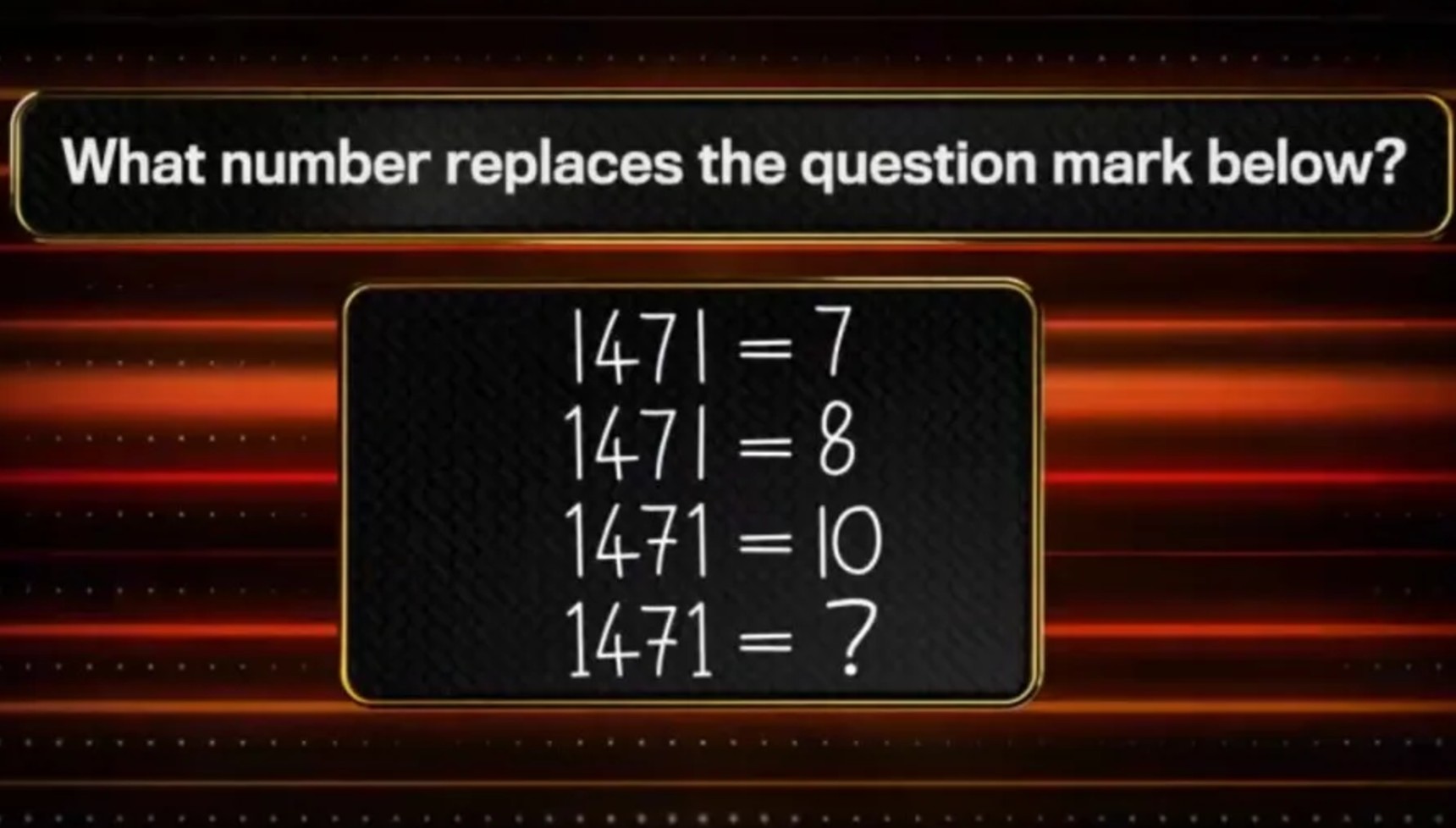
Four lines.
The same four digits.
Three completely different answers.
And one question mark waiting at the bottom.
It is exactly the sort of The 1% Club puzzle that can make you start inventing increasingly complicated calculations in your head.
Players are shown:
1471 = 7
1471 = 8
1471 = 10
1471 = ?

At first glance, it makes absolutely no mathematical sense.
How can 1471 equal three different numbers?
Is there a hidden equation?
Are the digits supposed to be added, multiplied or rearranged?
Is each line using a different mathematical rule?
That is where this question can send you badly off course.
Because the biggest clue isn’t hidden in the value of 1471 at all.
It is sitting right in front of your eyes.
Give yourself 30 seconds before scrolling to the solution.
The More Maths You Try, The Stranger It Gets

The natural instinct is to treat each line as an equation.
You might start experimenting with the four digits:
1, 4, 7 and 1.
Perhaps:
1 + 4 + 7 + 1 = 13
That doesn’t give 7, 8 or 10.
Maybe multiplication is involved.
Perhaps the numbers on the right form their own sequence.
7, 8, 10…
Could the next one be 13?
It is easy to disappear down that rabbit hole.
But there’s a much more important question to ask:
Are those four versions of 1471 actually identical?
Look again.
Very carefully.
There’s A Tiny Visual Difference Hiding In Plain Sight

The digits may represent the same number, but they aren’t written in exactly the same way.
Pay particular attention to the 1s and the 7s.
Some have additional strokes.
Some are written more simply.
One 7 may be formed with only its top and diagonal strokes, while another includes an extra horizontal bar.
Likewise, the number 1 can be drawn as a single vertical stroke — or with extra lines at the top or bottom.
That changes everything.
Because suddenly the numbers on the right begin to make sense.
You don’t need to calculate what 1471 equals.
You need to count something.
The First Line Gives Away The Rule

Take the first version of 1471.
Ignore the numerical values completely.
Instead, count the individual straight lines used to draw the four digits.
The simple 1 uses one stroke.
The 4 uses three.
The 7 uses two.
The final simple 1 uses one.
So:
1 + 3 + 2 + 1 = 7
And suddenly:
1471 = 7
makes perfect sense.
Not mathematically.
Visually.
Now Look At Why The Next Answers Change
The second version still reads 1471, but one of the digits contains an additional stroke.
That pushes the total from:
7 to 8.
The third line contains still more strokes, producing:
10.
So the numbers on the right aren’t answers to equations at all.
They’re telling you how many individual lines have been used to write 1471 in each row.
Once you realise that, all that mathematical pattern-hunting becomes completely unnecessary.
Which leaves only the final row.
Look carefully at the way its two 1s and its 7 are drawn.
Count every straight stroke.
What total do you get?
The Answer: 12
The missing number is:
12
The trick is to count the straight lines or strokes used to form the digits, rather than treating 1471 as an actual number.
In the final row, the digits are drawn using a total of 12 separate strokes.
The 1s have additional strokes rather than appearing as simple vertical lines, while the 7 also includes its extra cross-stroke.
Together with the three strokes forming the 4, the complete row contains:
12 lines
So the final pattern is:
1471 = 7
1471 = 8
1471 = 10
1471 = 12
The clever part is that your brain sees 1471 four times and automatically assumes you’re looking at a number puzzle.
You’re not.
It’s a visual puzzle disguised as maths.
And the longer you spend searching for some sophisticated numerical relationship between 7, 8 and 10, the further you move away from the surprisingly simple thing the question actually wants you to notice.