The 1% Club’s 1-8-11-69-88-96-101 Sequence Looks Like A Brutal Maths Pattern — But The Next Three-Digit Number Is Found By Looking At The Digits Completely Differently
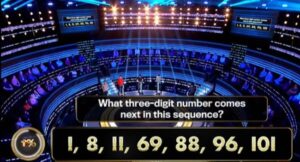
Seven numbers.
No obvious progression.
And a question asking for the next three-digit number in the sequence.
Players are shown:
1, 8, 11, 69, 88, 96, 101
Then comes the challenge:
“What three-digit number comes next in this sequence?”
At first glance, it looks like the sort of number puzzle that demands some serious arithmetic.
Perhaps 1 becomes 8 through multiplication.
Maybe the jump from 11 to 69 contains the key.
Could 69, 88 and 96 be increasing according to some hidden mathematical rule?
And once 101 appears, the temptation is to start calculating differences between every number on the screen.
But that instinct can send you completely in the wrong direction.
Because the numbers aren’t connected by what happens when you calculate with them.
They’re connected by what happens when you look at them in a very unusual way.
Give yourself 30 seconds before scrolling down to the answer.
The Differences Between The Numbers Tell You Almost Nothing
Try subtracting consecutive terms:
From 1 to 8, the difference is 7.
From 8 to 11, it is 3.
Then suddenly:
11 → 69
That’s a jump of 58.
Next:
69 → 88 = 19
Then:
88 → 96 = 8
And finally:
96 → 101 = 5
There is no neat progression hiding there.
Multiplication doesn’t make things much better.
Nor does splitting the sequence into alternating groups.
That should be the first warning that this may not really be a traditional number sequence at all.
69 And 96 Are The Biggest Clue

Forget the beginning for a moment and look at these two numbers:
69
and
96
They are particularly interesting because the digits seem to transform into one another.
Now imagine turning the screen completely upside down — a full 180-degree rotation.
A 6 becomes a 9.
A 9 becomes a 6.
But because their positions also swap when the entire number is rotated, something surprising happens.
69 still reads 69.
And:
96 still reads 96.
That is the trick hiding behind the whole sequence.
Now Try It With 88
Turn:
88
upside down.
Each 8 still looks like an 8, while the two digits swap positions.
But because they’re identical, you still get:
88.
Exactly the same thing happens with:
11
Rotate it 180 degrees and it remains:
11.
And the single-digit numbers at the beginning also work:
1 → 1
8 → 8
Suddenly, every number in the sequence has something very unusual in common.
101 Confirms You’ve Found The Rule
@1percentclubitvAnybody good at maths? #the1percentclub #itv #quizshow #television #quizchallenge #quiztok
The first three-digit term is:
101
Rotate the whole number 180 degrees.
The final 1 moves to the beginning.
The 0 stays a 0.
The first 1 moves to the end.
And because the two outer digits are identical, you are left with:
101
again.
So the sequence is not based on arithmetic.
It is simply listing numbers, in ascending order, that remain valid and unchanged when rotated through 180 degrees.
Now the question becomes much easier.
What is the next number after 101 with that same property?
The Answer: 111

The next three-digit number is:
111
The sequence consists of numbers that look exactly the same when rotated 180 degrees.
The terms shown are:
1
8
11
69
88
96
101
After 101, the next smallest number with the same rotational property is:
111
Turn 111 upside down and the three 1s reverse position — but because they’re all identical, the number still reads:
111
So the sequence continues:
1, 8, 11, 69, 88, 96, 101, 111…
The trick is that there was never a mathematical relationship between the numbers at all.
You weren’t supposed to add them, subtract them or calculate the gaps.
You were supposed to turn them upside down.
And once you do that, a sequence that initially looks completely random suddenly becomes beautifully simple.