
Lanterns review: How HBO finally cured my superhero fatigue
There was a time when the arrival of another superhero series would have been something to look forward to. Eventually, though, the endless quips, CGI battles, magical costumes and increasingly interconnected universes began to feel exhausting.
For me, the breaking point was The Falcon and the Winter Soldier. I remember watching it and feeling that the script had been assembled from leftover Marvel one-liners. The action was familiar, the jokes felt forced, and I suddenly realised I had very little appetite left for another conventional superhero story.
Apparently, I wasn’t the only one.
The phrase “superhero fatigue” became increasingly common as audiences grew less enthusiastic about the genre’s once-unstoppable dominance. Studios and networks began experimenting with different ways to tell comic-book stories, and one approach has proved particularly interesting: make the superhero elements secondary to a story that could almost work without them.
That is exactly what HBO’s Lanterns does.

Lanterns barely feels like a superhero show
Based on DC’s Green Lantern mythology, Lanterns could easily have been another origin story packed with green costumes, spectacular powers and cosmic battles.
Instead, HBO has built something much closer to a grounded detective drama.
The official premise follows new recruit John Stewart and Green Lantern veteran Hal Jordan as two intergalactic cops pulled into a dark, Earth-based mystery involving a murder in the American heartland.
That choice changes the entire tone.
The supernatural and extraterrestrial elements are treated almost casually. Aliens exist, but nobody seems particularly amazed by them. They can appear on the news and the world simply carries on. Hal’s extraordinary ring can run out of power, leaving him with the mundane problem of needing to recharge it.
A mass shooting can involve alien victims. John can bring Hal his superhero uniform only for it to become the butt of a joke.
Those details are funny, but they also serve a larger purpose. The series takes the extraordinary and makes it ordinary, allowing the characters and the mystery to occupy the foreground.
Even the premise itself reflects that approach. HBO describes Hal and John as intergalactic cops investigating a murder rather than leading with their status as superheroes.

The Watchmen blueprint
That balance makes sense when you look at the people behind the series.
Lanterns was developed by Damon Lindelof, Chris Mundy and comic-book writer Tom King, with the first two episodes directed by James Hawes. Critics have also noted the show’s debt to detective television, particularly True Detective, while its creators have drawn on the familiar structure of mismatched investigators working through an increasingly complicated case.
Lindelof’s connection to Watchmen is especially significant.
His 2019 HBO adaptation took a world populated by superheroes, masked vigilantes and comic-book mythology and approached it as a serious television drama. HBO’s own description frames Watchmen as an alternate history in which masked vigilantes are treated as outlaws.
Lanterns appears to be working from a similar principle. The comic-book mythology is still there, but it does not have to dominate every scene.
That makes the series feel more grounded and, for viewers experiencing superhero fatigue, considerably easier to settle into.

Superheroes work differently when the genre gets out of the way
This approach has been appearing elsewhere, too.
Marvel’s Wonder Man takes its central comic-book character and places his ambitions as an actor and his relationship with Hollywood at the heart of the story. Simon Williams has always had a strong connection to show business in the comics, where he becomes a Hollywood star alongside his superhero career. Marvel’s television lineup includes the Wonder Man series for 2026.
That gives the character a different kind of story to inhabit. The superhero identity becomes part of a larger examination of acting, ambition and identity rather than the sole reason for the series to exist.
Then there is The Penguin.
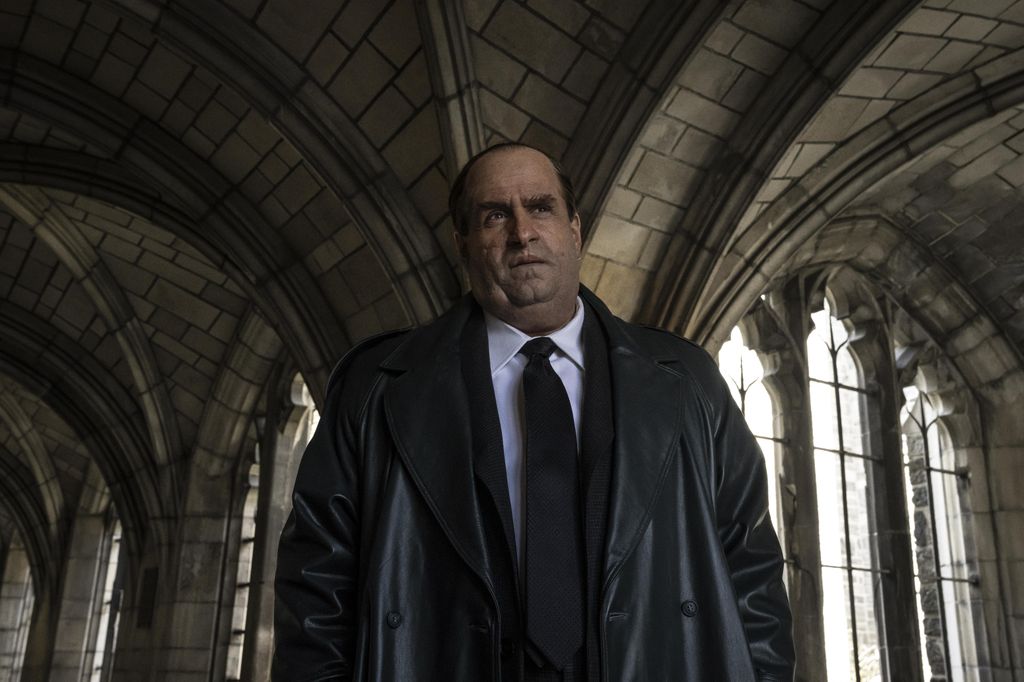
The DC series takes Oswald “Oz” Cobb, played by Colin Farrell, and turns him into the centre of a crime drama about power and control in Gotham City. HBO explicitly positions it as the next chapter in The Batman saga, but its storytelling is rooted in the conventions of a gangster drama.
Batman barely needs to be present for that story to work.
That is the trick these shows have increasingly understood. A comic-book property does not have to constantly remind viewers that it came from a comic book.
Why Lanterns works for me
There is still plenty of superhero mythology underneath Lanterns. Hal Jordan and John Stewart are Green Lanterns, their rings have extraordinary abilities, and the larger story reaches far beyond Earth.
But the show rarely treats those elements as the most interesting thing happening on screen.
Instead, the focus is on the people carrying the mythology.
Kyle Chandler’s Hal Jordan and Aaron Pierre’s John Stewart form the centre of the series, while Kelly Macdonald plays Sheriff Kerry, one of the key figures in the earthly mystery. The chemistry between Chandler and Pierre gives the show a human tension that would be difficult to create if every episode were simply moving from one spectacle to another. Critics have similarly highlighted the contrast between Hal’s cynical, weathered attitude and John’s more disciplined personality.
That grounded quality also gives the stranger elements more room to breathe.
When aliens are already part of everyday reality, there is no need for every extraterrestrial appearance to be accompanied by a huge musical cue or a speech about how impossible it all is.
The world simply accepts that this is the way things are.
And that makes the characters feel more believable.
The superhero genre may not need more spectacle
There will always be room for straightforward superhero shows. Daredevil: Born Again and VisionQuest sit much closer to that traditional side of the genre.
But after years of increasingly elaborate cinematic universes, Lanterns demonstrates how refreshing it can be to step sideways rather than push further into spectacle.
The series takes characters who could easily have been surrounded by cosmic battles and glowing visual effects and instead drops them into an Earth-based mystery. HBO’s official description puts the murder investigation at the centre of the story, and that decision goes a long way toward explaining why the show feels different from the superhero fare that preceded it.
For me, that has been enough to make the genre feel interesting again.
Maybe superhero fatigue does not require fewer superheroes. Maybe it requires stories that are willing to forget, for a while, that they are superhero stories at all.