**By the time the orchestra began playing the wedding march, I had already decided I would not marry Adrian Vale.**
The world outside the bridal suite did not know that yet.
To them, I was still Elena Hale, daughter of Victor Hale, heiress to one of the oldest hotel empires in the country, bride of the year, girl in the ivory gown, woman with the perfect smile. Five hundred guests waited beneath the painted ceiling of the Grand Aurelia ballroom, surrounded by towers of white roses, crystal chandeliers, and cameras ready to capture a romance that society magazines had spent months calling “a fairy tale.”
But fairy tales were careful things.
They knew how to hide monsters behind velvet curtains.
I stood before the mirror in a gown that had taken six seamstresses four months to finish. Silk fell around me like moonlight. Pearls shimmered down the sleeves. My veil trailed across the marble floor like spilled fog. On the vanity, a diamond necklace flashed beneath the sunlight pouring through stained-glass windows.
And beneath my left cheekbone, under layers of concealer and powder, **a bruise pulsed like a second heartbeat.**
Purple. Swollen. Tender.
Adrian had left it there the night before.
Not in anger, he had said afterward, but in correction.
“You need to learn,” he had whispered as I held my face, tasting blood at the corner of my mouth. “Once we’re married, you represent my family too. You can’t embarrass me with tears, Elena. You can’t keep running charity kitchens like some saint begging for applause. You’re a Hale. Soon you’ll be a Vale. Act like it.”
Then he had kissed my forehead as if that healed anything.
Now he stood in my bridal suite, wearing an ivory tuxedo and holding a champagne glass between two lazy fingers. His blond hair was perfect. His cufflinks were sapphire. His smile had the casual sharpness of a knife laid on white linen.
Behind him, his mother, Claudia Vale, sat in a high-backed chair like a queen forced to wait among servants. Her emerald gown glittered with diamonds. Her lips were painted a deep red, and her eyes kept sweeping over my dress, my hair, my necklace, as if calculating how much of me already belonged to her.
Adrian’s younger brother, Nicholas, leaned against the wall with his phone raised, recording everything.
He had been recording for twenty minutes.
At first, I thought it was vanity. The Vales recorded everything. Their smiles, their champagne, their polished cruelty. They collected evidence of their own importance.
But Nicholas’s smile was different.
It did not shine.
It hid.
“Turn your face to the window,” Claudia said, waving one jeweled hand at me. “The bruise is still visible from the left.”
My stomach tightened, but I did not move.
Adrian chuckled. “Mother, don’t fuss. The photographers will edit it.”
Claudia’s eyes narrowed. “Photographers edit light, darling. They do not edit humiliation. If anyone sees that mark, they will ask questions.”
“Then Elena will answer properly.” Adrian lifted his glass toward me. “Won’t you, sweetheart?”
I met his gaze in the mirror.
For six months, I had practiced softness in front of him. Soft voice. Soft steps. Soft smiles. He mistook it for surrender. Claudia mistook it for breeding. Nicholas, perhaps, mistook it for silence.
They were all wrong.
I had not been silent.
I had been listening.
**Every insult. Every threat. Every whispered plan. Every ugly sentence spoken when they believed kindness meant weakness.**
My phone lay on the vanity beneath a lace handkerchief. It looked harmless. Bridal. Feminine. Forgettable.
It had been recording since Adrian entered.
My father had taught me that.
Victor Hale had many rules, but one had shaped my bones: **“Never raise your voice when the truth can speak louder.”**
He had said it when I was ten and a board member accused him of weakness because he refused to destroy a competitor during a recession.
He had said it when I was sixteen and a classmate stole donations from a charity drive and blamed me.
He had said it again after my mother died, when grief made him quieter but not smaller.
“Your mother believed in mercy,” he told me, sitting beside me in the garden beneath rain-heavy roses. “I believe in proof. Between the two, we survive.”
I had loved him for that.
I had feared disappointing him more.
That fear was how Adrian entered my life.
He was charming when he arrived. He made my father laugh at a charity gala. He remembered the names of waiters. He donated loudly and shook hands gently. When he asked about the children’s shelter I funded, he seemed interested.
“You care so deeply,” he told me the first evening we danced. “It’s rare. Most people only pretend.”
I believed him because I wanted to.
Because grief had left rooms inside me that echoed.
Because my father had grown distant after my mother’s death, buried beneath work and silence, and Adrian knew exactly how to appear warm.
The first month, he sent flowers.
The second, he criticized my clothes.
The third, he asked why I needed so many meetings with shelter directors when I could be planning our future.
The fourth, he laughed when Claudia called me “a little charity nun in designer shoes.”
The fifth, he gripped my wrist hard enough to bruise when I contradicted him at dinner.
The sixth, he struck my face.
Now, on my wedding day, Claudia leaned forward and said, “Remember, Elena. A woman’s dignity is not in being untouched. It is in knowing when to keep family matters private.”
Adrian smiled. “Just teaching her a lesson in our family.”
Those words landed harder than the slap.
Not because they surprised me.
Because they freed me.
Something cold and clear opened inside my chest.
A lesson in our family.
No.
Not mine.
The door opened.
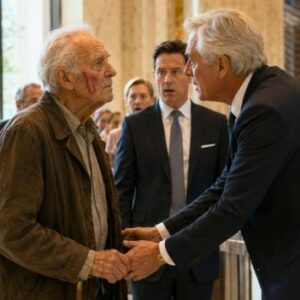
My father walked in.
Victor Hale was not a tall man, but rooms rearranged themselves around him. He wore a black morning coat, silver tie, and the expression of a man who had built towers through storms. His hair had gone almost entirely white since my mother died, but his eyes remained the same storm-gray I had inherited.
He stopped just inside the doorway.
For one fragile second, he looked like any father seeing his daughter on her wedding day.
Then his eyes moved past the veil, past the pearls, past the diamond necklace.
They went straight to my face.
The sunlight through the stained-glass windows painted the marble floor red, blue, and gold, but all the color disappeared from his expression.
“My dear daughter…” he whispered. “Who did this to you?”
The room changed.
Even the quartet beyond the doors seemed to fade.
I opened my mouth, but Adrian laughed.
It was a careless sound. A rich man’s laugh. The laugh of someone who had never imagined consequences entering through the same door as a father.
“Victor,” Adrian said, spreading his hands. “Let’s not make a scene.”
My father did not look at him. He looked only at me.
“Elena.”
I had prepared speeches. Explanations. Evidence. Rage. I had practiced a dozen versions in the mirror at midnight.
But under my father’s eyes, all that came out was, “I’m sorry.”
His face broke.
Not loudly. Not theatrically. But something in him cracked open, and I saw the years fall away. I saw the man who had taught me to ride a bicycle in the courtyard. The man who sat through every school play with a program folded in his hands. The man who had stood beside my mother’s coffin and promised me, “No harm reaches you while I breathe.”
He stepped closer.
Adrian moved between us.
That was his mistake.
My father looked at him then.
He did not yell. He did not threaten. He did not raise a hand.
He simply said, **“This wedding is over.”**
The sentence sliced through the room.
Claudia rose so fast her diamonds flashed. “You cannot be serious.”
“Entirely,” my father said.
Adrian’s smile tightened. “Victor, you’re emotional. I understand. But Elena and I had a disagreement. Couples do.”
“Couples disagree over flowers,” my father said. “Not facial bruises.”
Nicholas lowered his phone slightly.
Claudia’s voice turned icy. “Consider the optics. Five hundred guests are seated. Every paper in the city is waiting outside. Your shareholders are here. Our partners are here. Do you really want gossip spreading because your daughter is too delicate to handle discipline?”
My father’s eyes sharpened.
“Discipline,” he repeated.
I watched Claudia realize too late that she had chosen the wrong word.
Adrian set down his champagne glass. “Elena, tell your father you’re fine.”
I stared at him.
For six months, fear had taught my body to obey the slightest change in his tone. My shoulders knew when to fold. My hands knew when to still. My mouth knew when to smile.
But fear is a house with locked doors.
And sometimes, one word becomes a key.
“No,” I said.
Adrian blinked.
It was such a small word. One syllable. Barely louder than breath.
But it made him look at me as if I had struck him.
“What did you say?”
I lifted my chin, and pain sparked beneath my cheekbone. “I said no.”
His face darkened. “Elena—”
My father stepped between us before Adrian could move.
“Do not speak to her as if she belongs to you.”
The silence afterward was enormous.
Beyond the bridal-suite doors, the ballroom hummed with wealth. Guests laughed softly. Glasses chimed. Reporters whispered. Somewhere, a violin tuned a string, the note trembling like a warning.
Claudia moved first.
“Victor,” she said, smiling again, though anger burned beneath it. “This is a family misunderstanding. Let us settle it privately.”
“I agree,” my father said. “Family should hear the truth first.”
Then he turned, opened the bridal-suite doors, and walked into the ballroom.
For one stunned second, no one followed.
Then I picked up my phone from beneath the lace handkerchief.
Adrian saw it.
His expression changed.
Not anger.
Fear.
“Elena,” he said softly. “What is that?”
I looked at him and felt nothing break. Nothing tremble. Nothing beg.
“Proof.”
Then I followed my father.
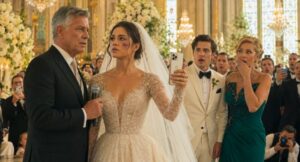
The ballroom of the Grand Aurelia had been built for emperors and scandals. Its ceiling was painted with angels in blue robes. Its chandeliers held three thousand crystals. White roses climbed gold pillars. A silk runner stretched down the aisle toward an altar wrapped in candles.
Five hundred faces turned toward us.
At first, they smiled.
Then they saw my father’s face.
Then they saw mine.
Whispers moved through the room like wind through dry leaves.
My father took the microphone from the officiant.
“Before this wedding continues,” he said, his voice carrying with terrifying calm, “there is something everyone needs to hear.”
Adrian emerged behind me, pale now. Claudia followed, posture rigid. Nicholas lingered near the door, phone still in hand.
“Victor,” Adrian called, loud enough for the front rows. “Do not do this.”
My father looked back. “I’m not doing anything.”
Then his gaze came to me.
I raised my phone.
My thumb hovered over the recording.
For a moment, the entire world narrowed to the glowing screen. The file name was simple: **VALE_BRIDAL_SUITE_11_42_AM.**
My hand shook once.
Then it steadied.
I pressed play.
At first, there was only static.
Then Adrian’s voice filled the ballroom.
“Just teaching her a lesson in our family.”
A gasp rippled through the guests.
Then Claudia’s voice followed, sharp and polished.
“If anyone sees that mark, they will ask questions.”
Adrian laughed through the speakers.
“Then Elena will answer properly. Won’t you, sweetheart?”
Every word echoed off the chandeliers, the roses, the painted angels.
Guests shifted in their seats. Some covered their mouths. Cameras swung toward Adrian. His face drained of color.
The recording continued.
Claudia: “A woman’s dignity is not in being untouched. It is in knowing when to keep family matters private.”
Adrian: “She’ll learn. After the merger papers are signed, she won’t have much choice.”
My breath caught.
The merger papers.
I had almost forgotten that part.
Almost.
Six weeks earlier, Adrian had convinced me to approve a post-wedding consolidation of several Hale philanthropic properties with Vale Development. He called it “a romantic union of families.” My father had hesitated. I had argued in Adrian’s favor.
The shame of that still burned.
The recording rolled on.
Adrian’s voice, lower now: “Once Victor transfers the foundation assets, we’ll restructure. Sell the shelter buildings first. The land alone is worth more than those miserable people could earn in ten lives.”
The ballroom went silent in a way I had never heard silence before.
Not empty.
Alive.
Horrified.
I felt tears rise, but they did not fall. The children’s shelter. The kitchens. The women’s clinic. The old library my mother had restored.
All of it had been marked in Adrian’s mind as land.
Claudia’s voice came next.
“Do not underestimate Elena. Gentle girls sometimes grow sentimental.”
Adrian laughed. “Gentle girls are the easiest. They apologize for being hurt.”
My father closed his eyes.
That broke me more than anything.
I had wanted him angry. I had expected fury. But his grief stood beside me like another person.
I stopped the recording.
Not because it was over.
Because it had done enough.
For several seconds, no one moved.
Then a woman in the third row stood. Mrs. Bellamy, director of the children’s shelter, gray-haired and trembling, stared at Adrian as if seeing rot beneath marble.
“You were going to sell our building?” she asked.
Adrian’s jaw flexed. “This is being taken out of context.”
A reporter shouted, “What context justifies hitting your bride?”
Another voice: “Did you assault her?”
Another: “Mr. Vale, is the merger fraud?”
The room erupted.
Adrian moved toward me.
My father’s security team moved faster.
Two men in dark suits stepped into the aisle, blocking him without touching him. Adrian stopped, breathing hard.
Claudia raised both hands. “Everyone calm down. This is a private family matter, and any recordings made without consent—”
“Were made in my daughter’s bridal suite,” my father said, “where she was being threatened.”
A deep voice spoke from near the back.
“And they were not the only recordings.”
The crowd turned.
Nicholas Vale stepped forward.
Adrian stared at his brother. “Nick?”
Nicholas lowered his phone at last. His cruel smile was gone. Without it, he looked younger. Tired. Almost sick.
“I’m sorry, Elena,” he said.
I did not know what to answer.
He walked down the aisle, stopping several feet away from me. The guests watched him as if he carried a bomb.
Maybe he did.
“I’ve been recording them for months,” Nicholas said, his voice shaking. “Not for fun. Not to mock you. Because I knew no one would believe me if I spoke.”
Claudia’s face turned white.
“Nicholas,” she hissed. “Stop.”
He looked at her, and the pain in his face was so raw that even I felt it.
“You told me to stop being weak when Dad died,” he said. “You told me Adrian was the future. You told me family survives by controlling the room.”
Adrian’s eyes burned. “Shut your mouth.”
Nicholas swallowed. “No.”
It was the same word I had spoken minutes earlier.
Small.
Unstoppable.
Nicholas turned to the guests. “Vale Development is insolvent. The merger wasn’t about love or partnership. They needed access to Hale foundation assets to cover illegal loans, falsified valuations, and shell-company debt. Adrian planned to marry Elena, pressure her into signing authority, then force Victor out through a governance clause hidden in the merger documents.”
A murmur exploded across the ballroom.
I looked at my father.
His expression had not changed.
That was when I understood.
He had known.
Not everything, perhaps.
But enough.
Adrian saw the realization pass over my face and laughed bitterly. “Oh, that’s rich. You think Daddy is innocent?”
The room quieted again.
My stomach dropped.
Adrian smiled now, desperate and vicious. “Ask him, Elena. Ask your beloved father why he approved the wedding after I hit you last night.”
My blood went cold.
My father turned very slowly.
“What did you say?”
Adrian’s smile faltered. “Don’t pretend. You knew what I was. You knew my company was bleeding. You arranged this marriage to swallow us cheap.”
My heart slammed against my ribs.
For the first time all day, I could not read my father’s face.
“Dad?” I whispered.
He looked at me, and the grief there was terrible.
“Elena,” he said softly, “I did not know he struck you.”
“But you knew about the company?”
“Yes.”
The word fell between us like glass.
The ballroom blurred at the edges.
I took one step back. “You knew they were using me?”
“No.” His voice broke. “I knew they were trying.”
“That is not the same,” Claudia snapped, seizing the opening. “Victor has been circling Vale Development for years.”
My father did not deny it.
Adrian’s laugh grew louder. “There he is. The saint of old money. He let this wedding happen because he wanted us exposed in front of everyone.”
My knees felt weak.
Had I been a daughter to protect?
Or bait?
My father faced the crowd, then me.
“Elena,” he said, “when your mother died, I made the mistake of trying to protect you by keeping ugly things away from you. I thought if I carried enough darkness alone, you could stay kind.”
His eyes shone.
“That was arrogance. And cowardice.”
The room was utterly still.
“Three months ago, Nicholas came to me.”
I turned to Nicholas.
He nodded, eyes wet.
“He said Adrian and Claudia were planning something around the merger,” my father continued. “He had documents, fragments, recordings. Enough to concern me. Not enough to stop them without exposing Nicholas or risking them destroying evidence. So I delayed. I investigated. I hoped you would come to me.”
A tear slipped down my cheek, cutting through the makeup near the bruise.
“I didn’t know how.”
“I know,” he said. “And that failure is mine.”
Adrian scoffed. “Beautiful speech.”
My father ignored him.
“I asked the board to prepare a public withdrawal from the merger this morning. Before the ceremony. Before any vows. I came to tell you privately that I had found fraud and the wedding could not proceed.”
He looked at my cheek.
“Then I saw what he had done.”
The room seemed to exhale.
The betrayal inside me shifted shape. It did not vanish. It became something more complicated. Pain, yes. But not abandonment.
My father stepped closer, not touching me without permission.
“I should have trusted you with the truth sooner. I thought I was shielding you. Instead, I left you alone in a room with wolves.”
For the first time since he entered the suite, I saw not Victor Hale, empire builder.
I saw my father.
Old. Frightened. Sorry.
My mother used to say that love was not proven by never failing.
It was proven by what one did after failure.
I wiped my cheek. “No more secrets.”
His shoulders trembled once. “No more secrets.”
Claudia clapped slowly.
The sound was obscene beneath the chandeliers.
“How moving,” she said. “Unfortunately, emotion does not erase law. You have no authority to publicly defame my family with stolen recordings and hysterical accusations.”
Then she turned toward the cameras.
“Ladies and gentlemen, what you have witnessed is a coordinated attack by the Hale family to destroy a business rival. My son and Elena had a private disagreement. Nothing more. There is no crime here. There is only power wearing a father’s face.”
Adrian straightened as if her words gave him bones.
“Yes,” he said. “Exactly.”
For one awful second, I saw how they might survive.
The wealthy often did.
They wrapped truth in procedure. They renamed cruelty as misunderstanding. They drowned pain in lawsuits until victims grew tired of breathing.
Then Nicholas laughed.
It was not cruel this time.
It was broken.
“You still don’t know?” he said.
Claudia turned on him. “Know what?”
Nicholas looked at me.
And there, in his expression, was the first hint of the impossible.
“Elena,” he said, “I wasn’t the first person to record them.”
My brow furrowed.
“What?”
He reached into his jacket and pulled out a small velvet pouch.
Inside was a brooch.
My mother’s brooch.
A gold rose with a tiny pearl at its center.
I had not seen it since her funeral.
My father went completely still.
“Nicholas,” he whispered. “Where did you get that?”
Nicholas held it like it might burn him.
“My father kept it in a locked safe,” he said. “I found it after he died. I thought it was jewelry he’d stolen or bought. Then I found the drive hidden inside.”
The ballroom vanished.
The chandeliers. The guests. Adrian’s pale face. Claudia’s fury.
All I could see was the brooch.
My mother had worn it in every photograph. At galas. At garden parties. At the shelter opening. She used to tap it when she was thinking.
Tap. Tap.
“Your mother was investigating Vale Development before she died,” Nicholas said quietly.
My father’s face drained.
“No,” he said.
Nicholas nodded. “She met my father in secret. She knew about the fraud. She was trying to convince him to turn himself in and protect both families’ employees before Claudia and Adrian buried everything.”
My father staggered as if struck.
My mother had died in a car accident on a rainy November night.
A tragic accident, the police said.
A slick road. Poor visibility. A truck that never stopped.
I remembered the phone call. My father’s hand dropping the receiver. The sound he made, half roar, half wound.
I remembered the brooch pinned to her coat at breakfast that morning.
Then gone forever.
Until now.
Claudia’s voice cut across the room. “That is absurd.”
Nicholas looked at her. “Is it?”
For the first time, Claudia Vale looked afraid.
Not angry.
Afraid.
Nicholas turned to the enormous projection screen above the altar, where a slideshow of Adrian and me had been looping all morning. Engagement photos. Charity gala pictures. A beach portrait where I wore white and Adrian kissed my temple.
Nicholas connected his phone.
The screen went black.
Then my mother appeared.
Alive.
The room gasped.
She sat in what looked like a hotel study, wearing a navy coat and the gold rose brooch. Her dark hair was pinned low. Her face was thinner than I remembered from that year, but her eyes were bright with the same fierce kindness that had built half the shelters in the city.
My hand flew to my mouth.
My father whispered her name.
“Victor,” my mother said from the screen, voice trembling but clear, “if you are seeing this, then I failed to come home.”
A sob escaped me.
My father reached for me, and this time I let him.
His arm came around my shoulders as if he had been waiting sixteen years to hold both his grief and mine at once.
My mother continued.
“I discovered that Vale Development has been laundering debt through charitable construction grants. Richard Vale wants to confess. Claudia does not. She says too many people depend on the lie now. I am recording everything because truth buried politely is still buried.”
The video flickered.
My mother looked over her shoulder, frightened by some sound beyond the door.
Then she leaned closer.
“Elena, my darling, if you ever see this, remember what I told you about roses. People admire the bloom and forget the thorns. Kindness without courage is only decoration. But kindness with courage can cut through anything.”
I was crying openly now.
Not soft tears.
The kind that rose from the deepest cellar of the soul.
She smiled sadly.
“And Victor, forgive yourself only after you protect her. Not before.”
The video ended.
For a heartbeat, no one breathed.
Then the ballroom doors opened.
Uniformed officers entered.
Behind them came a woman in a charcoal suit, holding a folder thick with documents. I recognized her from my father’s legal team, but the badge clipped to her belt made my pulse jump.
Federal investigator.
Claudia stepped backward.
Adrian looked from the officers to Nicholas to my father.
“What is this?” he demanded.
The investigator’s voice was calm. “Claudia Vale, Adrian Vale, you are being detained for questioning in connection with financial fraud, conspiracy, obstruction, and the reopened investigation into the death of Marianne Hale.”
My mother’s name moved through the ballroom like thunder.
Claudia’s mask shattered.
“You have nothing,” she spat.
Nicholas lifted his phone again.
“Actually,” he said, tears slipping down his face, “we have everything.”
Adrian lunged for him.
Security caught him before he crossed two steps.
The champagne glass he had abandoned earlier toppled from the vanity cart near the aisle and shattered against the marble. The sound rang like a bell.
Adrian fought, face twisted with the ugliness he had hidden behind charm.
“Elena!” he shouted as officers restrained him. “You think this makes you strong? You’re nothing without your father!”
I stepped forward.
The entire ballroom watched.
My cheek throbbed. My eyes burned. My gown felt heavy as armor.
But my voice did not shake.
“No,” I said. “I was never nothing. You were just too small to see me.”
The officer led him away.
Claudia did not scream. She did not plead. She lifted her chin as if even arrest could be made elegant.
But when she passed me, she whispered, “You will regret this.”
I looked at her and thought of my mother’s brooch. Her roses. Her voice crossing death to find me.
“No,” I said. “I already did my regretting.”
Then she was gone.
The ballroom remained full, but the wedding had become something else entirely. Guests stood among the roses, stunned and tearful. Reporters lowered cameras, some out of respect, others out of shock. Mrs. Bellamy came to me first and wrapped me in a fierce, trembling embrace.
“You saved us,” she whispered.
I thought of how close I had come to signing everything away.
“No,” I whispered back. “My mother started it.”
My father heard.
His hand closed over mine.
For a long moment, we stood beneath the altar where I was supposed to promise my life to a man who saw me as property. Above us, the screen had gone dark, but I could still see my mother’s face in my mind.
Kindness with courage can cut through anything.
The officiant cleared his throat awkwardly. “Mr. Hale, Miss Hale… shall we dismiss the guests?”
I looked around the ballroom.
The white roses no longer looked like wedding flowers. They looked like witnesses.
My father followed my gaze. “Elena?”
I stepped onto the altar platform and took the microphone.
My reflection trembled in a hundred camera lenses. A bride with ruined makeup. A bruise beneath one eye. A veil like storm clouds. A daughter whose mother had just returned from the dead in a recording hidden inside a rose.
I should have felt exposed.
Instead, I felt seen.
“There will be no wedding today,” I said.
A ripple of murmurs followed, though everyone already knew.
“But there is food for five hundred people. There are flowers enough to fill a hospital. There is music already paid for. There are shelter directors, nurses, teachers, volunteers, and donors in this room.”
I looked at Mrs. Bellamy.
“Today was supposed to celebrate a union. Let it still do that. Not between families built on secrets, but between everyone who refuses to let power prey on gentleness.”
My father’s eyes widened slightly.
I turned to him. “Can we open the ballroom to the shelter families? The kitchen staff already prepared everything.”
A smile broke through his grief like sunlight through rain.
“Yes,” he said. “Of course.”
And so the wedding of the year became something no society magazine could have planned.
By late afternoon, the Grand Aurelia ballroom was filled not with gossiping elites but with children from the shelter running between gold chairs, women from the clinic eating chocolate cake beneath chandeliers, volunteers carrying trays, musicians playing waltzes for people who had never once been invited into rooms like this.
The white roses were taken down from their towers and bundled into bouquets. Drivers delivered them to hospitals, nursing homes, and shelters across the city. The untouched wedding favors, tiny silver boxes embossed with Adrian’s initials, were opened and filled instead with handwritten notes from my mother’s charity foundation:
**You are worthy of safety. You are worthy of joy. You are worthy of a future.**
At sunset, I slipped away to the hotel garden.
My gown was stained at the hem. My hair had loosened from its pins. My veil was gone, claimed by a little girl named Sophie who said it made her feel like a cloud princess. I had let her keep it.
I found my father sitting on a stone bench beneath climbing roses, holding my mother’s brooch in both hands.
For a while, neither of us spoke.
The sky over the city burned pink and gold.
Finally, he said, “I thought I had lost her last words.”
I sat beside him. “Maybe they were waiting until we needed them most.”
He nodded, but tears slipped down his face.
“I failed you,” he said.
I leaned my head against his shoulder. For years, grief had stood between us like a locked door. Today, somehow, horror had found the key.
“You made mistakes,” I said. “So did I.”
“You were manipulated.”
“I was lonely.”
He closed his eyes.
I took his hand.
“No more secrets,” I reminded him.
“No more secrets,” he said.
Nicholas found us just as the first stars appeared. He stood at the garden entrance, uncertain, hands in his pockets, his face pale with exhaustion.
“I can leave,” he said.
I looked at him for a long moment.
Part of me wanted to hate him. He was a Vale. He had stood in that room and recorded my humiliation. He had smiled.
But now I understood that sometimes people trapped in cruel families learn strange disguises to survive.
“Why did you smile?” I asked.
He looked down.
“Because Adrian watched my face. Claudia too. If I looked disgusted, they stopped talking. If I looked entertained, they forgot I was there.”
It was a horrible answer.
It was also true.
My father stood and held out the brooch.
Nicholas shook his head. “That belongs to Elena.”
My father looked at me.
I took it.
The gold rose was warm from his hands.
“Thank you,” I told Nicholas.
He swallowed hard. “Your mother tried to save my father. He was too scared. I didn’t want to be him.”
That sentence stayed with me.
A person could inherit a name without inheriting its cowardice.
Inside the ballroom, someone began playing the first song Adrian and I had chosen for our wedding dance. I almost laughed at the absurdity of it.
Then the song changed.
A softer melody rose through the open garden doors.
My mother’s favorite.
My father heard it too.
His face crumpled.
“She used to dance to this in the kitchen,” I said.
“With flour on her cheek,” he whispered.
“And bare feet.”
“And she always made me join before the chorus.”
I stood and held out my hand.
My father stared at it.
“Dance with me,” I said.
His mouth trembled. “Here?”
“Here.”
So my father and I danced in the garden beneath the roses while the city lit up around us.
Not perfectly. Not gracefully. He stepped on my hem once, and I laughed through tears. He laughed too, the sound rusty from disuse. Nicholas stood at the edge of the path, looking away politely, though I saw him wipe his eyes.
For the first time in years, I felt my mother not as an absence but as a presence.
In the music.
In the roses.
In the courage that had waited inside me until I was ready to name it.
Weeks later, the story was everywhere.
The society pages called it **The Wedding That Became a Reckoning.** Financial papers called it **The Fall of Vale Development.** True crime shows fought over the reopened investigation into my mother’s death. Claudia’s lawyers tried to dismiss the recordings, then grew quiet when investigators found matching documents in three offshore accounts and a payment trail connected to the truck driver from the night my mother died.
Adrian pleaded innocence until Nicholas testified.
Then others came forward.
Assistants. Accountants. Former partners. Women Adrian had frightened into silence. Men Claudia had ruined with a smile and a contract.
The empire cracked.
Then collapsed.
But the happiest ending did not come in headlines.
It came six months later, on a cold morning bright with winter sun, when the old Vale headquarters reopened under a new name: **The Marianne Hale Center for Safe Futures.**
My father donated the building anonymously at first.
I changed that.
“No more secrets,” I told him.
So his name went on the deed, mine went on the program, and my mother’s went above the door.
The center housed legal aid offices, emergency apartments, counseling rooms, a children’s library, and a kitchen that smelled always of cinnamon and soup. Mrs. Bellamy ran the shelter wing. Nicholas, after testifying against his family, took a job there doing the least glamorous work possible: inventory, maintenance requests, moving donated furniture up narrow staircases.
He never asked for forgiveness.
That made it easier, eventually, to give him some.
On opening day, Sophie—the little girl who had stolen my veil—ran up wearing it again over a purple winter coat.
“Miss Elena!” she shouted. “Are you getting married today?”
I laughed so hard I nearly dropped the ceremonial scissors.
“No, sweetheart.”
“Good,” she said seriously. “Weddings are too much drama.”
My father burst out laughing beside me.
And there it was—the sound I had missed for years.
After the ribbon cutting, I walked alone into the children’s library. Sunlight poured across shelves of new books. On the wall hung a framed photograph of my mother wearing the gold rose brooch.
Beneath it, engraved in brass, were her words:
**Kindness with courage can cut through anything.**
I touched the brooch pinned now to my own coat.
For a moment, I thought the story was finished.
Then Nicholas appeared in the doorway.
“Elena,” he said, “there’s something else.”
My heart tightened. “Please tell me there are no more secret recordings.”
“No.” A faint smile touched his mouth. “Not recordings.”
He handed me an envelope, yellowed with age.
My name was written on the front in my mother’s handwriting.
My fingers went numb.
“Where did you get this?”
“It was inside the brooch pouch,” he said. “I didn’t see it before. It was tucked into the lining.”
I stared at my name.
Elena.
My mother’s hand. My mother’s ink.
I opened it carefully.
Inside was a letter.
My darling Elena,
If you are reading this, then life has asked you to become braver than I ever wanted you to be.
I hope you are still kind. I hope no one has convinced you that softness is the same as weakness. The world will try. It tries especially hard with girls who love deeply.
There is something I need you to know.
Your father is not a perfect man. Neither am I. But he loves you with a devotion that frightens him. Forgive him when he tries to protect you badly. Teach him how to stand beside you instead.
And one more thing, my rose.
Do not measure the future by the person who hurt you. Love is not the hand that strikes and calls it guidance. Love is the hand that trembles before touching your wound. Love is the voice that tells the truth even when truth costs everything.
When you are ready, live loudly.
Dance barefoot.
Feed people.
Build rooms where frightened souls can become themselves again.
And never forget this:
The day someone tries to make you feel small is the day you must remember whose daughter you are.
Not only mine.
Your own.
I sank into a chair, crying so hard the words blurred.
Nicholas quietly left.
My father found me there minutes later, holding the letter against my heart.
He read it.
Then he sat beside me, and we wept together beneath shelves of children’s books while sunlight warmed the floor.
That was the twist no one wrote about.
Not the arrest.
Not the hidden evidence.
Not the dead woman speaking from a screen.
The true surprise was this: **after all that pain, all that betrayal, all that darkness, my heart did not become cruel.**
It became larger.
Not immediately. Not easily. But slowly, deliberately, like a house rebuilt brick by brick after fire.
A year later, on what would have been my first wedding anniversary, I returned to the Grand Aurelia ballroom.
There were roses again.
White ones.
But no altar.
No Adrian.
No cameras waiting for scandal.
Instead, the ballroom was filled with children painting at long tables, survivors dancing in borrowed gowns, volunteers laughing over plates of food, and my father trying very seriously to learn how to braid Sophie’s hair.
At the center of the room stood a donation box for the Marianne Hale Center.
Above it hung a sign written in gold:
**The First Annual Rose Gala: A Celebration of Safe Futures.**
Nicholas arrived late, carrying three boxes of donated books and looking nervous in a suit that did not quite fit. Sophie ran to him, veil flying behind her, and demanded he read aloud from a book about dragons who learned to bake.
He obeyed.
My father came to stand beside me.
“She would be proud,” he said.
I looked at the ballroom where my life had almost narrowed into a cage and saw instead a room full of open doors.
“Yes,” I said. “I think she would.”
The orchestra began to play.
Not the wedding march.
My mother’s song.
My father held out his hand.
I took it.
And this time, when we danced beneath the chandeliers, I was not a bride pretending to be happy.
I was a woman who had walked through humiliation, grief, and fire—and come out carrying roses.
The bruise beneath my cheekbone had faded long ago.
But sometimes, in certain light, I imagined I could still feel where it had been.
Not as pain.
As memory.
As warning.
As proof.
Because once, five hundred people gathered to watch me give my life to a man who thought kindness made me weak.
Instead, they watched me press play.
And when the truth echoed through that ballroom, it did more than end a wedding.
**It gave me back my name.**
**It gave my father back his daughter.**
**It gave my mother’s voice a final victory.**
And most of all, **it proved that even the gentlest rose can hide a thorn sharp enough to bring an empire to its knees.**