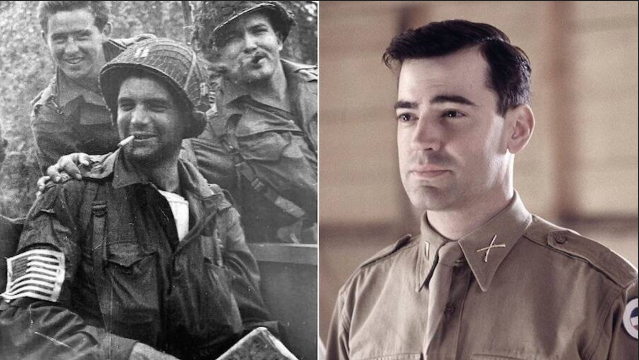
In the pantheon of World War II heroes brought to life by HBO’s Band of Brothers, Captain Lewis Nixon holds a unique place. Portrayed with a soulful, weary charm by Ron Livingston, Nixon is the intellectual foil to Dick Winters’ stoic leadership. He is the man who never fired a shot in combat but jumped into the darkness of Normandy and Holland, all while seemingly sustained by a steady supply of VAT 69 blended scotch.
To fans, Nixon’s drinking was a quirky character trait—a coping mechanism for a wealthy “Yale man” lost in the mud of Bastogne. But the real-life story of Lewis Nixon is far more complex, darker, and ultimately more inspiring than the “functional alcoholic” we saw on screen. From his “silver spoon” upbringing to the brutal reality of his addiction, here is the deep dive into the man who survived the war only to face his toughest battle at home.
A Dynasty Built on Nitrates and Alcohol
Long before he donned the jump suit of the 101st Airborne, Lewis Nixon III was born into the kind of American royalty the People cameras would have stalked today. His grandfather was a legendary shipbuilder, and the family’s wealth was anchored by Nixon Nitration Works in New Jersey.
However, wealth came with a shadow. Alcoholism ran deep in the Nixon bloodline. His father, Stanhope Nixon, was a notorious figure whose own drunken escapades made headlines decades before the war. From assaulting a telephone engineer during a “wine party” at Yale to being arrested for a dare-fueled robbery, Stanhope’s life was a cautionary tale. Lewis inherited the family’s brilliance and its bank account, but he also inherited the thirst that would define his military career. By the time he reached Officer Candidate School (OCS) at Fort Benning, Winters noted that Nixon was already a “hard drinker” who hid whiskey in his footlocker.
The “Worst Drunk” or a Tactical Genius?
The television series often softens Nixon’s addiction, showing him as a reliable friend who just happened to always have a flask. But for some of the men who served under him, the reality was grittier.
Ed Shames, a veteran known for his bluntness, once called Nixon “the worst drunk in the history of the U.S. military.” As Nixon’s assistant in England, Shames recalled having to “scrape him off the floor” on multiple occasions. According to Shames, Nixon’s drinking was so severe that he rented a private house in Aldbourne just to hide the sheer number of empty bottles.
Even Colonel Robert Sink, the commander of the 506th, eventually reached a breaking point. While the show treats Nixon’s demotion from Regiment to Battalion as a minor logistical swap, in reality, Sink was fed up. “The man’s drunk all the time,” Sink told Winters. “I can’t get any damn work out of him.” He only kept Nixon in the unit because Winters—the man who didn’t touch a drop of alcohol—refused to let his friend be sent away.

Why Dick Winters Never Gave Up
The relationship between Winters and Nixon is the emotional core of Band of Brothers. On paper, they were opposites: the teetotaler farm boy and the wealthy alcoholic intellectual. Yet, Winters saw something in Nixon that others missed.
“Captain Nixon was always my finest combat officer,” Winters wrote in his memoirs. He viewed Nixon’s drinking as a burden he was willing to carry because, when the “real work” started, Nixon’s mind for intelligence and tactics was peerless. During the war, Winters would often sit silently in their shared quarters, watching his best friend drink himself into a stupor, waiting for the morning when they would have to lead men into death again.
The Turning Point: Why We Fight
The war took everything from Nixon. He was one of only four survivors to make it out of a plane that was shot down during a combat jump. Shortly after, a letter arrived from his wife back in the States—she was leaving him and taking the dog. Then came the discovery of the concentration camp at Landsberg.
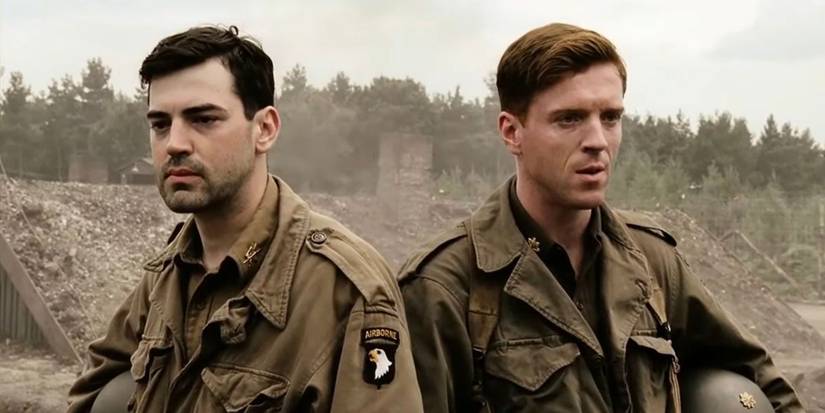
For a man already leaning on the bottle, these traumas were gasoline on a fire. The series brilliantly captures his frantic search for VAT 69 in a decimated German town, a moment that highlighted how much of his humanity was being eroded by the war. Yet, despite the chaos in his personal life, Nixon stayed. When he won a lottery for a 30-day furlough during the brutal siege of Bastogne, he didn’t take it. He gave it to another soldier and stayed in the freezing foxholes with his men.
The Battle After the War
The “happy ending” for Nixon in the series shows him offering Winters a job at the family business. But the years that followed were a struggle. Winters accepted the job, but he soon found himself managing not just the business, but Nixon’s ongoing battle with the bottle.
“To visit with Nixon was to sit there and watch him get drunk,” Winters recalled of the post-war years. It took two failed marriages and years of darkness before Nixon found his salvation. In 1956, he married his third wife, Grace Monson. She was the one who finally helped him find the strength to get sober.
In his later years, the “lush” of Easy Company became a man of peace. He spent his time traveling the world, studying history, and remaining the loyal friend Dick Winters always knew him to be. When Nixon passed away in 1995, it was Winters who delivered the eulogy, honoring the man who had faced the horrors of the 20th century and, in the end, conquered his own demons.
Final Salute
Lewis Nixon III could have spent the war in a comfortable office in New Jersey, protected by his family’s essential industry status. Instead, he chose to jump out of planes. He was a man of immense flaws and even greater courage—a decorated soldier who earned three combat jump stars and a Bronze Star.
Today, as we watch Ron Livingston sip from that iconic bottle, we shouldn’t just see a “drunk.” We should see a human being who held onto his brilliance and his loyalty even when his world was falling apart. As Dick Winters simply put it: “He was absolutely the most reliable man I’ve ever known.”