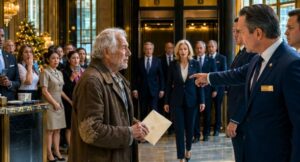
David Cole stepped directly into the old man’s path and raised one polished hand.
“You need to leave before security removes you.”
The elevator doors opened behind him, releasing three executives in dark suits.
None of them moved past the confrontation.
Thomas Grant stood beneath the crystal chandelier with rain shining across his torn coat.
His shoes were gray with road salt, and one lace had been tied with thin black cord.
He did not look embarrassed.
He looked at David as though the interruption belonged to someone else.
“I’m here to meet the board,” Thomas said.
David blinked once, then laughed loudly enough to turn every nearby head.
A pianist stopped midway through a quiet jazz standard.
At the front desk, two receptionists froze over their keyboards.
David looked around, enjoying the attention.
“The board does not meet with people who wander in from the street.”
Thomas shifted his gaze toward the private elevators at the far end of the lobby.
A brass panel beside them displayed the words EXECUTIVE ACCESS ONLY.
“The meeting is on the forty-second floor,” Thomas said.
David’s smile tightened.
“You have been watching the wrong movies.”
Thomas remained still.
“The directors began at nine.”
David checked his silver watch.
It was nine twelve.
That small detail unsettled him, but only for a moment.
He stepped closer and lowered his voice.
“Listen carefully, sir.”
The word sir carried no respect.
“This is the Imperial Crown, not a shelter, warming center, or public waiting room.”
Several guests looked away.
Others watched with the open curiosity of people expecting entertainment.
Thomas glanced toward a family standing near the concierge desk.
A little girl held a red balloon against her winter coat.
Her father gently turned her toward the revolving doors.
Thomas returned his attention to David.
“I know where I am.”
“Then you know you do not belong here.”
Thomas’s expression did not change.
“I have more reason to be here than you understand.”
David gave a short, breathless laugh.
“Everyone says that after being asked for a reservation.”
“I did not come for a room.”
“You came for the board?”
“Yes.”
David spread his hands toward the marble lobby.
“Should I also prepare the presidential suite?”
Thomas looked past him again.
“No.”
The answer was quiet, which made the mockery fall flat.
David’s jaw hardened.
He had spent fourteen years building his career around controlled appearances.
Every suit was tailored.
Every shoe was polished.
Every employee knew where to stand when wealthy guests entered.
The Imperial Crown had survived two recessions, a labor dispute, and three ownership restructurings.
David believed order had protected it.
He also believed he represented that order.
A man like Thomas threatened the image David guarded.
Not through danger, but through contrast.
Thomas looked like every hardship the lobby was designed to hide.
The chandelier scattered warm light across the gold trim.
A twenty-foot Christmas tree rose beside the staircase.
Luxury retailers displayed watches and jewelry behind glass.
Thomas stood among them like an unanswered question.
David saw only disorder.
A young bellman named Caleb Ward approached with a folded towel.
Rainwater had gathered beneath Thomas’s shoes.
“Sir, you can use this,” Caleb said.
David turned sharply.
“Return to the entrance.”
Caleb hesitated.
“The floor is getting wet.”
“Then have housekeeping clean it.”
Thomas accepted the towel before Caleb could retreat.
“Thank you.”
Caleb nodded and moved away.
David watched him go with visible irritation.
“You are delaying my staff.”
“I did not ask him to come.”
“You walked into my lobby looking like that.”
Thomas glanced down at his coat.
The left sleeve had been patched twice.
A split seam near the pocket revealed faded lining.
“It still keeps out most of the cold.”
David stared at him.
“That was not a joke.”
“Neither was my answer.”
A receptionist covered a nervous smile with her hand.
David noticed.
His face flushed.
“Name.”
“Thomas Grant.”
The receptionist nearest the center desk looked up quickly.
Her name tag read EMILY PARKER.
She repeated the name silently.
David saw her reaction.
“Do not search anything,” he said.
Emily’s fingers stopped above the keyboard.
Thomas studied her face.
“Were you going to help me?”
Emily swallowed.
“I was going to check the executive calendar.”
David stepped between them.
“She was going to waste company time.”
Thomas looked at the reception desk.
Behind it hung a framed black-and-white photograph of the hotel’s original foundation ceremony.
Workers stood beside a dirt lot beneath a cloudy Manhattan sky.
A younger Thomas appeared near the edge of the picture.
He wore a hard hat and carried rolled blueprints.
Age, distance, and grain made him easy to overlook.
David had passed that photograph every morning for six years.
He had never studied the faces.
Thomas had studied each one.
“You should update that frame,” Thomas said.
David followed his gaze.
“It is part of the hotel’s history.”
“The glass is cracked in the lower corner.”
David looked closer.
A thin fracture ran beneath the photograph.
His annoyance deepened.
“You are not here to inspect our walls.”
“No.”
“Then stop behaving like you own them.”
Thomas held David’s gaze.
A hush moved through the closest employees.
It lasted only two seconds.
Still, David felt it.
He stepped nearer until the toes of his shoes almost touched Thomas’s worn pair.
“You came in without a reservation, appointment, or suitable clothing.”
“I have an appointment.”
“With whom?”
“The full board.”
David shook his head.
“That answer has not improved.”
“Call upstairs.”
“I will not interrupt nine directors because a stranger demands attention.”
“Call Margaret Ellis.”
David’s expression shifted.
Margaret Ellis was the hotel’s chairwoman.
Her name was not printed in guest materials.
It did not appear on lobby directories.
David recovered quickly.
“You found her name online.”
Thomas said nothing.
David mistook silence for defeat.
“Do you know how many people claim they know our leadership?”
“I did not claim to know her.”
“You asked me to call her.”
“I told you whom to call.”
David pointed toward the entrance.
“And I am telling you where to go.”
A cold gust rolled through the revolving doors.
Thomas’s coat moved around his thin frame.
For the first time, he looked tired.
It was not the tiredness of surrender.
It was the fatigue of someone forced to wait for a predictable mistake.
Emily watched him closely.
She saw his hands.
They were scarred across the knuckles and darkened by old work.
She also saw a plain gold ring.
It had been repaired with a narrow seam along one side.
Thomas noticed her looking.
“My wife hated flashy jewelry,” he said.
Emily offered a small smile.
David cut between them again.
“This conversation is finished.”
Thomas folded the towel and placed it on the edge of a luggage cart.
“I agree.”
“Good.”
“Call upstairs.”
David’s mouth became a hard line.
“You do not give orders here.”
Thomas turned his eyes toward the private elevators.
“We will discover that soon enough.”
David took one slow breath through his nose.
He had learned that anger looked weak in luxury hotels.
A manager was supposed to remain polished while making other people disappear.
He adjusted his cuff and signaled toward the security desk.
Two guards noticed immediately.
The older guard, Marcus Bell, started across the lobby.
His younger partner, Jason Reed, followed half a step behind.
Thomas watched them approach without moving.
Marcus had worked at the Imperial Crown for eighteen years.
He knew most repeat guests, every service entrance, and every emergency route.
He also knew when David wanted force disguised as procedure.
“Is there a problem?” Marcus asked.
David kept his eyes on Thomas.
“This gentleman refuses to leave.”
Thomas turned slightly toward Marcus.
“I asked him to contact the board.”
Marcus glanced at David.
“That is all?”
“That is more than enough,” David replied.
Thomas reached inside his coat.
Jason’s hand moved toward the radio on his shoulder.
David stepped backward.
Marcus raised one calming palm.
“Slowly, please.”
Thomas removed a folded paper envelope.
Its edges were softened from years of handling.
He held it where everyone could see.
“No weapon,” Thomas said.
David gave a dismissive laugh.
“An old envelope does not make you a guest.”
Thomas opened it and removed a cream card.
A small embossed crown appeared in one corner.
Emily leaned forward from the desk.
She recognized the hotel’s original corporate seal.
The modern seal used a taller crown and narrower letters.
Thomas’s card had not been issued in decades.
David barely looked.
“Expired membership materials mean nothing.”
“It is not a membership card.”
“Then what is it?”
“An invitation.”
David extended his hand.
Thomas did not give it to him.
“Call Margaret first.”
David’s eyes hardened.
“You are bargaining from a very weak position.”
Thomas returned the card to the envelope.
“I am trying to save you from a stronger one.”
A quiet murmur moved through the guests.
David heard it and felt control slipping.
The people watching were no longer amused by Thomas.
They were becoming curious about David.
That change mattered more than the old man’s claim.
David turned toward Emily.
“Contact police and report a trespasser.”
Emily looked at Thomas, then at the card.
“Mr. Cole, perhaps I should verify his appointment first.”
David stared at her.
“Did I ask for your opinion?”
“No, sir.”
“Then follow my instruction.”
Emily reached for the phone, but her hand remained on the receiver.
Thomas looked toward the clock above the front desk.
Nine sixteen.
“Margaret will send someone soon,” he said.
David scoffed.
“She does not know you are here.”
“She knows I was expected downstairs at nine.”
“You said the meeting began at nine.”
“It did.”
“Then why were you downstairs?”
Thomas studied him.
“I wanted to enter through the front door.”
David spread his arms.
“You accomplished that.”
“Yes.”
The answer carried disappointment rather than triumph.
Marcus noticed.
He had seen that tone from veterans, judges, and grieving parents.
It belonged to people measuring conduct, not defending pride.
Marcus moved closer to David.
“Let me call executive security.”
David lowered his voice.
“You are not paid to debate me.”
“I am trying to prevent a scene.”
“The scene is already here.”
David looked toward Thomas.
“Escort him outside.”
Marcus did not move.
Thomas’s eyes shifted toward him.
“You have been here a long time.”
Marcus frowned.
“Eighteen years.”
“Longer than most.”
“Yes.”
“Then you remember the east ballroom fire.”
Marcus’s posture changed.
The fire had happened eleven years earlier.
A defective kitchen line had ignited during a charity banquet.
Smoke had filled two service corridors.
Marcus had carried an injured chef down six flights.
Only employees and senior executives knew every detail.
“I remember,” Marcus said.
“You found the blocked exit near the linen room.”
Marcus stared.
“How do you know that?”
David interrupted.
“He read an article.”
“That detail was never reported,” Marcus said.
Thomas nodded toward the guard’s left shoulder.
“You injured that arm breaking the jammed bar.”
Marcus instinctively touched the place.
David looked between them.
“This proves nothing.”
Thomas spoke to Marcus.
“You received a commendation in a private ceremony.”
Marcus’s voice dropped.
“Who are you?”
“I already gave my name.”
Marcus repeated it under his breath.
Thomas Grant.
Something distant moved across his face.
He remembered an elderly founder mentioned during orientation years earlier.
The founder rarely appeared at corporate events.
Most employees assumed he had retired somewhere warm.
David saw Marcus thinking and stepped between them.
“Do not encourage him.”
Marcus looked uneasy.
“I think we should verify this.”
“I think you should remember the chain of command.”
Thomas glanced toward the ceiling.
Above them, forty-two floors of rooms, offices, kitchens, and meeting spaces filled the tower.
Somewhere at the top, directors waited around a walnut table.
David imagined them discussing occupancy forecasts and renovation budgets.
He did not imagine them waiting for Thomas.
That possibility now existed, but pride kept him from examining it.
Emily lifted the receiver.
“I will call executive reception.”
David reached over and pressed the cradle down.
“No.”
Emily’s face reddened.
“There is no harm in checking.”
“There is harm in teaching every person off the street that demands receive attention.”
Thomas looked at her.
“You tried.”
Emily met his eyes.
“I am sorry.”
“You have nothing to apologize for.”
David laughed sharply.
“Now he is reviewing staff performance.”
Thomas turned back toward him.
“You seem worried about that.”
The guests nearest the desk went silent.
David’s polished expression finally cracked.
“You have been tolerated long enough.”
Thomas’s voice remained even.
“Tolerance is a poor substitute for judgment.”
David stepped closer.
“You are standing on imported marble beneath a chandelier worth more than most homes.”
Thomas glanced down.
David folded his arms.
“You read the brochure.”
Marcus watched him closely.
David’s face tightened.
“Enough.”
Thomas looked at the ceiling.
“I was here before the roof.”
David finally smiled again.
It was a harder smile.
“Construction workers helped build this hotel.”
Thomas nodded.
“Many good people did.”
“Perhaps you were one of them.”
“Perhaps.”
“That does not give you access to the board.”
“No.”
“Then your story changes nothing.”
Thomas looked at the old foundation photograph.
“It should change how you speak to people.”
David followed his gaze, then looked away.
“My job is protecting guests.”
“From an old man asking for a telephone call?”
“From disruption.”
Thomas looked around the silent lobby.
“You created the disruption.”
A woman near the concierge desk whispered agreement.
David heard her.
His embarrassment turned toward anger.
He pointed at Marcus.
“Remove him now.”
Marcus lowered his voice.
“Mr. Cole, I strongly recommend verification.”
David’s eyes narrowed.
“Are you refusing a direct order?”
Marcus looked at Thomas.
Thomas gave no plea and no command.
That made the choice harder.
Marcus had a mortgage, two grandchildren, and a wife recovering from surgery.
David controlled his schedule and performance reports.
Marcus slowly exhaled.
“No, sir.”
He stepped toward Thomas.
“I am sorry, Mr. Grant.”
Thomas nodded.
“You are being placed in a difficult position.”
Marcus reached carefully for his arm.
Thomas did not resist.
Jason moved to the other side.
David relaxed as though order had finally returned.
Then Thomas looked toward the private elevators.
A small light above the center door changed from red to white.
Someone was coming down.
David saw the light and smiled.
“Good,” he said. “Executive security can handle this.”
The elevator doors opened.
A tall woman in a navy suit stepped into the lobby with a tablet beneath one arm.
Her name was Nora Hayes, executive coordinator for the board.
She had worked upstairs for seven years.
She scanned the lobby, searching for someone.
Thomas saw her immediately.
Nora looked past him toward the entrance.
David released a quiet breath.
She had not recognized Thomas.
He raised one hand.
“Ms. Hayes, I need assistance with a trespasser.”
Nora turned toward him.
“The board is waiting for a guest.”
David gestured at Thomas.
“This man claims that guest is him.”
Nora studied the old man’s face.
Thomas looked older than the photograph in her files.
His hair was thinner, and his shoulders had narrowed.
The torn coat concealed the careful posture she remembered.
She glanced at the envelope in his hand.
“May I see that?” she asked.
Thomas extended it.
David laughed.
“You cannot seriously entertain this.”
Nora removed the card and read the handwritten line inside.
Her expression changed.
The card carried Margaret Ellis’s signature.
Beneath it appeared a simple note.
Come through the lobby, just as you requested.
Nora looked at Thomas again.
Before she could speak, David took the card from her fingers.
He examined it quickly.
“This could be forged.”
Nora reached for it.
“Give that back.”
David held it away.
“Anyone can imitate a signature.”
“Mr. Cole, return the card.”
His confidence weakened.
“You know him?”
Nora hesitated.
She knew the name and face from confidential board documents.
She had never met Thomas in person.
Company policy restricted her from confirming major ownership details publicly.
Her uncertainty lasted only seconds.
David seized those seconds as proof.
“You do not know him.”
“I know the board expects Mr. Grant.”
“He could have learned that name.”
Nora’s eyes narrowed.
“How?”
“The internet, old news, public records.”
Thomas looked at David.
“You should stop now.”
David turned toward him.
“You do not decide when I stop.”
Nora took the card back.
“He has provided a signed invitation.”
“He entered without identification.”
Thomas reached inside his coat again.
David raised his voice.
“Do not move.”
Thomas paused.
“You asked for identification.”
“I asked security to remove you.”
Nora stepped between them.
“Let him show it.”
Thomas removed a worn leather wallet.
Inside was a New York driver’s license.
Nora read the name aloud.
“Thomas Edwin Grant.”
David looked at the birth year.
He then compared the photograph with Thomas’s face.
The license was valid.
His mind searched for another objection.
“A name can be shared.”
Thomas almost smiled.
“Not usually with the same face.”
A few guests laughed quietly.
David’s neck reddened.
He turned to Nora.
“Call the chairwoman and verify everything.”
Thomas’s gaze sharpened.
“That was my first request.”
David ignored him.
Nora touched her earpiece.
“Executive reception, this is Nora.”
She listened.
Her brow tightened.
“No response?”
Another pause followed.
“Check the boardroom.”
Nora looked toward the elevator.
“The meeting room line is occupied.”
David folded his arms.
“Then we wait until they finish.”
“They are waiting for him,” Nora said.
“You still have not confirmed that.”
Nora lowered her voice.
“The name matches.”
“The hotel cannot admit people based on a matching name.”
“The invitation matches.”
“Signatures can be forged.”
“The identification matches.”
“Identification can be altered.”
Thomas watched the excuses multiply.
Each one protected David from facing the simplest fact.
He had judged a person before checking anything.
Now every piece of evidence threatened more than his decision.
It threatened his image of himself.
David pointed at the doors.
“The sidewalk is public.”
Nora noticed mud along Thomas’s right shoulder.
It matched the shape of a handprint.
Thomas offered no explanation.
He seemed unconcerned with persuasion.
David saw only another reason for suspicion.
“Perhaps the board enjoys dramatic stories.”
Thomas looked at him.
“The board prefers accurate reports.”
“That sounds rehearsed.”
“It sounds familiar because accuracy matters.”
David stepped closer.
“Do you know what matters here?”
Thomas waited.
“Standards.”
David gestured across the lobby.
“Guests pay thousands each night because we control every detail.”
“Their sheets, meals, cars, privacy, and safety are managed without compromise.”
Thomas nodded.
“That requires discipline.”
David mistook agreement for retreat.
“Exactly.”
“It also requires judgment.”
“I have excellent judgment.”
Thomas looked at Marcus’s hand around his arm.
Nobody missed the meaning.
David’s voice hardened.
“Take him outside.”
Nora moved in front of Marcus.
“No one is taking him anywhere until I speak with Margaret.”
David lowered his voice.
“You report to the board, not to strangers.”
“I am protecting the board’s appointment.”
“You are embarrassing the hotel.”
Nora looked around the lobby.
“No, David.”
Her use of his first name landed like a warning.
“You are doing that yourself.”
The pianist looked down at the keys.
Rosa’s eyes widened.
Caleb stood perfectly still.
David glanced at the guests watching him.
He saw phones in two hands.
A young man near the fireplace was recording.
David’s stomach tightened.
“Sir,” he called toward the young man, “recording guests violates privacy policy.”
The young man lowered his phone but did not stop the video.
Thomas noticed the growing spectacle.
“This can still end quietly,” he said.
David turned back.
“You should have considered quiet before entering.”
Thomas’s face showed the first hint of sadness.
“I entered through a door my wife chose.”
The sentence silenced Nora.
David frowned.
“What does that mean?”
Thomas looked toward the revolving entrance.
“The original architect wanted the main doors facing the avenue.”
“My wife argued that morning light should reach the lobby.”
“She said people should enter warmth, not shadow.”
Emily looked toward the broad windows.
Winter light stretched across the marble from the eastern angle.
Thomas continued.
“She spent three weeks moving cardboard walls across an empty lot.”
David stared at him.
“You expect us to believe your wife designed the entrance?”
“No.”
“She convinced the architect to redesign it.”
Nora knew the founder’s history.
Evelyn Grant had served on the early development committee.
Her name appeared in old charitable records.
Nora took one step closer.
“Your wife was Evelyn.”
Thomas’s eyes softened.
“Yes.”
David looked between them again.
“Another detail available online.”
Nora did not respond.
Thomas glanced at the foundation photograph.
“Evelyn stood behind the camera that morning.”
“She disliked photographs of herself.”
His thumb moved across the repaired wedding ring.
The lobby became quiet enough to hear rain tapping the windows.
For one brief moment, Thomas looked less like a mystery.
He looked like a widower standing inside a memory.
Emily’s eyes lowered.
Marcus released Thomas’s arm.
David saw it.
“I did not tell you to let go.”
Marcus faced him.
“I will not use force against him.”
“That is insubordination.”
“Then document it.”
David stared at the guard.
Marcus’s fear remained visible, but he held his ground.
Jason stepped back from Thomas as well.
David’s authority narrowed by another degree.
He turned toward Nora.
“Take responsibility for him.”
“I already have.”
Nora held the invitation carefully.
Thomas looked at her.
“Is Margaret still upstairs?”
“Yes.”
“Then let us go.”
Nora moved toward the private elevators.
David blocked her path.
“No.”
Nora stopped.
“You cannot prevent an invited board guest from entering.”
“I can prevent an unverified person from reaching secure floors.”
“You demanded verification, then rejected every result.”
“I demand confirmation from the chairwoman.”
Thomas checked the clock.
Nine twenty-six.
“Margaret will come down,” he said.
David gave a brittle smile.
“She chairs a corporation.”
“She does not run downstairs for people like you.”
The elevator light changed again.
This time, all three private elevators began descending together.
The three elevator doors opened at once.
Margaret Ellis emerged from the center car.
Eight directors followed her into the lobby.
Two carried folders.
One still held a conference speaker in his hand.
Another had left reading glasses hanging from his collar.
They had clearly abandoned the meeting without preparation.
Margaret scanned the room.
Her eyes found Thomas beside the security guards.
Relief crossed her face first.
Then she saw the handprint on his coat, the gathered guests, and David blocking the elevators.
Her expression changed completely.
“Mr. Grant.”
The name carried across the marble.
David turned.
Margaret walked past him without slowing.
She stopped before Thomas and bowed her head.
“Sir, the entire board has been waiting for you.”
Nobody moved.
The pianist’s hands dropped into his lap.
Emily stared at Thomas.
Caleb’s mouth opened slightly.
Marcus closed his eyes for one brief second.
David looked toward the directors, searching for uncertainty.
He found none.
Every board member stood respectfully behind Margaret.
Thomas gave a small nod.
“I arrived a little early.”
Margaret looked at the lobby clock.
“You arrived twenty-eight minutes ago.”
Thomas glanced at David.
“I encountered a delay.”
Margaret followed his gaze.
“What happened?”
David stepped forward.
“Ms. Ellis, there has been a misunderstanding.”
Thomas did not speak.
Margaret looked at Marcus.
“Mr. Bell?”
Marcus straightened.
“Mr. Grant requested contact with the board.”
“And?”
“Mr. Cole refused to verify the appointment.”
David interrupted.
“He had no reservation and appeared unable to establish his identity.”
Nora held up the invitation.
“He presented this.”
Margaret took the card.
She recognized her own handwriting.
“You had my signed invitation.”
David’s voice became careful.
“I could not confirm its authenticity.”
“He also had identification,” Nora said.
David looked at her.
“The license did not prove corporate authority.”
Margaret’s eyes sharpened.
“He did not need to prove corporate authority to enter the lobby.”
David opened his mouth.
She continued before he could answer.
“He needed only to be treated like a human being.”
The words landed without raised volume.
Thomas watched David’s face.
The manager’s confidence had vanished.
In its place appeared frantic calculation.
He was no longer deciding how to remove Thomas.
He was deciding which explanation might save him.
“Mr. Grant’s clothing caused a legitimate security concern,” David said.
Margaret looked at Thomas’s coat.
“The concern was fabric?”
“The concern was inconsistency with our guest profile.”
Thomas finally spoke.
“Say what you mean.”
David looked at him.
“I was protecting the property.”
Thomas’s eyes remained calm.
“From me?”
David swallowed.
“From an unknown individual refusing to follow instructions.”
“I asked for one telephone call.”
“You demanded access to a restricted meeting.”
“I requested the meeting that invited me.”
David looked toward the board.
Several directors avoided his eyes.
Others watched without sympathy.
He turned back to Thomas.
“I regret the confusion.”
Thomas studied him.
“You regret the result.”
David’s face tightened.
“That is unfair.”
“No.”
Thomas’s voice remained quiet.
“Unfair was deciding my worth before asking my name.”
David glanced toward the guests.
“This conversation should happen privately.”
“You made the humiliation public.”
Thomas let the sentence settle.
“So the correction will be public.”
Margaret stepped beside him.
“Mr. Grant owns the ground beneath this hotel.”
A murmur swept through the lobby.
David stared at her.
Margaret continued.
“His family company holds the controlling land agreement.”
“He also remains the largest individual shareholder in Imperial Crown Hospitality.”
David’s skin lost color.
Thomas looked toward the old photograph behind reception.
“The hotel stands because hundreds of people built it.”
“My name appears on documents, but their hands raised the walls.”
He turned back to David.
“That is why clothing never impressed me.”
David’s voice was barely audible.
“I did not know.”
Thomas nodded once.
“That is the point.”
He stepped closer.
“You should not require a balance sheet before offering dignity.”
David looked toward Margaret.
“Please consider my record.”
Margaret’s face remained still.
“Your record brought us here.”
“I have managed this property through difficult years.”
“You have,” Thomas said.
“You maintained revenue, reduced complaints, and protected expensive appearances.”
A faint hope returned to David’s eyes.
Thomas continued.
“But authority reveals character when nobody important appears to be watching.”
The hope disappeared.
“You believed I was powerless.”
David said nothing.
“You believed that gave you permission to shame me.”
“I followed security standards.”
Marcus spoke from behind Thomas.
“No standard required those insults.”
Emily added quietly.
“He told Mr. Grant that he was unworthy to stand on the carpet.”
Margaret looked at David.
“Did you say that?”
David’s lips parted.
The lobby waited.
“Yes,” he whispered.
Thomas looked down at his worn shoes.
“My clothes are old.”
He raised his eyes again.
“But my authority to dismiss you remains fully intact.”
David stood motionless.
Thomas turned toward Margaret.
“Terminate his employment immediately.”
Margaret nodded.
“Effective now.”
David took one step backward.
“Mr. Grant, please.”
Thomas’s expression carried no pleasure.
“You had many chances to stop.”
David looked toward Nora.
She held his gaze but offered nothing.
He looked toward Marcus.
The guard’s face remained respectful and firm.
Finally, David looked at Emily.
She lowered her eyes.
Margaret addressed him.
“Turn over your keys, badge, and company phone.”
David’s fingers shook as he removed the badge from his jacket.
The small metal crown caught the chandelier light.
He placed it on the front desk.
His keys followed.
The company phone made the loudest sound when it touched the marble counter.
Margaret signaled Jason.
“Escort Mr. Cole to his office while he collects personal items.”
Jason nodded.
David looked at Thomas one last time.
“I am sorry.”
Thomas studied him for several seconds.
“I hope you become sorry for what you did, not only for what it cost.”
David’s eyes dropped.
Jason guided him toward the staff corridor.
Nobody applauded.
Thomas had not wanted applause.
The absence of celebration gave the moment greater weight.
A career had ended.
The consequence was necessary, but it was not entertainment.
When the corridor door closed, the lobby slowly released its breath.
Margaret turned toward Thomas.
“I am deeply sorry.”
Thomas handed her the invitation.
“You did not speak to me that way.”
“I appointed the person who did.”
“You also appointed the people who tried to stop him.”
Margaret looked toward Emily, Marcus, Nora, and Caleb.
Thomas faced them.
“Mr. Bell, you risked your position when you released my arm.”
Marcus nodded.
“I should have refused sooner.”
“Perhaps.”
Thomas’s voice softened.
“But courage often arrives after fear.”
He turned to Emily.
“You tried to verify my appointment.”
Emily looked embarrassed.
“I should have called anyway.”
“You were threatened by your supervisor.”
“That does not make silence right.”
“No,” Thomas said.
“But recognizing that matters.”
He looked toward Caleb.
“And you brought me a towel before anyone knew my name.”
Caleb shifted nervously.
“The floor was wet.”
Thomas smiled for the first time.
“That was not your only reason.”
Caleb smiled back.
Margaret asked the guests to accept the hotel’s apologies.
She also requested that recordings protect the privacy of uninvolved employees.
The young man near the fireplace lowered his phone completely.
Thomas walked toward the old photograph.
He touched the cracked corner of its frame.
“Replace the glass,” he told Margaret.
“We will.”
“Keep the picture.”
“Of course.”
Thomas studied the younger workers in the image.
Some had died.
Others had retired across the country.
A few still sent holiday cards.
His own younger face seemed almost unfamiliar.
Margaret joined him.
“The board can reconvene upstairs.”
Thomas looked toward the entrance.
“First, I want a new lobby policy.”
Margaret waited.
“No person is removed solely because of clothing, age, or appearance.”
“Security concerns must be based on conduct.”
Margaret nodded.
“I will have counsel draft it today.”
“Training must include every manager.”
“It will.”
“And create an anonymous reporting channel for staff.”
Margaret looked toward Emily.
“That should have existed already.”
“Yes,” Thomas said.
“It should have.”
Thomas turned toward Marcus.
“Your commendation from the ballroom fire should be displayed.”
Marcus looked surprised.
“I never asked for that.”
“That is why it should be.”
Margaret made a note.
Thomas then looked at Emily.
“Finish the call you were prevented from making.”
Emily blinked.
“Which call?”
“The executive calendar.”
A nervous laugh moved through the staff.
Emily picked up the receiver.
“Executive reception, this is Emily Parker.”
She paused, then looked at Thomas.
“Yes, Mr. Grant has arrived.”
Thomas heard the answer through the receiver.
The board is waiting.
Emily smiled.
“He already knows.”
The tension finally broke.
Several people laughed softly.
Thomas walked toward the elevators with Margaret and the directors.
Before entering, he stopped beside the little girl with the red balloon.
She had watched everything from her father’s side.
“Do you live here?” she asked.
Her father looked horrified.
Thomas crouched slightly.
“No.”
“Do you own it?”
“Part of it.”
She considered that answer.
“Your coat is ripped.”
Thomas looked at the torn sleeve.
“So it is.”
“My mom can sew.”
Her father apologized quickly.
Thomas shook his head.
“That is a valuable skill.”
The girl held out the balloon string.
“You can have this.”
Thomas accepted it for one second, then returned it.
“Keep it warm for me.”
She nodded seriously.
The elevator doors opened.
Margaret entered, but Thomas remained outside.
He looked toward the revolving doors again.
Morning light reached across the marble exactly as Evelyn had imagined decades earlier.
It touched his worn shoes, the cracked frame, and the badge David had surrendered.
Thomas looked at Caleb.
“Is there still a diner on Forty-Ninth Street?”
“Ruthie’s?”
“That is the one.”
“It opens all day.”
Thomas nodded.
“Tell the board I will be upstairs in twenty minutes.”
Margaret stared at him.
“They have already waited.”
“They can wait while I eat breakfast.”
A faint smile reached her face.
“Would you like a car?”
“No.”
“An umbrella?”
Thomas looked at the rain.
“Yes, please.”
Caleb brought him a plain black umbrella from the concierge stand.
Thomas accepted it with the same gratitude he had shown for the towel.
He walked toward the entrance.
Marcus opened the door.
“Mr. Grant,” Marcus said, “I am sorry I touched your arm.”
Thomas paused beside him.
“Next time, ask one more question before following an easy order.”
Marcus nodded.
“I will.”
Thomas stepped outside.
Rain tapped against the umbrella as taxis rolled through the avenue.
Behind him, the Imperial Crown resumed its morning rhythm.
Phones rang.
Luggage wheels crossed the marble.
The pianist began the unfinished song again.
Thomas walked toward the diner without looking back.
In the hotel window, morning light caught his torn sleeve and made the old fabric briefly shine.