My Husband Called Me a Placeholder—So I Put Everything in Writing
His mistress mailed me a box of my own wedding photos with her face taped over mine.
My husband called it “processing her emotions.”
I called it evidence.
The box arrived in the marble foyer of our penthouse on a rainy Tuesday morning, wrapped in cream tissue paper and tied with a black satin ribbon. It looked expensive. Deliberate. Almost ceremonial.
The return address was written in red ink.
Sloane Hart. Apartment 12B. The Aurora Residences. Tribeca.
I already knew the name.
I knew her perfume from Carter’s shirts.
I knew her laugh from the foundation gala four nights earlier.
And I knew the exact expression on my husband’s face when he looked at her—a softness he had stopped wasting on me years ago.
I carried the box to the dining table without opening it.
Then I put on gloves.
Inside were twelve photographs from our wedding.
In every one, my face had been covered by hers.
Glossy magazine cutouts. Crooked tape. Red lipstick.
In one picture, Carter was kissing my forehead while Sloane’s pasted-on smile stared back at me beneath a lipstick crown.
On the back of the final photograph, she had written:
Some women are born to be remembered.
Some are only placeholders.
I stared at the words for a long time.
Then I noticed something that changed the entire morning.
The photograph she had written on was not from our public wedding album.
It had never appeared online.
It had never been published.
There were only two physical copies.
One was in a bank box.
The other had been kept for eleven years inside a leather album in Carter’s private study.
I reached for my phone.
Not to call my husband.
Not yet.
First, I photographed everything exactly where it lay.
Because suddenly, the question was no longer why Sloane Hart hated me.
It was how she had gotten inside a part of my marriage that only Carter could have opened for her.
Chapter 1: The Woman in White
Four nights earlier, Carter had replaced me in front of three hundred people without ever saying the words.
That was the elegant thing about men like my husband.
They rarely pushed you from the room themselves.
They simply moved the light somewhere else and waited for everyone to understand.
The Winter Arts Foundation gala was held in a converted bank building downtown, all marble columns, candlelight, white orchids, and people who knew how to smile without showing what they were thinking.
For eleven years, I had attended at Carter’s side.
Not because I loved galas.
I hated them.
I hated the tiny portions of food balanced on oversized plates. I hated introductions that sounded like résumés. I hated being asked what I was “working on” by people who already knew the answer and were only measuring whether it impressed them.
But I loved what the foundation had once meant to Carter.
His mother had taken him to free music classes there when he was a child. Years later, when he had enough money to become useful, he joined the board.
When we married, I helped.
Quietly.
I organized donor dinners. Reviewed grant applications when they needed another set of eyes. Remembered whose daughter had started violin lessons and whose husband was recovering from surgery. I knew which donors hated being seated near the speakers and which young artists needed introductions but were too proud to ask.
Carter stood on stages.
I made sure the stages held.
For years, that arrangement felt like partnership.
Then Sloane arrived.
She called herself a cultural strategist.
No one seemed entirely sure what that meant.
She was thirty-two, polished, socially fearless, and gifted at making powerful people feel as if whatever they had just said was the most interesting thing she had heard all week.
The first time Carter mentioned her, he called her brilliant.
The second time, fearless.
By the fifth time, he stopped pretending I had not noticed.
At the gala, she wore white.
Not bridal white.
Something sharper.
A floor-length ivory dress with a high neckline and bare shoulders, severe enough to look intentional.
Carter saw her before he saw me.
That detail stayed with me.
We had stepped out of the car together. His hand had been at the small of my back. Cameras were waiting near the entrance.
Then Sloane came down the stairs.
Carter’s hand dropped.
His face changed.
Only for a second.
But marriages are built on seconds.
You learn them.
The half-second before someone lies.
The second too long before they answer.
The glance they do not realize you caught.
“Carter,” she called.
Not Mr. Vale.
Not Carter and me.
Just Carter.
He smiled.
Then he seemed to remember I existed.
“You remember Sloane.”
“I do.”
Sloane’s eyes moved over my midnight-blue gown.
“You look very classic.”
It was not a compliment.
I smiled anyway.
“And you look very visible.”
Her expression shifted.
Carter cleared his throat.
“We should go in.”
That was the first moment of the evening when he realized I might not behave the way he expected.
The second came during dinner.
For three years, the foundation had opened its annual presentation with photographs of artists, donors, and volunteers.
There had always been one image of Carter and me.
Nothing dramatic. Nothing romantic.
Just the two of us standing beside a group of scholarship recipients at the previous year’s event.
That year, when the screen lit up, my photograph was gone.
In its place was Sloane.
Sloane beside Carter in the gallery.
Sloane speaking to students.
Sloane laughing with donors.
Sloane standing beneath the foundation logo.
The final image was a close-up of her looking over her shoulder toward Carter.
People at my table became fascinated with their wine.
Across the room, Sloane looked directly at me.
And smiled.
Then Carter took the stage.
He adjusted the microphone.
“Institutions survive,” he said, “when they understand when to honor the past and when to make room for a new chapter.”
There are sentences that mean one thing to a room and another thing to a wife.
That was one of them.
He spoke about reinvention.
Fresh energy.
Courage.
Letting go of what no longer served the future.
Every few seconds, his eyes found Sloane.
Never me.
My friend Marissa, seated two chairs away, leaned toward me.
“Do you want to leave?”
“No.”
Her hand closed around her water glass.
“I can arrange a car.”
“I came in a car.”
“You know what I mean.”
I did.
She was offering me escape before the pity hardened around the table.
But leaving would have given Carter something he did not deserve.
Control over my exit.
So I stayed.
When he finished speaking, everyone applauded.
I applauded too.
Slowly.
Sloane watched me.
She wanted humiliation.
Not merely mine.
She wanted the moment when I understood that she had won.
I refused to give it to her.
Instead, I lifted my glass, took one measured sip, and looked around the ballroom.
Board members.
Donors.
Friends.
People who had vacationed in our home.
People who had toasted our anniversaries.
Some looked embarrassed.
Some sympathetic.
Several looked entertained.
And a few looked relieved—as if Carter had finally made public what they had already been allowing in private.
That was when something inside me became very still.
Not broken.
Still.
I began remembering faces.
Who avoided me.
Who came over afterward.
Who suddenly became too busy.
Who stood beside Sloane for photographs.
Who looked at Carter with disapproval.
And who looked at him with the approving smile men give one another when they believe a wife has become an old contract.
In the car home, Carter loosened his tie.
“You were quiet.”
“I was listening.”
“To what?”
“You.”
He stared out the window.
“Don’t make tonight into something it wasn’t.”
I turned toward him.
“What was it?”
“A fundraiser.”
“You called Sloane the foundation’s new muse.”
“She’s brought energy.”
“You removed every photograph of me.”
“That wasn’t personal.”
“Who approved the presentation?”
He glanced at me.
“You’re really doing this?”
“I asked a question.”
“I don’t know. Communications.”
“You signed off on it.”
Silence.
That was answer enough.
I looked out at the wet streets sliding past us.
“Are you sleeping with her?”
His jaw tightened.
“Not tonight.”
I almost laughed.
Not because it was funny.
Because even after eleven years, he still believed postponing an answer changed the truth.
“That wasn’t my question.”
“I am not having this conversation while you’re emotional.”
“I’m not emotional.”
“You’re clearly upset.”
“Those are different things.”
He leaned back.
“Sloane has become important to the foundation. You’re threatened by that.”
There it was.
The oldest trick in a certain kind of marriage.
Make a choice.
Hide the choice.
Then diagnose the person who notices.
I turned toward the window again.
“You should be careful, Carter.”
His voice hardened.
“Is that a threat?”
“No.”
I watched our reflection in the glass.
“It’s advice.”
He slept in the guest room that night.
I slept perfectly.
And four days later, a box arrived.
By eleven that Tuesday morning, I had photographed every photograph, every tape edge, every lipstick mark, the ribbon, the tissue paper, the shipping label, and the note.
Then I called Carter.
He answered on the sixth ring.
“What?”
No hello.
Not unusual anymore.
“Did you give Sloane our wedding photographs?”
A pause.
“What are you talking about?”
“She mailed me a box.”
Another pause.
Longer.
“What kind of box?”
I looked at the photographs.
He had asked the wrong question.
Not what did she send?
What kind of box.
As if he already knew there was one.
“Our wedding pictures. She pasted her face over mine.”
He exhaled.
“Oh, for God’s sake.”
Not shock.
Not disbelief.
Annoyance.
“Did you know she was sending them?”
“No.”
“Did you give them to her?”
“Don’t interrogate me.”
“Did you?”
“Sloane is upset.”
I looked down at the red lipstick crown.
“About what?”
“Everything.”
“That narrows it down.”
“She’s been under enormous emotional pressure.”
“From sleeping with my husband?”
Silence.
There are admissions spoken with words.
And then there are admissions built from the absence of them.
When Carter spoke again, his tone was lower.
“She’s processing her emotions.”
I almost admired the sentence.
It was so absurd that it briefly became elegant.
“Carter, she mailed damaged photographs to my home and wrote that I was a placeholder.”
“She was making a point.”
“She made it in writing.”
“Please don’t turn this into one of your projects.”
I stopped.
One of my projects.
That was what he called anything I handled carefully enough that he could no longer control the outcome.
“I won’t,” I said.
His voice softened, relieved.
“Good.”
“I’m turning it into a record.”
“What does that mean?”
But I had already ended the call.
Then I photographed the call log.
I saved the box.
I separated the tissue paper.
I placed Sloane’s note into a clear archival sleeve.
And before lunch, I made two more calls.
The first was to a former NYPD detective named Marcus Reed, who now handled private investigations and executive security.
The second was to my attorney, Nathan Bell.
Nathan answered with the same two words he used whenever something mattered.
“Start talking.”
So I did.
And when I told him about the photograph that had never been public, Nathan stopped me.
“Where is the original?”
“In Carter’s study.”
“Do not go looking for it alone.”
“It’s my home.”
“That isn’t why.”
I understood.
If the album was still there, that mattered.
If it was gone, that mattered more.
Nathan continued.
“Do not confront either of them. Do not threaten. Do not post. Do not respond to Sloane.”
“I wasn’t planning to.”
“I know. I’m saying it because Carter may be planning for you to.”
I looked toward the hallway leading to his study.
“What do I do?”
“Document what already exists.”
“And then?”
“Then we find out whether your husband is merely a coward or something more expensive.”
For the first time that morning, I smiled.
Then my phone buzzed.
A text from Carter.
Please do not embarrass me over this.
I read it twice.
Not Are you okay?
Not I’m sorry.
Not even We need to talk.
Please do not embarrass me.
I took a screenshot.
And added it to the file.
Chapter 2: The Photograph That Shouldn’t Exist
Marcus arrived at three that afternoon.
He was in his late fifties, with a quiet face and the patient posture of a man who had spent years waiting for people to lie before asking the next question.
He did not touch the box immediately.
He stood over the dining table and looked.
“Walk me through it.”
I did.
Time of delivery.
Where I found it.
How I carried it.
When I put on gloves.
What I touched before that.
What I photographed.
What Carter said.
Marcus nodded once.
“You did better than most people.”
“I was angry.”
“That usually makes people do worse.”
“My anger is very organized.”
That earned the faintest smile.
Then he leaned over the last photograph.
“This is the private one?”
“Yes.”
“How certain are you?”
“Completely.”
Our photographer had taken it after the ceremony, when the guests had moved toward the reception garden.
I had been standing barefoot on the stone steps because one of my shoes had broken.
Carter had found me laughing.
He had wrapped his jacket around my shoulders and kissed my forehead.
The photographer caught it from a distance.
It was not glamorous.
That was why I loved it.
No posing.
No foundation.
No donors.
No strategy.
Just us, before we became the people we were now.
We had never released it because I wanted one wedding memory that belonged only to us.
Two prints had been made.
I put one in a safe-deposit box with legal papers.
Carter placed the other inside the leather album in his study.
Marcus straightened.
“Who has access to the study?”
“Carter. Me. Housekeeping, technically, though they don’t open drawers or cabinets.”
“Sloane?”
“Not with my permission.”
“Has she ever been in this apartment?”
“Not while I was here.”
He studied my face.
“That wasn’t my question.”
I hated that he was good at his job.
“I don’t know.”
He nodded.
“Then that’s one question.”
Nathan joined us by video call.
He had already reviewed the photographs I sent.
“Before anybody gets excited,” he said, “one box does not magically become a courtroom drama. We proceed carefully.”
Marcus glanced at the screen.
“Agreed.”
Nathan continued. “But repeated unwanted contact, threats, trespass, interference with property, or coordinated behavior can change the picture. So we document. No amateur heroics.”
“Carter thinks I’ll make a scene,” I said.
Nathan’s expression did not change.
“Then disappoint him.”
That afternoon, Marcus photographed the contents again using his own chain-of-custody procedures.
I signed a statement describing exactly how I received and handled the package.
Then, with Nathan still on the phone, we went to Carter’s study.
The room smelled like cedar and the expensive aftershave he had worn since before our wedding.
Nothing looked disturbed.
His desk was immaculate.
Books aligned.
Pens parallel.
A framed photograph of Carter with a former mayor sat beside one of him receiving a foundation award.
Our wedding picture had been moved to a lower shelf months ago.
I had noticed.
I had pretended not to.
The leather album was kept in a cabinet beneath the window.
I opened the door.
The shelf was empty.
My stomach tightened.
Marcus said nothing.
Nathan’s voice came through my phone.
“Was it definitely there before?”
“Yes.”
“When did you last see it?”
I thought.
“About three months ago.”
“Why?”
“I was looking for a photograph for our anniversary.”
The anniversary dinner Carter canceled because of an “emergency donor meeting.”
I suddenly knew what that emergency had probably looked like.
Marcus crouched near the cabinet.
“No damage. No forced entry.”
“He has a key.”
“Of course.”
I stared at the empty space.
There should have been grief.
Instead I felt clarity.
The box had not come from nowhere.
Someone had removed the album.
Someone had given Sloane access to photographs she could not otherwise have possessed.
Maybe Carter.
Maybe not.
But the circle had become very small.
That evening he came home at seven twenty.
I heard the elevator.
His footsteps.
Then silence.
He had seen Marcus’s card on the foyer table.
He walked into the dining room slowly.
“What is going on?”
I was drinking tea.
“Which part?”
His eyes moved to the empty table.
I had already stored the package safely.
“The investigator.”
“Marcus?”
“You hired an investigator?”
“I consulted one.”
“About Sloane?”
“About a package sent to my home.”
He stared at me.
“You’re overreacting.”
“Then you have nothing to worry about.”
Carter loosened his tie.
“This is insane.”
“Possibly.”
“You’re going to destroy her reputation because she sent you some stupid pictures?”
“I haven’t spoken publicly about her at all.”
“Yet.”
I set down my cup.
“Why are you frightened of what I might say if nothing happened?”
His mouth tightened.
“You know exactly what you’re doing.”
“I do.”
“That’s what scares you.”
For a second, anger flashed across his face.
Then he controlled it.
Carter was always most dangerous when he became calm.
He sat opposite me.
“Sloane made a mistake.”
“Did you give her the wedding album?”
“No.”
“Did she take it?”
“I don’t know.”
“Has she been inside this apartment?”
He looked at me.
That second.
There it was again.
Too long.
“Carter.”
“This is my home too.”
“That isn’t an answer.”
“I don’t have to account for every person who walks through a property I pay for.”
There are moments when a marriage ends legally.
There are other moments when it ends inside the body.
That was mine.
Not because I finally knew he had brought her into our home.
Because he had chosen ownership as his defense.
A property I pay for.
Not our home.
His property.
I nodded.
He seemed unsettled by how little I reacted.
“I need you to stop this,” he said.
“No.”
“Think carefully.”
“I have.”
“She’s fragile.”
“And therefore I should accept whatever she sends me?”
“She was angry.”
“With me?”
He stood.
“You really want me to explain why?”
“Yes.”
His face changed.
For one instant, I saw cruelty arrive before he decided whether to use it.
Then he did.
“She thinks you’re refusing to accept that this marriage has been over for a long time.”
My throat tightened.
I kept my expression still.
“And what do you think?”
He looked away.
That hurt more.
“I think we’ve been pretending.”
“How long?”
“This isn’t productive.”
“How long, Carter?”
“Months.”
“Her?”
Silence.
“Months?”
He rubbed his forehead.
“It didn’t start the way you’re making it sound.”
I almost smiled.
“They never do.”
He paced toward the windows.
“She understands me.”
I had wondered whether he would say it.
Apparently every unfaithful husband receives the same small script at the door.
“She understands who I am now.”
“And I only understand who you were?”
He looked at me as if I had finally grasped something.
“Yes.”
That answer should have destroyed me.
Instead, it freed me.
Because suddenly I could see the entire architecture of his excuse.
He had not betrayed me.
He had evolved.
Sloane had not invaded our marriage.
She had recognized his transformation.
And I, inconveniently still present, had become evidence of a version of himself he wanted erased.
A placeholder.
I rose.
“Where is the wedding album?”
He looked irritated.
“I don’t know.”
“I do.”
“What?”
“Not where it belongs.”
I walked past him.
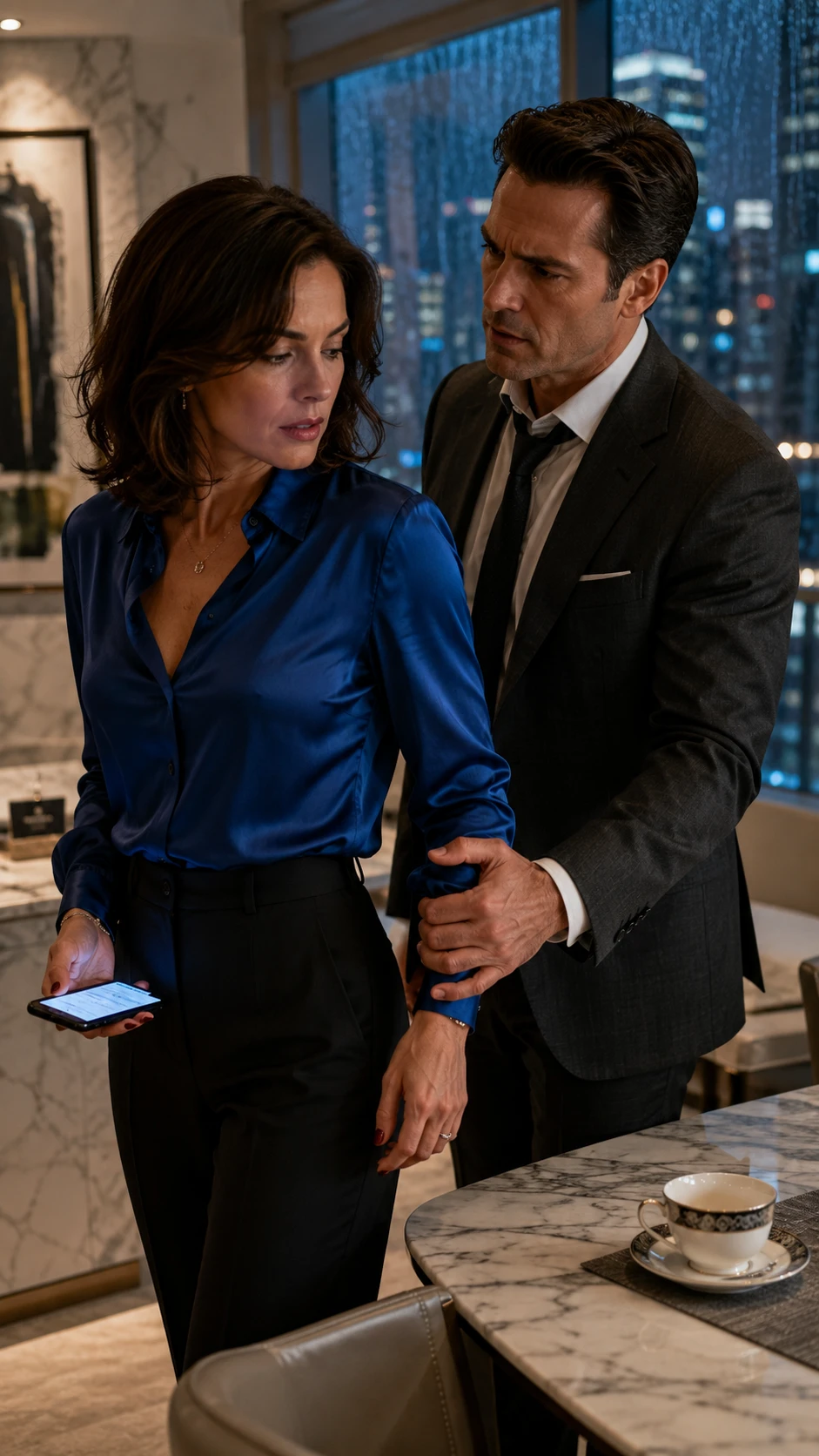
He caught my arm.
Not painfully.
But enough.
“Don’t do this.”
I looked down at his hand.
Then up at him.
“Take your hand off me.”
He did.
Immediately.
Good.
I stepped back.
“From now on, anything important goes through Nathan.”
His face went pale.
“Nathan Bell?”
“Yes.”
“You called a divorce attorney?”
“Nathan has represented me for years.”
“You’re filing?”
“I didn’t say that.”
“You didn’t have to.”
My phone buzzed.
A message from an unknown number.
I looked down.
A photograph loaded.
It showed me entering the building that morning.
Taken from across the street.
Below it were six words.
Still pretending this is your home?
Carter saw my face change.
“What?”
I turned the phone toward him.
For the first time since the box arrived, he looked genuinely shocked.
And that frightened me more than his lies.
Chapter 3: Someone Was Watching
Marcus was back within forty minutes.
By then, Carter had called Sloane eleven times.
She did not answer.
I knew because I heard him pacing inside his study, leaving messages in a stage whisper that kept becoming louder.
“Sloane, call me.”
Then:
“This isn’t funny.”
Then:
“You need to stop.”
Interesting.
Not Did you do this?
Stop.
By his third message, Nathan had instructed me not to be alone in the apartment with Carter that night.
Carter laughed when I told him.
“Seriously?”
“Yes.”
“You think I’m dangerous now?”
“I think this situation is unstable.”
“Because you made it unstable.”
Marcus looked at him.
“No, sir.”
Carter turned.
Marcus rarely raised his voice.
He did not need to.
“A package was sent to your wife’s residence containing altered personal photographs. Then somebody photographed her entering the building and sent the image anonymously. Mrs. Vale didn’t create either event.”
Carter stared at him.
For years, people had arranged their language around my husband’s comfort.
Marcus did not.
It was refreshing.
“I’ll handle Sloane,” Carter said.
Nathan’s voice came through my phone.
“No.”
Carter’s head snapped toward it.
Nathan continued.
“You will not act as intermediary. If Ms. Hart contacts your wife again, we preserve it. If you have relevant communications, preserve those too.”
Carter laughed without humor.
“I’m not handing over my phone.”
“No one asked you to.”
“Yet.”
Nathan paused.
“Interesting word.”
Carter looked at me.
“You planned this.”
I almost admired his ability to place himself at the center of every disaster.
“You think I planned for your girlfriend to mail me my own wedding photographs?”
“You wanted leverage.”
“For what?”
His eyes flicked toward Marcus.
Money.
There it was.
He did not say it.
He did not have to.
He thought this was about divorce.
Assets.
Property.
Settlement.
Eleven years reduced to an anticipated negotiation.
I looked at him and realized that Carter still believed the most important thing he could lose was measurable.
That mistake would cost him far more than money.
Marcus traced the anonymous image.
The number itself led nowhere useful, but the photograph contained details.
Reflections.
Angles.
The position of a delivery truck.
The exact time on the digital clock inside the pharmacy window across the street.
He did not explain his process in detail.
He simply asked the building manager for camera footage from the relevant time and requested that it be preserved.
Carter objected.
“It’s my building account.”
I looked at him.
“Our building.”
He ignored me.
The manager, who had known us nine years, glanced awkwardly between us.
“Mrs. Vale is also an owner of record.”
That silenced him.
The footage showed a woman standing under the awning across the street at 10:13 that morning.
Baseball cap.
Dark coat.
Phone raised.
We could not see her face.
But at 10:19, she walked toward a black sedan.
The building’s side camera caught the car.
The license plate was obscured by rain.
Marcus replayed the clip.
Again.
Again.
Then he froze it.
“Do you recognize the coat?”
I did not.
Carter did.
I saw it before he spoke.
His shoulders tightened.
“No.”
Marcus looked at him.
“You’re sure?”
“Yes.”
I leaned closer to the monitor.
A narrow strip of pale fabric showed beneath the woman’s dark coat.
Maybe a scarf.
Maybe a blouse.
Maybe nothing.
Then she turned toward the sedan.
A gold charm swung from her wrist.
A tiny sunburst.
I had seen it at the gala.
Sloane had worn the bracelet while lifting her champagne glass.
I said nothing.
Neither did Marcus.
Carter left ten minutes later.
He claimed he needed air.
Marcus waited until the elevator doors closed.
“He recognized her.”
“I know.”
“You recognize the bracelet?”
“Yes.”
He nodded.
“Good. Don’t announce it.”
My phone buzzed again.
This time, the message came from Sloane’s actual number.
I had never saved it, but Carter had once copied me accidentally on a dinner reservation chain.
Can we talk without lawyers? Woman to woman.
Marcus read it over my shoulder.
“No.”
“I know.”
Another message.
Carter is making this worse.
Then:
There are things you don’t understand.
I typed nothing.
Ten minutes passed.
Then she sent a photograph.
The leather wedding album.
Open on a white bedspread.
My chest tightened.
Marcus leaned closer.
“Save that.”
I did.
Below the image, she wrote:
He gave it to me.
For one second, satisfaction surged through me.
Proof.
Then I forced myself to slow down.
People lied.
Photographs could mislead.
Context mattered.
Nathan had warned me not to fall in love with evidence merely because it said what I wanted.
So I called him.
He reviewed the messages.
“Do not respond.”
“I wasn’t going to.”
“I know. I enjoy repeating myself.”
Marcus pointed toward the album photograph.
“Metadata may or may not survive the messaging platform, but the image itself matters. More importantly, she’s making a factual claim.”
“That Carter gave it to her.”
“Yes.”
Nathan said, “And now we see what Carter says in writing.”
He sent Carter a formal preservation notice that evening.
Short.
Professional.
It instructed him to preserve relevant communications concerning Sloane, the wedding album, the package, and any contact involving me.
Carter received it at 8:42.
At 8:47, he texted me.
You’ve lost perspective.
At 8:49:
I gave her the album months ago because she wanted to understand our history. That does not mean I approved what she did with it.
I stared at the sentence.
Then I sat down.
Marcus looked over.
“What?”
I handed him the phone.
He read the message once.
Then again.
“Well.”
One word.
That was all.
Because Carter had just done what angry, entitled people often do when they believe the accusation is smaller than the truth.
He had admitted the part he considered defensible.
He gave my mistress our wedding album because she wanted to understand our history.
It was such a staggering violation that for a moment the legal significance disappeared beneath the personal one.
He had sat somewhere with her.
Maybe her apartment.
Maybe ours.
He had placed our wedding photographs in her hands.
Had he explained them?
That was our honeymoon.
That was the dance with my father.
That was the toast where your sister cried.
That was the photograph my wife loved best.
And Sloane had looked through them while believing she was studying a position she intended to occupy.
My replacement.
I stood and walked to the window.
Below me, the city glowed wet and silver.
For eleven years, I had believed privacy meant safety.
That even if Carter and I failed each other, certain parts of us would remain sacred simply because they had once been true.
I had been wrong.
“You okay?” Marcus asked.
“No.”
He waited.
I appreciated that he did not tell me I would be.
After a minute, I turned.
“What happens now?”
Nathan answered through the call.
“Now we separate two problems.”
“Which are?”
“Your marriage and the harassment.”
“Carter connects them.”
“Yes. We don’t.”
That sentence became my anchor.
The marriage could be ending.
That did not give Sloane the right to intimidate me.
Sloane could be unstable.
That did not erase Carter’s betrayal.
Carter could claim innocence regarding the package.
That did not erase the fact that he handed private material to the woman humiliating me.
Separate problems.
Separate facts.
Separate consequences.
The next morning, I moved into the guest suite at a hotel three blocks away.
Not because Carter ordered me out.
Because I wanted the choice to be mine.
Before leaving, I photographed the apartment room by room.
I took personal papers, jewelry inherited from my grandmother, my laptop, medication, and clothes.
I did not touch Carter’s belongings.
I did not remove artwork.
I did not dramatically empty closets.
I did not leave my wedding ring on a table like a movie prop.
I wore it.
For one more day.
Because I had learned something in the previous forty-eight hours.
Symbolic gestures feel powerful.
Records are powerful.
At noon, Sloane called.
I let it go to voicemail.
Her voice sounded different from her messages.
Less confident.
“Please call me. Carter is telling people I did all of this because I’m unstable. That’s not what happened. He told me you were leaving. He told me the apartment was practically his. He told me—”
She stopped.
Then quietly:
“Just call me.”
The message ended.
I listened twice.
Then sent it to Nathan.
At three, Carter texted.
Whatever Sloane tells you, remember she’s emotional.
There it was again.
Emotional.
Fragile.
Processing.
The language he used to excuse her when she attacked me was now the language he was using to discredit her when she frightened him.
The pattern finally appeared.
Carter did not protect people.
He assigned them roles.
When Sloane adored him, she was brilliant.
When she challenged him, she was unstable.
When I supported him, I was indispensable.
When I questioned him, I was threatened.
When I stayed silent, I was dignified.
When I documented, I had lost perspective.
The problem had never been that Carter did not understand women.
He understood exactly how to describe us in whichever way protected him.
That evening, the foundation’s board chair called me.
Her name was Eleanor Price.
Seventy-one. Precise. Impossible to charm against her will.
“I heard there was an incident.”
I closed my eyes.
“From Carter?”
“From three people, each of whom believes the other two don’t know.”
Despite everything, I smiled.
“That sounds like the board.”
Eleanor did not.
“Is there any concern involving the foundation?”
“I don’t know yet.”
“Was Sloane representing the foundation when she contacted you?”
“Not that I’m aware of.”
“Did Carter use foundation resources in connection with this?”
“I don’t know.”
She paused.
“If that answer changes, you call me.”
“I will.”
“And for what it’s worth, the gala presentation was not approved by the full board.”
I opened my eyes.
“What?”
“I said what I said.”
“Who approved it?”
Another pause.
“Carter.”
The room seemed to sharpen around me.
“And the communications director?”
“Was told it had executive approval.”
“From whom?”
“You already know.”
I did.
Carter had not merely allowed my public erasure.
He had arranged it.
The gala had not been Sloane’s victory.
It had been his announcement.
And suddenly the box of wedding photographs felt less like an isolated act of jealousy.
It felt like an escalation in a story Carter had been writing for months.
The only difference was that now, for the first time, I had begun writing too.
Chapter 4: The Version He Needed Everyone to Believe
For the next six days, I said almost nothing publicly.
That drove Carter insane.
He was accustomed to controlling conflict through anticipation.
If he could predict your reaction, he could prepare for it.
Anger could be called instability.
Tears could be called manipulation.
Public accusation could be called vindictiveness.
But silence?
Documented, deliberate silence?
He could not argue with it.
So he began filling the silence himself.
Friends called.
“Carter says this is all a misunderstanding.”
“Carter says Sloane is having a difficult time.”
“Carter says you hired investigators because you’re furious about the affair.”
That last one almost impressed me.
He was trying to make the harassment disappear inside the adultery.
A bitter wife.
A younger mistress.
A powerful man caught between emotional women.
A familiar story.
Familiar stories are useful because people stop asking questions once they recognize the shape.
So I refused the shape.
When friends called, I said only:
“There is a personal matter being handled privately.”
Nothing else.
Marissa came to the hotel Friday night with takeout and a bottle of wine.
She kicked off her shoes and looked around the suite.
“This is depressing.”
“It has two bathrooms.”
“It can have six bathrooms and still be depressing.”
I laughed for the first time in days.
She handed me noodles.
Then became serious.
“I should have told you.”
The fork stopped halfway to my mouth.
“Told me what?”
“At the gala. Before the gala, actually.”
My stomach tightened.
“What did you know?”
“I saw Carter and Sloane together two months ago.”
“Where?”
“The Whitmore.”
A hotel.
Of course.
“I told myself it might be a meeting.”
“At night?”
She looked ashamed.
“Yes.”
“With his hand on her back?”
Marissa looked down.
I already knew.
“You should have told me.”
“I know.”
“Why didn’t you?”
“Because I was afraid of being wrong.”
I leaned back.
“And if you were right?”
She swallowed.
“I was afraid you would hate me for making it real.”
That answer hurt because I understood it.
The people at the gala had looked into their glasses for the same reason.
Truth creates obligation.
Once you admit what you see, you have to decide what kind of person you are going to be about it.
Marissa reached for my hand.
“I’m sorry.”
I let her hold it.
After a moment, I said, “Next time, make it real.”
She nodded.
“There won’t be a next time.”
“There will always be a next time. Maybe not with Carter. But with somebody. Tell the truth sooner.”
That night, I removed my wedding ring.
No ceremony.
No photograph.
I placed it inside the hotel safe beside my passport.
Then I slept.
The next morning, Marcus called.
“We found something.”
He had obtained building footage from the Aurora Residences through proper channels after Sloane’s attorney became involved.
Sloane had retained one.
That was not surprising.
What was surprising was the date Marcus wanted me to see.
Three months earlier.
Carter entering the Aurora with the leather wedding album beneath his arm.
I watched the clip once.
Then asked to see it again.
There he was.
My husband.
Walking through another woman’s lobby carrying eleven years of our private history.
The timestamp was 6:14 p.m.
I checked my calendar.
That same night, Carter had texted me at 6:03.
Board dinner. Don’t wait up.
I looked at Marcus.
“Do we need this?”
“For the harassment issue? It helps establish access and context.”
“For the divorce?”
“That’s Nathan’s lane.”
Nathan joined the call ten minutes later.
He was less interested in the adultery than I expected.
“The affair matters emotionally,” he said. “Legally, our strategy depends on broader facts. Don’t let Carter bait you into making this only about infidelity.”
Again.
Separate problems.
Then Marcus showed us something else.
Two days before the box arrived, Sloane had entered our penthouse building with Carter.
They remained upstairs for one hour and seventeen minutes.
I felt cold.
“I was in Connecticut.”
“Yes.”
“For my aunt’s birthday.”
“Yes.”
Carter had texted me that afternoon.
Long day. Going home early.
Technically true.
Nathan asked, “Any indication she entered the study?”
“No interior surveillance,” Marcus said. “Nor should there be.”
I closed my eyes.
The image formed anyway.
Sloane walking through my foyer.
Standing in my kitchen.
Seeing the photograph frames.
Opening closets.
Looking at my side of the bed.
Maybe Carter showing her where things were.
Maybe laughing.
Maybe promising her that soon everything would change.
I hated my imagination for wanting to punish me with details I could never prove.
So I stopped.
Facts.
The fact was enough.
He brought her into our home.
The fact was enough.
That afternoon, Sloane sent another message.
This time, not cruel.
He told me you knew.
I did not answer.
Five minutes later:
He said the gala was supposed to make the transition easier because everyone already understood.
I stared at the screen.
Transition.
Ten minutes later:
I shouldn’t have sent the box.
Then:
I was angry because after the gala he went home with you.
My hand tightened around the phone.
There it was.
Not an excuse.
A motive.
Sloane had expected the gala to be a public beginning.
Instead, Carter had returned to the penthouse with his wife.
She had wanted him to complete the story he had promised her.
When he did not, she punished me.
Because I was the visible obstacle.
I sent the messages to Nathan.
Still, I did not respond.
Then Carter called.
I ignored him.
He called again.
And again.
Finally, a voicemail appeared.
“You need to tell Sloane to stop contacting me.”
I actually laughed.
He wanted me to control his mistress.
Another voicemail.
“She thinks we’re working together against her.”
Another.
“This has gone too far.”
On the fourth, his voice changed.
“I made mistakes. I know that. But you are letting this become dangerous.”
There was the word.
Dangerous.
Not when Sloane mailed me defaced photographs.
Not when she photographed me outside my home.
Not when she called me a placeholder.
It became dangerous when Carter lost control of both women.
That night, Eleanor called again.
“Carter asked the board to issue a statement.”
“About me?”
“About what he called a private campaign designed to damage foundation leadership.”
I sat upright.
“What campaign?”
“He was not specific.”
“Did the board approve it?”
“No.”
Relief moved through me.
Then Eleanor added, “We asked him why foundation leadership required defending in a personal marital dispute.”
I could imagine his face.
“What did he say?”
“That outside parties were trying to exploit private circumstances.”
“Meaning me.”
“He did not name you.”
“He didn’t need to.”
“No.”
I walked to the window.
Traffic moved far below.
Eleanor continued.
“The board has concerns about Sloane’s role.”
“Because of the gala?”
“Because no one can identify who formally hired her.”
I turned from the window.
“What?”
“She has been introduced as a consultant. There is no completed consulting agreement in our records.”
That was not a crime.
It might not even be significant.
But it was another contradiction.
Carter had elevated her publicly through an institution that apparently had not formally elevated her at all.
“Eleanor, I don’t want the foundation used as a weapon in my divorce.”
“Neither do I.”
“Against Carter either.”
A pause.
“Good.”
Her voice sharpened.
“Then let the board handle governance. You handle your marriage.”
I understood.
Separate problems.
That phrase again.
By Monday, the pressure shifted.
Sloane’s attorney contacted Nathan.
She wanted no further direct communication with me.
Fine.
I wanted the same.
She also denied intending any physical harm and acknowledged sending the box.
More importantly, through counsel, she stated that Carter had given her the album and had represented that our marriage was functionally over.
Nathan read the letter aloud.
I interrupted.
“Does any of that matter?”
“It matters as context.”
“Does it excuse her?”
“No.”
“Does it excuse him?”
“No.”
“Good.”
Nathan paused.
“You’re getting better at this.”
“At what?”
“Not letting one person’s wrongdoing erase another person’s.”
I looked at the stack of documents on the desk.
For years, I had done the opposite.
I had used Carter’s stress to excuse coldness.
His ambition to excuse absence.
His childhood wounds to excuse control.
His public responsibilities to excuse private neglect.
Love had slowly become an accounting system where every injury came with a footnote explaining why I should absorb it.
I was done with footnotes.
That afternoon, I asked Nathan to prepare the divorce filing.
Not because of Sloane’s box.
Not because of the gala.
Not even because of the affair.
I filed because Carter had finally shown me the structure underneath all of it.
He believed other people’s feelings were real only when they served his version of events.
Mine did not.
Sloane’s did not.
Eventually, no one’s would.
That evening, I met Carter in Nathan’s conference room.
He arrived without a lawyer.
A mistake.
Or arrogance.
Usually the same thing.
He sat across from me and stared at the folder in front of my hands.
“You’re really doing this.”
“Yes.”
“Eleven years.”
“Yes.”
“For her?”
“No.”
His face tightened.
“Then why?”
For the first time, I realized he genuinely did not know.
And that might have been the saddest thing about us.
“You gave another woman our wedding album.”
“I already explained that.”
“You brought her into our home.”
“We were separated emotionally.”
“You forgot to tell me.”
He looked away.
“She told me you knew.”
“I didn’t.”
“She sent me photographs of our building.”
“That was wrong.”
“You called it emotional processing.”
“I was trying to calm things down.”
“You weren’t calming anything down. You were managing me.”
His jaw tightened.
“Everything with you has become language.”
“No. Everything with me has become accurate.”
He leaned forward.
“You want me to say I’m sorry?”
I studied him.
“Do you know what for?”
Silence.
That was my answer.
I closed the folder.
Carter’s eyes moved toward it.
“What’s in there?”
“Things you wrote.”
His face changed.
Just slightly.
I continued.
“Things she wrote. Building records. The gala approval chain.”
Now he went still.
“The gala has nothing to do with our marriage.”
“You’re right.”
I stood.
“That’s why the board gets to decide what it has to do with the foundation.”
He stared at me.
“You spoke to Eleanor.”
“She spoke to me.”
“You’re trying to remove me.”
“No.”
I picked up my coat.
“This is the part you still don’t understand, Carter.”
“What?”
“I don’t have to destroy you.”
I looked at the man I had once trusted more than anyone alive.
“I only have to stop protecting you from the consequences of things you actually did.”
And for the first time since Sloane’s box arrived, Carter had nothing to say.
Chapter 5: The Placeholder
The divorce filing became public two days later.
Not because I announced it.
Court records are not known for discretion.
By noon, three reporters had called Nathan.
By two, someone had photographed Carter leaving the foundation offices.
By four, social media had begun constructing a hundred versions of a marriage none of them had lived inside.
I read none of them.
Carter did.
That became obvious quickly.
At 4:17 he texted:
You’re letting strangers destroy my life.
At 4:24:
At least make a statement that Sloane acted alone.
At 4:31:
I never approved that box.
At 4:36:
Answer me.
I did not.
At five, Nathan called.
“Carter has counsel now.”
“Good.”
“His attorney wants to discuss a joint statement.”
“No.”
“I assumed.”
“What does Carter want it to say?”
“That the end of your marriage is private and unrelated to recent misunderstandings involving a third party.”
I laughed.
Nathan waited.
“Sorry.”
“No, that was appropriate.”
“A third party.”
“Yes.”
“A misunderstanding.”
“Yes.”
“And he wants my name under it?”
“He does.”
“No.”
“I know.”
The next morning, the foundation announced that Carter was taking a temporary leave from board leadership while an internal governance review was conducted.
The statement did not mention me.
It did not mention Sloane.
It did not accuse him of misconduct.
It simply said the board was reviewing recent decisions related to communications and consulting practices.
Boring language.
That was what made it powerful.
No spectacle.
No dramatic accusation.
Just process.
Carter called within minutes.
I answered this time.
Not because I wanted to.
Because Nathan had told me I could if I felt safe, so long as I assumed nothing said orally would remain private.
“What did you do?” he asked.
“Good morning.”
“Don’t.”
“What did I do?”
“You gave Eleanor information.”
“She already had most of it.”
“You showed her my texts.”
“No.”
A pause.
That frightened him.
“You didn’t?”
“No.”
“Then what did you give her?”
“Nothing.”
“That’s a lie.”
“It isn’t.”
I sat in my hotel room looking at sunlight spilling across the carpet.
“The board can investigate its own records without my help.”
“This is because of Sloane.”
“No, Carter. That is the mistake you keep making.”
“What mistake?”
“You think every consequence is something a woman did to you.”
Silence.
I continued.
“The gala presentation exists whether I complain or not. The approval trail exists whether Sloane cries or not. Her consulting status exists whether we divorce or not. You made those choices.”
“You’ve poisoned them against me.”
“I spent eleven years doing the opposite.”
That stopped him.
For years, I had softened Carter for other people.
Explained his lateness.
His temper.
His sharpness.
His arrogance.
His habit of interrupting.
His tendency to make decisions before meetings and call the meeting collaboration.
I had translated him into something more generous.
More thoughtful.
More human.
I had not realized how much of his reputation rested on women quietly editing him.
His mother first.
Then assistants.
Then me.
Now Sloane.
Carter’s voice lowered.
“I loved you.”
The sentence hurt because some part of it was true.
“I know.”
“You’re acting like none of it mattered.”
“I’m acting like it mattered enough not to lie about what happened to it.”
He breathed out.
“What do you want?”
There it was.
The question he should have asked months earlier.
Maybe years.
But now he meant settlement terms.
“I want this handled properly.”
“Money?”
“No.”
“The apartment?”
“We’ll resolve property through counsel.”
“What, then?”
I looked at my bare left hand.
“I want you to stop asking me to make your choices look better.”
He said nothing.
“I have to go.”
“Wait.”
I almost ended the call.
Then he said, “Sloane lied to me too.”
I closed my eyes.
Of course.
Even now.
“She told me the box was a joke.”
“A joke.”
“Yes.”
“And the photograph outside the building?”
“She said she wanted you to know she was serious.”
“Those things don’t match.”
“I know that now.”
“No, Carter. You knew then.”
His silence told me I had hit something.
“You knew enough to tell me she was emotional. You knew enough to ask me not to embarrass you. You knew enough to call her and tell her to stop.”
He breathed harder.
“You’re twisting this.”
“No. I’m finally keeping it straight.”
Then I ended the call.
That afternoon, Nathan received a formal proposal from Sloane’s attorney.
She would agree to no direct contact.
No third-party messages.
No approaching my residence.
No publication or distribution of private photographs.
The remaining wedding album would be returned through counsel.
There would also be a written acknowledgment that she had sent the package.
No dramatic confession.
No begging.
No public humiliation.
Just boundaries.
I accepted.
Some people thought I should have pushed harder.
Marissa, particularly.
“She taped her face over yours.”
“I know.”
“She mailed it to your home.”
“I know.”
“She called you a placeholder.”
“I remember.”
“And you’re just going to let her walk away?”
I looked at my friend across the restaurant table.
“Walk away from what?”
“Consequences.”
“She lost access to me.”
Marissa frowned.
“That’s enough?”
“It has to be.”
I stirred my coffee.
“I’m not building the next year of my life around punishing a woman who already showed me exactly who she is.”
“What about Carter?”
“Same answer.”
Marissa sat back.
“You’re infuriatingly calm.”
“I’m not calm.”
I smiled faintly.
“I’m exhausted.”
There was a difference.
The album came back on Friday.
Nathan called me to his office when it arrived.
It was inside a plain evidence envelope.
No ribbon.
No lipstick.
No performance.
I opened it carefully.
The leather cover had a shallow scratch near the corner.
Inside, several photographs had been removed.
Including the private one from the stone steps.
My stomach tightened.
Nathan noticed.
“What’s missing?”
“Four.”
“Are they copies of what she mailed?”
“Three are.”
“And the fourth?”
I turned pages slowly.
Then stopped.
The fourth missing photograph was from our first dance.
My father had been standing behind us, blurred in the background, one hand against his mouth because he was trying not to cry.
He died two years later.
That photograph mattered to me for reasons Sloane could never understand.
My eyes filled.
For the first time since the box arrived, I cried.
Not dramatically.
No collapse.
No broken glass.
Just tears landing silently on a conference-room table while Nathan looked away to give me privacy.
“I want that one back,” I said.
“We’ll request it.”
“I don’t care about the others.”
“Understood.”
I wiped my face.
Nathan hesitated.
“There’s something else.”
He handed me a clear sleeve.
Inside was a small folded piece of paper.
It had been tucked between the final pages of the returned album.
Sloane’s handwriting.
For one horrible second, I expected another insult.
Instead, there were only two lines.
He told me you never loved him.
I think he needed both of us to believe the other one was the problem.
I read it again.
Then a third time.
Nathan said, “You don’t have to assign meaning to it.”
“I know.”
“She may be sincere. She may also be trying to repair her image.”
“I know.”
“Both can be true.”
I nodded.
That was the lesson of the year, apparently.
More than one thing could be true at once.
Sloane had been lied to.
Sloane had also chosen to hurt me.
Carter had loved me once.
Carter had also betrayed me.
I had been loyal.
I had also been avoiding truths I did not want to see.
Complexity did not erase responsibility.
It only made responsibility harder to hide.
Three days later, the missing photograph of my father was returned.
No note.
I put it in my safe-deposit box beside the other copy of the private wedding photograph.
Then I went to Nathan’s office for mediation.
Carter was already there.
He looked older.
Not ruined.
Not destroyed.
Just diminished in the way people sometimes look when the rooms around them stop agreeing with their version of themselves.
His attorney sat beside him.
Mine beside me.
For two hours, we discussed numbers.
The penthouse.
Investments.
Art.
Accounts.
Possessions collected over eleven years.
It was strange hearing a marriage translated into columns.
At one point, Carter looked at my left hand.
“You stopped wearing it.”
Everyone knew what he meant.
Nathan said, “Carter.”
“It’s fine,” I said.
I looked at him.
“Yes.”
“When?”
“Last week.”
He nodded.
Then asked the question quietly.
“Did you ever think we could fix this?”
The attorneys stopped shuffling paper.
For once, Carter did not sound strategic.
He sounded tired.
So I answered honestly.
“Before the box? Maybe.”
His face changed.
“After?”
“No.”
“Because of Sloane.”
“Because of you.”
His jaw tightened.
“You keep saying that.”
“Because you keep trying not to hear it.”
I leaned forward.
“The box was cruel. But the box told me something useful.”
“What?”
“She had our photographs.”
He looked away.
“And she only had them because you gave them to her.”
“That doesn’t mean—”
“I know exactly what it means.”
I kept my voice low.
“It means while I was still living as your wife, you handed another woman our private history and let her examine it like an old floor plan.”
He stared at the table.
“You brought her into our home. You removed me from the gala presentation. You stood in front of our friends and talked about new chapters while I was sitting twenty feet away. Then when she crossed a line, you asked me to absorb it quietly because my reaction might embarrass you.”
He looked up.
“I was trying to protect everyone.”
“No.”
The word came easily now.
“You were trying to protect the version of yourself each person believed.”
Silence.
I continued.
“To me, you were the husband going through a difficult phase. To her, you were the man about to begin a new life. To the foundation, you were the visionary bringing in new energy. You needed all three stories running at once.”
His eyes went cold.
“That’s not fair.”
“Maybe not.”
I sat back.
“But it’s documented.”
That word landed harder than any insult could have.
Documented.
Carter had spent months living inside ambiguity.
He could reinterpret conversations.
Adjust timelines.
Change emotional emphasis.
Tell Sloane one version and me another.
But texts were stubborn.
Camera timestamps were stubborn.
Approval records were stubborn.
A wedding album carried through a lobby at 6:14 p.m. was stubborn.
Facts did not hate him.
They simply refused to help.
We finished mediation at six thirty.
Outside, the sky was turning gold between the buildings.
Carter followed me into the hallway.
“Can I ask you something?”
I stopped.
He looked at me for a long moment.
“What are you going to tell people?”
There it was.
Even at the end.
The audience.
I almost laughed.
Instead I said, “The truth, if they ask.”
His face tightened.
“All of it?”
“No.”
He looked surprised.
“Why not?”
“Because some of it belonged to a marriage that no longer exists.”
For the first time, he looked ashamed.
Not publicly.
Not strategically.
Just ashamed.
I turned to leave.
Then he said, “Were you ever happy?”
I looked back.
“Yes.”
That seemed to hurt him more than if I had said no.
So I gave him the rest.
“That’s why this mattered.”
Then I walked away.
Ending
The divorce was finalized nine months after the box arrived.
There was no dramatic courthouse scene.
No crowd.
No reporters waiting on the steps.
Nathan called me at 10:12 on a Wednesday morning and said, “It’s done.”
I was standing in the kitchen of my new apartment.
Not a penthouse.
No marble foyer.
No private elevator.
Just warm wood floors, tall windows, and a narrow balcony where I had planted rosemary I kept forgetting to water.
I thought I would feel victorious.
Instead, I felt quiet.
Some endings do not arrive like explosions.
They arrive like a room after someone turns off a machine you did not realize had been humming for years.
The foundation eventually announced that Carter would not return as board chair.
Its statement was polite.
Governance changes. Leadership transition. Appreciation for years of service.
I never asked for more.
Sloane disappeared from foundation events.
I heard she moved out of the Aurora several months later.
I did not look up where she went.
That surprised people.
They expected obsession.
Competition.
Maybe hatred.
But once the legal boundaries were in place, I discovered something almost insulting in its simplicity.
I did not need to know anything else about her.
The last piece of the story came in a plain envelope forwarded by Nathan.
Inside was the original photograph from the box.
The one of Carter kissing my forehead on the stone steps.
Sloane’s face had been carefully removed.
A faint square of adhesive remained over mine.
For several minutes, I stared at the damage.
Then I turned the photograph over.
Her old message was still there.
Some women are born to be remembered.
Some are only placeholders.
I carried the photograph to my desk.
For a second, I considered throwing it away.
Instead, I slipped it into a drawer.
Not because I wanted to remember Carter.
Not because I wanted to remember Sloane.
Because I wanted to remember the woman I had been when the box arrived.
The woman they both expected to scream.
The woman Carter expected to manage.
The woman Sloane expected to defeat.
They had mistaken restraint for weakness.
Silence for surrender.
Marriage for ownership.
And loyalty for permission.
The truth was much simpler.
I had been a placeholder only once.
Not in Carter’s life.
In my own.
For years, I had been standing in the place where the version of me who spoke clearly should have been.
The morning that box arrived, I finally moved.
And this time, no one got to paste another face over mine.