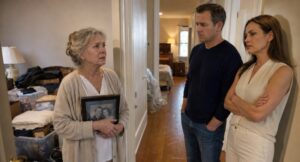
I knew my house had been taken from me before I even put the key in the lock.
From the other side of the front door came the harsh scrape of furniture dragging across hardwood.
Not footsteps.
Not the television.
Not the ordinary sounds a quiet house makes after its owner has been away.
This was deliberate.
Heavy.
The unmistakable sound of someone rearranging a life they believed no longer belonged to the person who had built it.
I stood beneath the porch light with my suitcase beside me and my key frozen between my fingers.
I had been gone for fourteen days.
Fourteen.
I had spent those two weeks on the Maine coast with my oldest friend, Ruth, watching gulls circle above gray water, drinking coffee from chipped ceramic mugs, and trying for the first time in years to enjoy a vacation without feeling guilty for being somewhere other than home.
Now, at sixty-eight years old, I had returned expecting an overflowing mailbox, a refrigerator containing nothing but mustard and half a lemon, and houseplants drooping dramatically because my son had once again forgotten that watering them was not optional.
Instead, something slammed inside my living room.
A man’s voice called, “Careful with that.”
Then came the mechanical whine of a drill.
I unlocked the door.
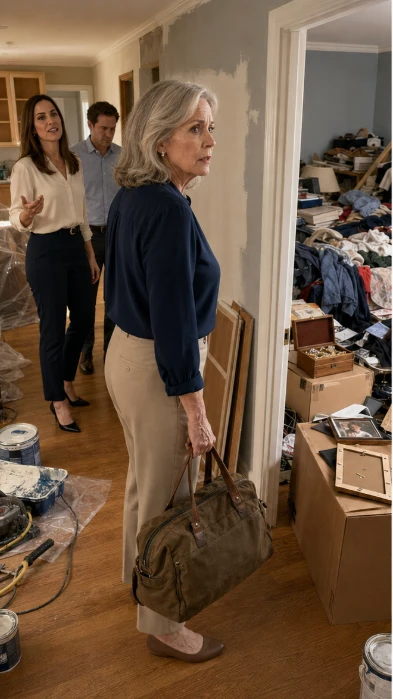
For several seconds, I could not understand what I was seeing.
Plastic sheets covered my furniture.
The walnut bookcase my husband had built was wrapped in cloudy plastic like evidence at a crime scene.
The faded green armchair where I had read every night for twenty years had been shoved beneath the bay window.
One wall was half painted a pale institutional gray I had never chosen.
The old cream color still showed beneath it in uneven islands.
Paint trays covered the floor.
A cordless drill lay on my dining table beside screws, cabinet hinges, measuring tape, and a half-eaten turkey sandwich.
The kitchen was worse.
Every upper cabinet door had been removed.
The doors stood stacked against the refrigerator.
Drawers had been emptied into cardboard boxes.
My copper pans were piled on the counter.
Someone had removed the curtains above the sink.
The curtains I had sewn myself in 1997.
For a moment, all I could hear was my own breathing.
Then a contractor I had never seen before stepped out of the kitchen.
He wore paint-stained jeans and held a pry bar.
He looked at me.
I looked at him.
“Can I help you?” he asked.
There are questions so absurd that your mind initially refuses to process them.
I glanced behind me, almost expecting to discover that I had entered the wrong house.
But there was the brass umbrella stand Henry and I had bought in Vermont.
There was the scratch on the hallway baseboard from the Christmas Daniel crashed his bicycle indoors when he was eleven.
There was the tiny crack above the staircase that Henry had promised for seven years he would repair and then declared, laughing, had become “architectural character.”
This was my house.
I looked back at the stranger.
“You can tell me why you’re tearing apart my kitchen.”
His face changed instantly.
“Mrs. Ellington?”
“Yes.”
“Oh.”
One syllable.
But it contained an entire confession.
Before he could say anything else, heels clicked against the hallway floor.
My daughter-in-law appeared.
Claire.
She wore cream trousers, a sleeveless blouse, and the calm expression of a woman walking through a home improvement showroom.
For half a second, surprise flickered across her face.
Then she smiled.
“Oh, good,” she said brightly. “You’re back.”
I stared at her.
She looked past me toward the porch.
“Where’s the rest of your luggage?”
I did not answer.
“Claire,” I said, “what is happening in my house?”
Her smile tightened.
“Nothing terrible. Please don’t react before I explain.”
That sentence has never once preceded anything reasonable.
I set my handbag slowly on the entry table.
“Explain.”
She stepped toward the living room and spread one hand toward the plastic-covered furniture.
“We’re freshening things up.”
“We?”
She hesitated.
Then my son appeared behind her.
Daniel.
Forty-two years old.
My only child.
He had my brown eyes and Henry’s habit of rubbing the side of his thumb when nervous.
He was rubbing it now.
He did not smile.
He did not say hello.
He did not ask about my trip.
He looked at the floor.
That was when something cold moved through me.
Not fear.
Recognition.
My son already knew.
Claire continued talking.
“The house needed updating anyway. You’ve said that yourself.”
“I said the upstairs bathroom needed a new faucet.”
“Well, yes, but once we started looking at things, it made more sense to do everything together.”
“Once you started looking at things?”
Daniel finally raised his head.
“Mom, just listen.”
“No. You listen.”
My voice surprised even me.
It was not loud.
It was flat.
“Who gave you permission to hire contractors?”
Claire exhaled dramatically.
“Nora, we’re not trying to hurt you.”
“Who gave you permission?”
No one answered.
I turned toward the contractor.
“Please stop working.”
Claire stepped forward.
“Wait.”
The contractor looked between us.
“Ma’am, I’ve got a signed work order.”
“I don’t care what you have. This is my property.”
Claire’s jaw tightened.
“Could everybody just calm down?”
I almost laughed.
Instead, I walked toward the hallway.
Something had changed there too.
The framed watercolor Henry bought on our twenty-fifth anniversary was gone.
So was the narrow mahogany table beneath it.
My pulse began beating harder.
I reached my bedroom.
And stopped.
My bed had been shoved against the wall.
My dresser had been dragged aside, leaving two long scratches across the hardwood.
The linen curtains were gone.
My bedside lamps were gone.
The framed photograph of Henry beside my reading chair was gone.
The jewelry box my mother gave me when I turned eighteen was gone.
My clothes were gone.
Every drawer.
Every shelf.
Empty.
For the first time since walking inside, panic struck me.
I turned.
“Where are my things?”
Claire’s face appeared in the doorway.
“They’re safe.”
“Where?”
“We moved them.”
“Where?”
She pointed toward the end of the hall.
The smallest bedroom.
The room Henry once called the sewing room because I spent years making curtains there when money was tight.
I walked toward it.
The door was half closed.
I pushed it open.
And there was my life.
Piled.
Not packed.
Not organized.
Piled.
My winter coats lay underneath cardboard boxes.
Books were stacked sideways against the wall.
My shoes had been tossed into plastic storage bins.
Family photographs leaned against one another without wrapping.
The cedar chest containing Henry’s letters had been shoved beneath a desk.
My jewelry box sat open on top of a box labeled LINENS.
And above everything else was a framed photograph of Henry and me standing on a rocky beach in Maine.
The photograph had been placed face-down.
Something inside me went completely still.
There is a kind of disrespect that does not shout.
It does not curse.
It does not slam doors.
It simply rearranges your entire existence while assuming you will be too shocked, too polite, too old, or too dependent to stop it.
I picked up the photograph.
The glass was scratched but not broken.
In the picture, Henry was fifty-six.
I was fifty-three.
His arm was around my waist.
The wind had blown my hair across my face, and we were laughing because the stranger taking the photo could not figure out our camera.
Henry had been dead eight years.
For eight years, that photograph had stood beside my bed.
I ran one finger over the glass.
Behind me, Claire sighed.
“Nora, you’re making this emotional when it doesn’t need to be.”
I turned.
She would later tell the police she regretted that sentence.
I am sure she did.
But not yet.
“What did you do to my bedroom?”
“We need the larger room.”
“We?”
She glanced toward Daniel.
Then said it.
Casually.
As though discussing grocery shelves.
“Daniel and I agreed it would be easier to finish the renovations before we moved in.”
I stared at her.
“Moved in where?”
Claire blinked.
“Here.”
“No.”
“Nora—”
“No.”
Daniel stepped into the hallway.
“Mom.”
I turned to him.
He looked exhausted.
For years, Daniel had been the person whose face could still turn me instantly into his mother.
Even when he was forty.
Even when he had gray beginning at his temples.
Some part of me could always see the boy who used to fall asleep in the back seat after baseball practice.
But that afternoon, standing in the hallway where his childhood height marks still existed beneath three coats of paint, I saw a stranger.
“You are not moving into this house,” I said.
Daniel rubbed his thumb again.
“Mom, Claire and I need somewhere to stay.”
“That does not make my home yours.”
“It’s temporary.”
Claire shot him a look.
Interesting.
Temporary was apparently not the version she preferred.
I looked at her.
“How temporary?”
She crossed her arms.
“We haven’t decided.”
“You removed my belongings from my bedroom.”
“The primary bedroom makes more sense for a couple.”
I actually felt the room tilt.
“My bedroom.”
“You don’t use all this space.”
There it was.
The sentence beneath every comment they had made for months.
The sentence beneath every suggestion that I should “simplify.”
The sentence beneath Claire’s jokes about how much house I had for “one little person.”
I turned toward Daniel.
He looked miserable.
Good.
“Tell your wife to put everything back.”
He swallowed.
“Mom, maybe we should talk about the bigger picture.”
“The bigger picture is that you entered my home while I was away, hired workers without permission, dismantled my kitchen, emptied my bedroom, and planned to move yourselves in.”
“You gave me a key.”
“For emergencies.”
“We’re family.”
“Family does not mean ownership.”
Daniel’s face hardened.
It was subtle.
But I saw it.
Then he said the words I would remember for the rest of my life.
“It’s going to be ours anyway.”
The contractor in the kitchen stopped moving.
Claire went silent.
Daniel seemed to realize too late what he had said.
I looked at my son.
“What?”
He shook his head.
“That came out wrong.”
“No. I think it came out exactly right.”
“Mom.”
“How long have you been waiting for me to die?”
His face drained.
“That’s not what I meant.”
“Then tell me what you meant.”
He did not.
Claire stepped in.
“Nobody is waiting for you to die.”
“Wonderful. Then you won’t mind leaving.”
Her expression sharpened.
“We gave up our apartment.”
I stared at her.
“What?”
Daniel closed his eyes.
Claire looked at him angrily.
“Tell her.”
He said nothing.
She turned back to me.
“Our lease ended.”
“When?”
“Yesterday.”
A strange pressure began behind my ribs.
“You have nowhere else to live?”
“We were planning around this.”
“This?”
“The move.”
“The move I never agreed to.”
Claire crossed her arms.
“We thought once you saw the improvements, you’d understand.”
I laughed once.
It was a terrible sound.
“You thought if you destroyed enough of my house before I returned, I would surrender.”
“Nora, that is ridiculous.”
“Is it?”
Daniel stepped closer.
“Mom, please.”
“Get the contractors out.”
“We’ve already paid deposits.”
“Not my problem.”
“We bought materials.”
“Not my problem.”
“We ended our lease.”
“Not my problem.”
His face changed.
I had never spoken to my son that way before.
Perhaps that was part of the problem.
For forty-two years, every one of Daniel’s problems had somehow become mine.
When he forgot a school project, I drove to the craft store at nine at night.
When he wrecked his first car, I helped pay the insurance deductible.
When his first business collapsed, Henry and I loaned him seventeen thousand dollars.
When his second marriage—his marriage to Claire—began struggling under credit card debt, I quietly paid one of their medical bills because Daniel sounded ashamed.
Help had become habit.
Habit had become expectation.
Expectation had become entitlement.
And entitlement had finally walked into my bedroom and thrown my husband’s photograph face-down on a box.
I pointed toward the front door.
“Everyone leaves.”
Claire did not move.
“Nora.”
“Now.”
The contractor cleared his throat.
“I think we should probably pack up.”
Claire whipped around.
“Don’t.”
He lifted both hands.
“Ma’am, this is a property dispute. I’m not touching anything else.”
Within twenty minutes, the workers were gone.
Their tools remained.
So did the plastic sheets.
So did the damaged cabinets.
Daniel and Claire remained too.
They stood in the living room while I called Ruth.
I asked if I could stay at her house for one night.
She immediately said yes.
Daniel looked stunned.
“You’re leaving?”
“For tonight.”
“Why?”
I looked around.
“Because I no longer feel safe sleeping in my own home.”
His face crumpled.
For one second, guilt rose inside me.
Old reflex.
Old motherhood.
Then Claire said, “That’s dramatic.”
The guilt vanished.
I picked up my suitcase.
Before leaving, I turned toward them.
“Do not touch another thing.”
Neither answered.
I drove away.
But I did not go directly to Ruth’s house.
I parked three streets away beneath a maple tree and cried so hard I had to grip the steering wheel.
Not because of the paint.
Not because of the cabinets.
Not even because of my belongings.
I cried because my son had looked at the home his father and I spent thirty-one years paying for and spoken about my death as though it were merely the closing date on his future property.
That night, Ruth poured tea and did not tell me everything would be fine.
That is one of the reasons I loved her.
She simply listened.
When I finished, she asked one question.
“Do you still use Martin Hale?”
I looked up.
Martin Hale had handled Henry’s estate.
“Yes.”
“Call him.”
“At eight-thirty at night?”
“Call him.”
I almost refused.
Then I remembered Claire saying they had given up their apartment.
They had not just made a mistake.
They had made plans.
Plans required assumptions.
And assumptions sometimes left paper trails.
I called Martin.
He answered on the fourth ring.
“Nora?”
His voice was warm and surprised.
I apologized for calling late.
He told me to stop apologizing and explain.
I did.
He did not interrupt once.
When I finished, there was silence.
Then he asked, “Have you signed anything concerning the house in the past year?”
“No.”
“Any refinancing documents?”
“No.”
“Power of attorney?”
“No.”
“Did Daniel ask you to?”
My skin prickled.
“No.”
Martin’s voice changed.
“Nora, I need you to do something.”
“What?”
“Do you have online access to your county property account?”
“I think so.”
“Open it.”
Ruth brought her laptop.
I logged in.
Martin told me where to click.
The property page loaded.
My address.
My parcel number.
My taxes.
Then I saw a notice.
RECORDED DOCUMENT.
Filed eleven days earlier.
I stared.
“What is that?”
Martin was quiet.
“Open it.”
I clicked.
A scanned document appeared.
At first, my mind refused to understand the words.
Then it did.
WARRANTY DEED.
Grantor: Nora Ellington.
Grantee: Daniel Ellington.
I stopped breathing.
My name appeared again at the bottom.
A signature.
My signature.
Except I had never written it.
Beneath it was a notarization.
Dated nine days earlier.
Nine days earlier, I had been sitting beside Ruth on a ferry off the coast of Maine.
Someone had transferred my house while I was hundreds of miles away.
I whispered, “Martin.”
“I see it.”
“I didn’t sign this.”
“I know.”
“How do you know?”
“Because Henry had me place a property-fraud alert on this address years ago.”
I looked at Ruth.
“What?”
Martin exhaled.
“Nora, I received an automated notice when this was recorded. I assumed you had finally decided to transfer the property to Daniel. I was planning to call you Monday.”
My hands began shaking.
“Why would Henry have done that?”
Another silence.
“Tomorrow,” Martin said. “Come to my office at eight.”
“What are you not telling me?”
“Nora.”
“What did Henry know?”
Martin spoke carefully.
“There are things in your estate file I was instructed to discuss with you only if a specific situation occurred.”
A chill passed through me.
“What situation?”
“If Daniel ever attempted to take control of the house while you were alive.”
I did not sleep.
At seven forty-five the next morning, I walked into Martin Hale’s office wearing the same clothes I had traveled home in.
Martin was sixty-three, thin, silver-haired, and incapable of pretending calm when he was worried.
A second attorney sat beside him.
Her name was Elena Cho.
She specialized in real-estate fraud.
A thick folder lay between them.
Martin did not waste time.
“The deed is fraudulent.”
I nodded.
“We’re certain?”
“You were in Maine. We have hotel receipts, flight records, photographs, and Ruth. More importantly, the notarization is defective.”
“How?”
“The notary listed on the document surrendered her commission six months ago.”
I stared.
“Who is she?”
Elena answered.
“Claire’s aunt.”
I sat back.
Of course.
Martin slid another page toward me.
“This is worse.”
A mortgage document.
Not a conventional mortgage.
A private bridge loan.
Borrower: Daniel Ellington and Claire Ellington.
Collateral: my house.
Amount: $185,000.
My mouth went dry.
“They borrowed against my home?”
“Using the fraudulent deed.”
“How much have they received?”
“Elena?”
“One hundred and twenty thousand has already been funded.”
I could not speak.
Martin continued.
“The lender filed a security interest yesterday.”
I looked toward the window.
For years, I had believed betrayal would feel like a knife.
It did not.
It felt like cold paperwork.
Clean.
Typed.
Witnessed.
Stamped.
I remembered Daniel’s words.
It’s going to be ours anyway.
Now I understood why he had sounded so certain.
I turned back.
“Did Daniel sign this?”
“Yes.”
His signature looked authentic.
I knew it because I had watched him write his name since kindergarten.
Claire’s signature was beneath his.
“Did he know the deed was forged?”
“We don’t know.”
“He signed a loan against a house he knew I owned.”
Martin nodded slowly.
“Yes.”
Something in my chest broke.
Not loudly.
Not dramatically.
But permanently.
Elena leaned forward.
“Nora, we need to move fast. We can file to invalidate the deed and freeze any further lending. But because there appears to be document fraud and potential identity theft, law enforcement needs to be involved.”
I looked at Martin.
“The police?”
“Yes.”
“Today?”
“Yes.”
I thought of Claire standing in my hallway.
You’re making this emotional.
I looked at Elena.
“What happens to them?”
“That depends on what they knew, what they signed, and whether they cooperate.”
“I want my house back.”
“You never legally lost it,” she said. “A forged deed conveys no valid title. But we need a court order to clear the record.”
“And I want them out.”
“We can address possession immediately.”
I nodded.
Then Martin placed one hand on the thick folder.
“There’s another matter.”
I almost laughed.
“How could there possibly be another matter?”
“This is the part Henry told me not to discuss unless it became necessary.”
The room seemed to narrow.
Martin opened the folder.
Inside was a letter.
Henry’s handwriting was on the envelope.
Nora.
Nothing else.
My throat tightened.
“When did he write that?”
“Six months before he died.”
I did not touch it.
“Why?”
Martin looked genuinely unhappy.
“Because this is not the first time Daniel tried to take something that wasn’t his.”
I stared at him.
“That’s impossible.”
“When Daniel was thirty-one, before Claire, he had significant gambling debt.”
I shook my head.
“No. He had business debt.”
“That is what he told you.”
The words landed slowly.
Martin continued.
“Henry discovered Daniel had forged his signature on a personal guarantee for ninety thousand dollars.”
I felt the blood drain from my face.
“No.”
“Henry paid the debt privately. He did not tell you because you had just undergone surgery and he was afraid of the stress.”
I stood.
I had to.
The room had become too small.
“You’re telling me my husband knew our son forged his name.”
“Yes.”
“And he hid it from me.”
“He believed Daniel was ashamed and would never do it again.”
“Then why the property alert?”
“Because Henry wanted a safeguard.”
I looked at the letter.
My hands were trembling.
“Open it,” Martin said softly.
I did.
Henry’s handwriting blurred immediately.
My Nora,
If you are reading this, then the thing I hoped would never happen has happened.
I had to stop.
I pressed my lips together and continued.
Daniel made a serious mistake several years ago. I chose to protect him because I believed a father should give his child one chance to come back from the worst thing he has done.
But I also learned something I wish I had understood sooner.
Love without boundaries can become permission.
If Daniel ever tries to pressure you about the house, take control of your finances, or make decisions about your property while you are alive, do not protect him because he is our son.
Protect yourself because you are my wife.
The house is not his.
It was never meant to be his simply because we died.
You and I built that home one payment, one repair, one overtime shift, one argument, and one Christmas at a time.
You owe nobody an inheritance for surviving them.
I lowered the letter.
I could not breathe properly.
Martin waited.
I looked at the last paragraph.
There is one more thing.
If this condition is ever triggered, Martin will explain the trust amendment.
Trust amendment.
I looked up.
“What amendment?”
Martin opened another folder.
In 2017, Henry and I had created a revocable family trust.
I remembered signing it.
I remembered very little else because Henry had always handled the details.
Martin turned several pages.
“After the guarantee incident, Henry asked you both to amend the trust.”
“I don’t remember that.”
“You signed in my office.”
I stared at the page.
There was my real signature.
Not forged.
Real.
Then I remembered.
A rainy Tuesday.
Henry joking that estate planning was “romantic paperwork.”
Me signing where Martin placed yellow tabs.
I had trusted my husband completely.
“What does it say?”
Martin took a breath.
“The house passes according to your wishes while you’re alive. You can sell it, give it away, keep it, mortgage it, burn it down if local fire ordinances permit.”
Despite everything, I almost smiled.
“That sounds like Henry.”
“It does.”
Then Martin’s expression hardened.
“But if Daniel, or any spouse acting with him, attempts fraud, coercion, unauthorized transfer, or encumbrance against property held by you or the trust, his status as contingent beneficiary is terminated.”
I stared.
“Terminated?”
“Yes.”
“Of the house?”
“Of everything.”
Silence.
I heard the hum of the air-conditioning.
Martin continued.
“Investment accounts. Certain securities. The cabin property. Henry’s remaining business interest. Everything governed by the trust.”
“How much?”
“Current value?”
I nodded.
“Approximately one-point-seven million dollars.”
I sat down.
Daniel had not merely risked my home.
He had triggered a clause that cost him nearly two million dollars.
I whispered, “Where does it go?”
Martin turned another page.
“If the forfeiture provision is triggered, the assets remain for your benefit during your lifetime. Upon your death, they are distributed to the Ellington Community Housing Foundation.”
I stared at him.
“The what?”
“Henry created it.”
I laughed then.
Actually laughed.
Tears ran down my face at the same time.
Henry.
Of course.
My husband had grown up in a two-room rental with six people.
His father had once moved the family in the middle of the night because they could not pay rent.
Henry spent his adult life terrified of instability.
At the end, apparently, he had found one final way to make sure his money would put roofs over people who needed them instead of rewarding someone who tried to steal one.
Elena waited quietly.
Finally, I folded the letter.
“What happens now?”
Martin looked at me.
“Now we protect you.”
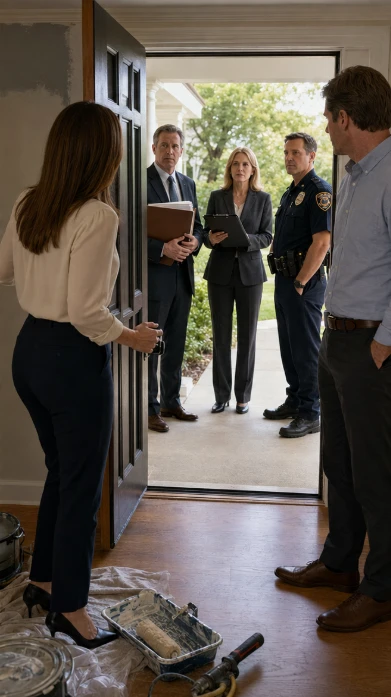
That afternoon, at two eleven, someone knocked on my front door.
I was standing inside the hallway.
Martin stood on the porch with Elena.
Officer Reynolds stood beside them.
Claire opened the door.
Her voice changed immediately.
“Why are there two lawyers and a police officer here?”
Daniel appeared behind her.
I walked forward.
The half-painted wall was still behind me.
The cabinets were still exposed.
The plastic sheets still covered my furniture.
Officer Reynolds stepped inside.
He looked around once.
Then at me.
“Mrs. Ellington, did you authorize any of this renovation work?”
“No.”
Claire turned.
“Nora—”
Officer Reynolds held up one hand.
“Please let her answer.”
I looked directly at him.
“I did not authorize anyone to renovate this house. I did not authorize my son or daughter-in-law to move into it. And I did not sign any document transferring ownership.”
Daniel went white.
Claire did not move.
That was when Elena opened the folder.
She pulled out the recorded deed.
Daniel stared at it.
Claire stared at me.
I watched something flicker across her face.
Not surprise.
Calculation.
Elena held up the page.
“This document was filed with the county eleven days ago.”
Daniel swallowed.
“Mom, I can explain.”
I looked at him.
“Then explain.”
Claire spoke first.
“It was supposed to be temporary.”
Elena turned toward her.
“A deed is not temporary.”
Claire’s mouth tightened.
Daniel looked at Claire.
“You said she signed it.”
Everything stopped.
I looked at him.
“What?”
He pointed toward the document.
“You said Mom had signed it before the trip.”
Claire’s face hardened.
“Daniel.”
“You told me Martin had prepared it.”
“No, I said—”
“You told me it was done.”
Officer Reynolds looked between them.
Elena spoke carefully.
“Mr. Ellington, did you witness your mother sign this deed?”
“No.”
“Did you speak to her about transferring the property?”
Daniel’s breathing became shallow.
“I thought Claire handled it.”
I laughed softly.
That hurt him more than shouting would have.
“You thought your wife handled my decision to give away my house?”
“Mom.”
“No.”
Claire stepped toward me.
“Nora, you were always going to leave it to Daniel.”
I stared at her.
“Was I?”
Her confidence wavered.
“Of course.”
“Interesting.”
Daniel looked at me.
I saw fear now.
Real fear.
I took Henry’s letter from my bag.
Claire’s eyes dropped to it.
Martin spoke.
“Daniel, you need counsel.”
“What is that?”
I held the envelope.
“Something your father left me.”
Daniel’s face changed.
Claire said, “This is getting ridiculous.”
Elena handed Officer Reynolds another document.
“The deed was notarized by Susan Weller.”
Claire went completely still.
Officer Reynolds looked at her.
“Your aunt?”
“No.”
Daniel turned toward Claire.
“What?”
Claire closed her eyes briefly.
That one gesture answered more than words.
Officer Reynolds continued.
“Her notary commission expired six months ago.”
Daniel stepped away from his wife.
“Claire.”
“It was paperwork.”
“You said Mom signed it.”
“She was going to.”
“You told me she signed it.”
“She would have eventually.”
I watched my son understand his marriage in real time.
It was terrible.
And still not enough to make me forget that he had signed a $185,000 loan secured by my house without speaking to me.
He looked toward Elena.
“The loan.”
Claire turned sharply.
“Stop talking.”
Daniel stared at her.
“The loan was based on that deed.”
Officer Reynolds said nothing.
Police officers, I learned, can make silence feel like a spotlight.
Claire looked toward Martin.
“This is a civil matter.”
Elena responded.
“A forged deed used to secure financing is not merely a civil matter.”
Claire’s face finally lost its color.
Daniel sat down.
Just folded into one of the dining chairs.
He covered his mouth.
I had seen that posture once before.
When he was sixteen and learned his best friend had been killed in a car accident.
For one painful moment, he looked like my boy again.
Then I remembered the scratches across my bedroom floor.
I remembered him saying, It’s going to be ours anyway.
Compassion did not require amnesia.
Officer Reynolds explained that Claire needed to answer questions at the station.
She demanded an attorney.
That, at least, was sensible.
She was not handcuffed.
No one dragged her away.
Real consequences are often much quieter than television.
Before leaving, she turned toward Daniel.
“Are you seriously letting them do this?”
Daniel stared at her.
“You forged my mother’s signature.”
“I did this for us.”
“No. You did this because you thought she wouldn’t fight.”
Claire looked at me.
There was hatred in her eyes now.
“Nora, if you do this, you’ll destroy your son.”
I looked at Daniel.
Then at her.
“No.”
My voice was steady.
“You counted on me believing that protecting my son meant protecting him from consequences.”
Claire said nothing.
I continued.
“His father made that mistake once.”
Daniel looked up.
“What?”
I placed Henry’s letter on the table.
“You should read it.”
By evening, Claire was gone.
Daniel was not allowed to remain in the house either.
He stood on the porch with two suitcases.
There is no photograph of that moment.
No dramatic recording.
Just my son beneath the porch light, looking smaller than I had ever seen him.
“I have nowhere to go,” he said.
My heart broke.
But it did not change my answer.
“You had somewhere.”
“Mom.”
“You gave it up because you believed mine was already yours.”
He looked down.
“I didn’t know she forged the deed.”
“I believe you.”
His head lifted.
Hope.
Then I continued.
“But you knew I never told you the house was yours.”
The hope disappeared.
“You signed a loan.”
He swallowed.
“Yes.”
“You planned renovations.”
“Yes.”
“You moved my things.”
He closed his eyes.
“Yes.”
“You heard Claire tell the contractor which bedroom would be yours.”
“Yes.”
“And when I objected, you told me the house was going to be yours anyway.”
He began to cry.
Quietly.
I had never seen my adult son cry.
“Mom, I’m sorry.”
I believed that too.
But apologies are strange things.
They can be genuine and still arrive after the bridge has burned.
“I love you,” I said.
His face crumpled.
“I love you too.”
“But you cannot stay here.”
He nodded.
For the next three months, my life became depositions, contractors, insurance adjusters, title hearings, bank statements, court filings, and conversations I never imagined having.
The fraudulent deed was voided.
The lender froze the remaining funds.
The contractor eventually admitted Claire had told him I had moved permanently to assisted living.
That discovery hurt in a way I had not expected.
Assisted living.
Not traveling.
Not downsizing.
Removed.
In Claire’s version of the future, I had already disappeared.
The unauthorized renovations cost thirty-six thousand dollars to repair.
Some things could not be repaired.
The scratches in the bedroom floor remained faintly visible even after refinishing.
I chose to leave them.
Ruth asked why.
“Because forgetting is how this happened.”
Daniel moved into a weekly rental above a laundromat.
Claire stayed with her sister.
Their marriage collapsed within six weeks.
Police investigators uncovered far more than the forged deed.
Claire had accumulated nearly $94,000 in secret credit-card debt.
She had borrowed money against Daniel’s business account.
She had falsified income information on two rental applications.
She had also paid her aunt five hundred dollars to stamp the deed.
But Daniel was not innocent.
He had signed the bridge loan.
He had falsely certified that he was the lawful owner and intended to occupy the property as his primary residence.
The prosecutor offered him a plea on a reduced financial-fraud charge in exchange for cooperation.
He accepted.
Probation.
Restitution.
Community service.
No prison.
Claire faced more serious charges.
For weeks, I waited to feel victorious.
I did not.
There is no victory in discovering that your own child has become someone you must legally protect yourself from.
There is only clarity.
And grief.
Six months after I came home from Maine, Daniel asked to meet me.
We chose a coffee shop.
Neutral ground.
He looked older.
He had lost weight.
He wore a plain work jacket instead of the expensive quarter-zips Claire used to buy for him.
We sat across from each other.
For several minutes, neither spoke.
Finally, he said, “Dad knew.”
“Yes.”
“About the guarantee.”
“Yes.”
Daniel stared at his coffee.
“I was addicted.”
“I know.”
“I stopped.”
“I know.”
“He never told you.”
“No.”
“He should have.”
I thought about that.
“Yes.”
Daniel looked surprised.
I continued.
“But you should have.”
His eyes filled.
“I was ashamed.”
“Shame is not honesty.”
He nodded.
“I know.”
Then he asked the question I had known was coming.
“What happens to Dad’s trust?”
I looked out the window.
Cars passed.
People carried grocery bags.
Ordinary life.
“It changed.”
“How?”
“You forfeited your contingent interest.”
He did not understand at first.
Then he did.
“All of it?”
“Yes.”
His face went blank.
“The investments?”
“Yes.”
“The cabin?”
“Yes.”
“The house?”
“The house was never automatically yours.”
He leaned back.
“How much?”
“About one-point-seven million.”
For several seconds, he did not speak.
Then he laughed.
Not because anything was funny.
Because sometimes the mind has no other emergency exit.
“So Claire was trying to get a house and cost us almost two million dollars.”
“No.”
He looked at me.
“You cost yourself nearly two million dollars.”
That sentence changed something.
I saw it happen.
For months, Daniel had spoken about Claire as though she were a storm that had carried him somewhere against his will.
But storms do not sign loan applications.
Storms do not move their mother’s belongings.
Storms do not say, It’s going to be ours anyway.
He lowered his head.
“You’re right.”
It was the first completely adult thing he had said to me in years.
I reached across the table.
Not to forgive everything.
Not to restore what was gone.
Just to touch his hand.
He let me.
“I don’t know how to fix this,” he said.
“You don’t fix it all at once.”
“How?”
“You stop lying.”
He nodded.
“To me?”
“To yourself first.”
Over the next year, Daniel did something I did not expect.
He kept showing up.
Not at my house.
I had changed the locks.
Martin had insisted.
Daniel showed up at probation meetings.
At therapy.
At financial counseling.
At community service.
He found work managing inventory at a building supply company.
He repaid what he could.
He never asked me for money.
That mattered.
At Christmas, he mailed me a card instead of inviting himself over.
Inside he wrote:
I finally understand that loving someone does not entitle me to anything they own.
I kept it.
Claire eventually pleaded guilty to forgery, attempted theft by deception, and financial fraud.
She received a combination of incarceration and supervised release.
Her aunt lost any chance of becoming a notary again and faced separate penalties.
The story appeared briefly in a local newspaper.
“Family Property Dispute Leads to Fraud Charges.”
Sixteen words.
That was all.
No article could explain what it felt like to stand in your own bedroom and find your dead husband’s face turned toward cardboard.
No court filing could measure the distance between a mother and son sitting across from each other in silence.
No sentence could explain what entitlement looks like before it becomes a crime.
Usually, it looks ordinary.
A spare key used without asking.
A joke about inheritance.
A comment about “too much house.”
A suggestion that you do not need a room because you are only one person.
A favor assumed instead of requested.
A boundary treated as selfishness.
People rarely begin by taking your house. They begin by teaching themselves that your “no” is negotiable.
Two years later, I sold the house.
Daniel did not know until after closing.
When I told him, he was quiet.
“Where are you going?”
“Maine.”
He smiled.
“Of course you are.”
I bought a smaller home overlooking a narrow strip of water twenty minutes from where Ruth and I had stayed.
Not because Claire had been right about me needing less space.
She had not.
I moved because I wanted to.
That distinction mattered more than square footage.
I took Henry’s walnut bookcase.
The green chair.
My copper pans.
The Maine photograph.
And, to everyone’s surprise, one damaged cabinet door.
Ruth laughed when she saw movers carrying it.
“Why on earth are you keeping that?”
“Architectural character.”
Henry would have appreciated it.
The Ellington Community Housing Foundation began operating the following spring.
Martin helped organize it.
The first grant assisted a seventy-four-year-old widow named Mrs. Alvarez whose landlord had threatened eviction after her husband died.
The second helped a single father and two daughters cover a security deposit.
The third paid emergency rent for a woman escaping an abusive marriage.
I attended the first board meeting.
Daniel did not.
He had no role in the foundation.
That boundary remained.
But he sent a letter.
No request.
No defense.
Just a check for two hundred dollars from his paycheck.
The note said:
For someone who needs a home more than I needed yours.
I cried when I read it.
Not because everything was healed.
Some things never return to what they were.
But scars can become evidence of survival rather than proof of ruin.
On the third anniversary of the day I found my house under plastic sheets, Daniel drove to Maine.
He called first.
That mattered too.
We sat outside my new home overlooking the water.
He looked older now.
So did I.
He had remained single after the divorce.
He had finished probation.
He had paid every dollar of court-ordered restitution.
He was still in therapy.
Still working.
Still rebuilding a life without shortcuts.
“I brought something,” he said.
He walked to his car.
When he returned, he carried a wooden frame.
Inside was a photograph.
Henry and me in Maine.
The same photograph Claire had left face-down.
But the old scratched frame was gone.
Daniel had built a new one himself.
Walnut.
The same wood Henry loved.
I touched the corner.
“You made this?”
He nodded.
“I’m learning woodworking.”
“Your father would have liked that.”
“I know.”
We sat quietly.
After a while, Daniel said, “There’s something I never told you.”
My stomach tightened automatically.
Even after years, betrayal teaches the body to brace before the mind has facts.
“What?”
“The night before you came home from Maine, Claire wanted me to put your things in a storage unit.”
I said nothing.
“She said when you saw the bedroom, you’d fight.”
He stared at the ocean.
“I told her no.”
I almost smiled bitterly.
“That was your line?”
“No.”
He swallowed.
“I told her Dad’s photograph stayed in the house.”
I looked at him.
He continued.
“She got angry and threw it on the box.”
My eyes dropped to the photograph.
“For years I thought I did nothing that week,” he said. “And mostly, I didn’t. But I remembered that.”
He shook his head.
“I stopped her from taking one photograph. Then I helped her take everything else.”
His voice broke.
“I used that tiny decent thing to convince myself I wasn’t doing something terrible.”
I understood.
Perhaps more than he expected.
Human beings are experts at finding one good act inside a bad decision and using it as permission to continue.
I placed the photograph beside me.
“Do you know what your father wrote in his letter?”
“Some of it.”
I had never shown Daniel the complete letter.
I went inside.
The original was kept in Martin’s vault.
But I had a copy.
I brought it outside.
Daniel read slowly.
When he reached Henry’s final lines, he stopped.
His eyes narrowed.
“Mom.”
“What?”
“This isn’t the same trust clause Martin explained.”
I looked.
At first, I thought he was mistaken.
Then I saw the sentence.
I had read Henry’s letter dozens of times.
Somehow, I had never fully understood it.
If Daniel triggers the protective clause, do not tell him about the second provision until he has lived three full years without financial support from you, without access to trust assets, and without another act of fraud or coercion.
My heart began beating harder.
Daniel looked at me.
“What second provision?”
I called Martin.
He answered on speaker.
When I read the sentence, he was silent.
Then he laughed softly.
“I wondered when you’d ask.”
“Martin.”
“I was bound by Henry’s instructions.”
Daniel stood.
“What does it mean?”
Martin’s voice became serious.
“The forfeiture was real.”
Daniel’s face fell.
“But it was not necessarily permanent.”
I stared at the phone.
“What?”
“Henry created a reinstatement mechanism.”
Daniel sat down again.
Martin continued.
“If Daniel lived for thirty-six consecutive months without requesting financial support from you, completed any legal obligations, remained employed or demonstrably self-supporting, did not commit fraud, did not pressure you about the estate, and made documented restitution…”
Daniel looked toward me.
“…then you, Nora, would receive an option.”
“An option to do what?”
“To reinstate a portion of his inheritance.”
Daniel covered his face.
Martin continued.
“Not the house.”
I almost laughed.
“No.”
“Henry was extremely specific about that.”
“What portion?”
“One-third of what Daniel originally would have received. The remaining two-thirds stay committed to the housing foundation.”
Daniel lowered his hands.
“Dad planned this?”
“Yes.”
“All of it?”
“He hoped it would never be needed.”
Daniel looked stunned.
Then Martin said something that surprised both of us.
“But Nora, there is another condition.”
“Of course there is.”
“Daniel cannot know whether you choose reinstatement until after the decision is irrevocable.”
Daniel stared at me.
I stared at the ocean.
Martin continued.
“The purpose was to make sure any change Daniel made was not performed for money.”
Silence.
Henry.
Even dead, the man could still design a lesson with the precision of a carpenter fitting a joint.
Daniel stood.
“I shouldn’t be here for this.”
I looked at him.
He nodded toward the phone.
“This is your decision.”
Then he picked up his jacket.
“Daniel.”
He stopped.
I wanted to tell him.
I wanted to say, You changed.
I wanted to say, I’m proud of you.
I wanted to erase three years of uncertainty with one sentence.
But Henry’s lesson was not about punishment.
It was about separating love from money.
So I said only, “Thank you for the frame.”
Daniel smiled.
“You’re welcome, Mom.”
He drove away.
A week later, I sat in Martin’s office again.
Same desk.
Same folders.
But I was not the woman who had sat there shaking three years earlier.
Martin pushed a document toward me.
“Your choice.”
If I reinstated Daniel, approximately $540,000 in future trust distributions would become available to him after my death.
If I refused, everything remained with the foundation.
I thought about the boy Daniel had been.
The man he became with Claire.
The man he had become afterward.
Then I thought about Henry’s letter.
You owe nobody an inheritance for surviving them.
That was still true.
Love did not require money.
Forgiveness did not require money.
But neither did accountability require permanent exile.
I picked up the pen.
And signed.
Martin looked at the page.
“You’re sure?”
“Yes.”
Daniel would receive one-third.
The foundation would receive everything else.
And the house?
The house was already gone.
Sold.
Finished.
No longer a symbol hanging over any of us.
Martin placed the document into the file.
“There’s something else.”
I laughed.
“I am beginning to dislike those words.”
He smiled.
“This one is good.”
He opened a drawer.
Inside was another envelope.
Henry’s handwriting.
For Nora, after she decides.
My eyes filled before I even opened it.
Inside were only four lines.
Nora,
If you gave him another chance, I knew you would.
If you did not, I would have trusted that too.
The house was never the inheritance.
You were.
I could not read the last line for several minutes.
Outside Martin’s office, traffic moved through downtown.
People hurried through crosswalks.
Somewhere, a contractor was probably dragging furniture across somebody’s floor.
Life continued.
But I sat with my dead husband’s words in my hands and finally understood the thing all of us had almost destroyed.
The real theft had never been the deed.
It had never been the mortgage.
It had never even been the house.
It was the belief that love meant ownership.
That being someone’s child entitled you to their sacrifice.
That helping someone meant surrendering your boundaries.
That family could replace consent.
Henry had protected me from that belief.
Then, somehow, he had left a narrow road back for our son if Daniel ever learned to abandon it.
That evening, I hung the newly framed Maine photograph above my fireplace.
The sun was lowering across the water.
The glass caught the orange light.
Henry was laughing in the photograph.
So was I.
For years, I thought that picture represented the life we had lost.
Now it meant something else.
A house can be sold.
A deed can be corrected.
A wall can be repainted.
A floor can be repaired.
Even trust, once broken, can sometimes be rebuilt.
But only when everyone finally understands the difference between being loved and being entitled.
I poured one glass of wine and stepped outside.
Across the inlet, porch lights began appearing one by one.
My phone buzzed.
Daniel.
A single message.
Thanks for letting me visit. I’m glad you’re happy there.
He did not ask about the trust.
He did not ask about the house.
He did not ask what he would inherit.
I looked back through the window at Henry’s photograph.
Then I typed:
I am too.
I set the phone down.
The wind moved softly through the grass.
For the first time since the afternoon I heard furniture scraping across my hardwood floor, I did not feel like a woman defending what belonged to her.
I simply felt free.
And somewhere behind me, inside a house no one had ever tried to claim before I was finished living in it, my husband’s final lesson rested beneath glass: the most valuable thing a parent can leave a child is not property, but the chance to become someone worthy of being trusted with love.
Three weeks after I signed the reinstatement document, I received another phone call from Martin.
By then, summer had reached the coast.
Every morning, fog drifted across the inlet and settled over the water like thin white cloth. I had fallen into a rhythm I had once thought belonged only to other people: waking without an alarm, drinking coffee on the porch, walking to the harbor before breakfast, and returning home without anyone asking where I had been.
The peace still surprised me.
For most of my adult life, quiet had meant that someone needed me and had not yet called.
Now quiet meant nothing was wrong.
I was trimming dead blossoms from a hydrangea when my phone rang.
Martin’s name appeared on the screen.
I smiled.
“If you say there’s another envelope, I’m hanging up.”
He laughed.
“No envelope.”
“That’s encouraging.”
“There is, however, another problem.”
I closed my eyes.
“Of course there is.”
His tone changed.
“It concerns Claire.”
I straightened.
“What about her?”
“She’s filed a civil claim.”
I felt the old coldness return.
“Against whom?”
“You.”
For several seconds, the gulls above the inlet seemed louder.
“What could she possibly sue me for?”
“She claims she invested personal funds into improvements on the property while acting under a reasonable belief that Daniel held ownership.”
I stared at the garden shears in my hand.
“You mean the renovations she started after forging my signature?”
“That is essentially our position.”
“She wants money?”
“Sixty-eight thousand dollars.”
I laughed.
Not because it was funny.
Because absurdity sometimes deserves exactly that response.
“Martin, she tore my kitchen apart.”
“I know.”
“She threw my clothes into boxes.”
“I know.”
“She forged a deed.”
“I know.”
“She borrowed money against my home.”
“I know.”
“And now she wants me to pay her for paint?”
“Legally speaking, she claims reimbursement for improvements, materials, temporary labor, storage expenses, and what she describes as ‘property enhancement contributions.’”
“Property enhancement?”
“Yes.”
“She removed cabinet doors.”
“I’m aware.”
“She damaged the floor.”
“Yes.”
“She told the contractor I lived in assisted living.”
“I remember.”
I sat down on the porch step.
“Does this have any chance?”
“Not much.”
“Not much is not none.”
“No.”
I hated how calmly lawyers said things like that.
Martin continued.
“There is something unusual about the filing.”
“What?”
“The invoices she attached.”
“Fake?”
“Some appear real. Others do not.”
I waited.
He said, “One of the companies listed belongs to Daniel.”
I frowned.
“Daniel doesn’t own a construction company.”
“Exactly.”
A week later, I sat in Martin’s office with Elena again.
On the table were copies of Claire’s civil complaint and more than two hundred pages of receipts.
Elena highlighted six invoices.
Each carried the name Ellington Residential Services.
I looked at them.
“I’ve never heard of this company.”
“Neither has Daniel,” she said.
“Then why his name?”
“The business was registered eight months before the deed fraud.”
My stomach tightened.
“By Claire?”
“No.”
Elena slid another page toward me.
Registered agent: Daniel Ellington.
The address was his former apartment.
His signature appeared on the registration form.
I studied it.
“This one looks like his.”
“It probably is.”
I felt anger stir again.
Had he lied?
After everything?
Martin saw my expression.
“Before you assume the worst, we spoke to Daniel.”
“And?”
“He says Claire told him she was setting up a handyman side business and needed him listed temporarily because her credit was poor.”
I closed my eyes.
“Of course she did.”
“He signed without reading the paperwork.”
“That sounds familiar.”
Martin did not argue.
Elena tapped another document.
“Here’s what matters. That company received more than forty thousand dollars from the bridge loan proceeds.”
I stared.
“Where did the money go?”
“Mostly to a bank account controlled by Claire.”
“So she paid herself?”
“Essentially.”
That changed the shape of the entire scheme.
It was no longer only about taking my house.
It was about extracting money from it.
Elena continued.
“Some renovation costs were genuine. But a substantial amount appears to have been routed through shell invoices.”
I thought of Claire standing in my living room, explaining paint colors while money moved quietly through accounts behind the scenes.
“Did Daniel know?”
“We don’t have evidence that he did.”
“Yet.”
“Correct.”
There was a time I would have rushed to defend him.
Now I waited for facts.
That, too, was part of what had changed.
The civil suit backfired almost immediately.
By filing it, Claire had introduced financial documents her criminal defense team had apparently hoped would remain unnoticed.
The prosecutor requested them.
Investigators traced the accounts.
Within two months, Claire faced additional allegations of wire fraud and fraudulent invoicing.
Her civil attorney withdrew.
The reimbursement claim disappeared.
Daniel called me the evening the new charges became public.
“I didn’t know,” he said.
I stood beside the kitchen window looking out at dark water.
“I believe you.”
He was silent.
Then he asked, “Why?”
“Why what?”
“Why do you believe me now?”
I thought about that.
“Because you didn’t call asking me to fix it.”
He gave a small laugh.
“I wanted to.”
“I know.”
“I almost drove up there.”
“But you didn’t.”
“No.”
“That matters.”
He breathed out slowly.
“I keep thinking about Dad.”
“So do I.”
“What would he say?”
I smiled despite myself.
“Probably something irritatingly simple.”
“Like?”
“Read before you sign.”
Daniel laughed.
Then I did too.
It was the first time we had laughed together since everything happened.
For a moment, it felt almost ordinary.
But our relationship was not ordinary anymore.
Perhaps it never would be.
That did not mean it was worthless.
Some relationships do not heal by returning to what they were.
They heal by becoming something more honest than they had ever been before.
In October, Daniel asked if he could visit again.
He arrived Saturday morning carrying a toolbox.
I looked at it suspiciously.
“No renovations.”
He raised both hands.
“I swear.”
“What is that for?”
“The porch rail.”
I glanced toward the loose section I had been pretending not to notice.
“How do you know it’s loose?”
“You complained about it last time.”
“I did not complain.”
“You shook it and said, ‘This thing is trying to kill me.’”
“That was an observation.”
He smiled.
“May I fix it?”
The question mattered.
Not I’ll fix it.
Not You need me to fix it.
May I?
“Yes.”
He spent two hours repairing the rail.
I watched from the kitchen window.
At one point, he measured a board twice, frowned, measured again, then muttered something under his breath.
I froze.
Henry used to do exactly that.
Measure.
Frown.
Measure again.
Then complain about whoever had manufactured the tape measure.
I had to turn away.
Memory is cruel that way.
It does not knock.
It simply walks into the room wearing someone else’s posture.
When Daniel finished, we sat on the porch with sandwiches.
He ran one hand along the rail.
“Dad would say I used too many screws.”
“Your father believed every screw was either unnecessary or in the wrong place.”
Daniel smiled.
Then he became serious.
“Mom?”
“Yes?”
“Why didn’t you tell me about the reinstatement provision?”
My hand stopped.
For one second, fear moved through me.
“How do you know?”
He looked startled.
“I don’t.”
I stared.
He continued.
“I meant before. When Dad made the trust amendment. Why didn’t either of you tell me there was a forfeiture clause?”
I exhaled.
He had no idea.
“Because your father wanted you to behave properly without needing to know what punishment waited if you didn’t.”
Daniel looked out at the water.
“That worked out well.”
“No.”
He nodded.
After a while he said, “I used to think inheritance was proof that parents loved their children.”
I said nothing.
“I think Claire believed that too. Or maybe I told myself she did because it made me feel less greedy.”
He picked at the label on his water bottle.
“When you said the trust was gone, I was furious.”
“I know.”
“I blamed Dad.”
“I know.”
“I blamed you.”
“I assumed.”
“I even blamed Claire for costing me money I never earned.”
That sentence stayed between us.
Then he looked at me.
“Do you know when I finally understood how insane that was?”
“When?”
“At the laundromat.”
I almost smiled.
He continued.
“I was sitting upstairs listening to dryers spin below me at two in the morning. I had eighty-seven dollars until payday. And I thought, Dad worked his whole life for that money. You did too. I didn’t.”
His voice softened.
“I had spent years planning around money that only existed if both of you died.”
That hurt.
He saw it.
“I’m sorry.”
“No. Keep going.”
“I don’t know when I started thinking that way.”
“I do.”
He looked at me.
“Gradually.”
He nodded.
“Yes.”
That was the frightening part.
No one wakes one morning transformed into an entitled person.
It happens through tiny permissions.
A bill someone else pays.
A consequence someone removes.
A favor never acknowledged.
A rescue expected the next time.
Henry and I had spent decades trying to give Daniel everything we had not had.
We had not understood that sometimes giving a child every cushion means they never learn how painful the ground is until they fall from somewhere much higher.
That winter, the foundation approved funding for its first permanent housing project.
An old twelve-unit building near Columbus had been sitting empty for five years.
Broken windows.
Damaged plumbing.
A roof that leaked badly enough for weeds to grow through one upstairs ceiling.
Martin thought restoring it would cost too much.
I disagreed.
“So did Henry,” I reminded him.
“He’s been dead ten years.”
“And still winning arguments.”
We bought the building.
The board voted to name it Harbor House.
I refused when they suggested Ellington House.
“This is not a monument.”
“What is it?” Ruth asked.
“A second chance with plumbing.”
She laughed.
Daniel learned about the project through the foundation website.
He called me.
“I want to help.”
“With money?”
“With labor.”
I hesitated.
He heard it.
“You can say no.”
That made me hesitate again.
Finally I said, “Talk to the project manager. Not me.”
“I understand.”
He did.
No special treatment.
No family shortcut.
The project manager assigned him demolition cleanup every Saturday.
For three months, Daniel hauled broken drywall, pulled nails, swept dust, and carried old cabinets down three flights of stairs.
No photographs.
No speeches.
No donor plaque.
He did it quietly.
One freezing morning, I visited the site unexpectedly.
Daniel was kneeling beside an elderly man named Curtis who would eventually live in one of the ground-floor units.
They were studying a damaged window frame.
Curtis had spent eleven months sleeping in his car after medical bills destroyed his savings.
He pointed toward the wood.
“If you replace the whole thing, it’ll cost twice as much.”
Daniel nodded.
“Could reinforce it.”
“That’s what I’d do.”
They worked side by side.
Neither noticed me.
I stood in the doorway and watched.
Something inside me shifted.
Not forgiveness.
That word had always sounded too clean for what we were doing.
Trust was returning in grains.
A phone call made before visiting.
A borrowed tool returned.
A bill paid on time.
A question asked instead of an assumption made.
A Saturday spent hauling debris for strangers.
Trust does not come back because somebody says “I’ve changed.” It returns when their actions become so consistent that eventually you stop waiting for the old person to reappear.
Harbor House opened the following June.
Twelve families moved in.
Mrs. Alvarez, the widow from the foundation’s first grant, attended the opening and brought me a pie.
“You saved my apartment,” she said.
“No.”
I looked toward Martin.
“He did paperwork. I complained.”
She laughed.
Then she hugged me.
Daniel stood near the back.
He had not been invited as family.
He was there with the volunteer crew.
I preferred it that way.
After the ceremony, a little girl ran down the hallway holding a red balloon.
Her mother followed, carrying a cardboard box labeled KITCHEN.
The girl stopped beside Daniel.
“Is this ours?”
She pointed toward an apartment.
Daniel crouched.
“That one is.”
“All of it?”
“All of it.”
She ran inside.
Daniel watched her go.
Then he looked across the hallway at me.
Neither of us spoke.
We did not need to.
Months passed.
Then one afternoon, a letter arrived at my Maine house.
No return address.
The handwriting was unfamiliar.
Inside were three pages.
The first sentence made my stomach tighten.
Mrs. Ellington,
My name is Natalie Mercer, and I believe Claire tried to do to my mother what she did to you.
I read the letter twice.
Natalie’s mother, Jean Mercer, was seventy-two.
Claire had met her through a financial-planning seminar four years earlier.
According to Natalie, Claire had befriended Jean, helped organize her bills, persuaded her to add a “trusted contact” to several accounts, and repeatedly encouraged her to sell her house.
Natalie found my name after searching Claire’s criminal case online.
She did not know whether anything illegal had happened.
She only knew that Claire had once said something that frightened her mother.
“You don’t need all this house at your age.”
The same words.
Different woman.
I called Elena.
Within forty-eight hours, investigators contacted Natalie.
What emerged over the next six months stunned even the prosecutors.
Claire had not invented her methods with me.
She had practiced versions of them before.
Not always illegal.
Not always successful.
But consistent.
She identified older homeowners.
Widowed.
Financially stable.
Adult children living elsewhere.
Then she inserted herself as helpful.
Paperwork.
Contractor recommendations.
Financial organization.
Estate discussions.
In Jean Mercer’s case, nothing had been stolen because Natalie intervened early.
Another woman had paid Claire nearly twelve thousand dollars for “property transition consulting” that produced nothing.
A third had nearly signed a power of attorney.
Claire had been building a business model around vulnerability.
My house had simply been the boldest version.
When Daniel learned, he was devastated.
“I brought her to you.”
His voice cracked over the phone.
“I brought her into your life.”
“You married her.”
“I should have known.”
“Maybe.”
“Mom.”
“You should have questioned more. You should have listened when things felt wrong. But Claire’s crimes are hers.”
He went quiet.
I surprised myself with the certainty of those words.
For years, I had confused accountability with assigning every ounce of blame.
They were different.
Daniel was responsible for what he had done.
Claire was responsible for what she had done.
I was responsible for what I allowed after I understood it.
Healthy boundaries became much easier once I stopped trying to decide whose guilt should cancel someone else’s.
Claire’s final sentencing took place nearly four years after the day I came home from vacation.
I attended.
Not because I wanted to see her punished.
I wanted to hear whether she understood.
The courtroom was smaller than television courtrooms.
Beige walls.
Wood benches.
Fluorescent lights.
Nothing dramatic.
Claire looked older.
Her hair was shorter.
She wore no jewelry.
When given the opportunity to speak, she stood.
For a long moment, she looked at the judge.
Then at me.
“Nora,” she said.
The judge corrected her.
“Address the court.”
Claire swallowed.
“Yes, Your Honor.”
She looked forward again.
“I spent years believing people who had more than they needed were selfish if they didn’t share it with people who needed it.”
My hands tightened in my lap.
Claire continued.
“I told myself Nora had a large home. Daniel and I had debt. She had savings. We had problems. So taking from her became something I called fairness.”
The courtroom was silent.
“I kept changing the meaning of words.”
Her voice shook.
“Pressure became persuasion. Forgery became paperwork. Theft became borrowing. Entitlement became family.”
I did not expect tears.
They came anyway.
Claire wiped her face.
“I hurt people because I convinced myself need was permission.”
For the first time, I believed she understood at least part of it.
That did not erase what happened.
Understanding is not undoing.
The judge imposed the sentence.
Afterward, I stood outside the courthouse.
Daniel joined me.
Neither of us mentioned Claire.
Finally, he said, “You okay?”
“Yes.”
“You sure?”
“No.”
He smiled faintly.
“Fair.”
We walked toward the parking lot.
“Mom?”
“Yes?”
“If Dad could see all this…”
“He’d probably complain about the legal fees.”
Daniel laughed.
I stopped walking.
He turned.
I looked at him.
There are moments when a mother sees every age of her child at once.
The infant asleep on her chest.
The boy with scraped knees.
The teenager who lied about where he had been.
The young man who signed things he did not read.
The son standing in her hallway saying the house would be his anyway.
And the man who had spent four years becoming someone different.
“You’re doing well,” I said.
His expression changed.
It was such a small sentence.
But perhaps I had withheld it too long.
“Thanks.”
“I mean it.”
He nodded.
His eyes became wet.
“I know.”
The following February, Daniel received a promotion.
He became regional operations manager.
The salary was good.
Not extravagant.
Enough.
He called to tell me.
“I bought a house.”
My stomach tightened before I could stop it.
He laughed.
“Legally.”
“That would be my preference.”
“Tiny place.”
“How tiny?”
“Two bedrooms.”
“That sounds enormous for one person.”
He groaned.
“I deserved that.”
“Yes.”
He had saved a down payment for almost three years.
No trust money.
No loan from me.
No co-signer.
When he sent me a photograph, the house looked ordinary.
Brown siding.
Small yard.
Crooked mailbox.
I loved it instantly.
“When do you move?”
“Next month.”
“Need help?”
The question came naturally.
Then I caught myself.
Daniel did too.
He said, “You can come have pizza.”
I smiled.
“Better.”
On moving day, I drove down from Maine.
For the first time in years, I entered Daniel’s home without fear.
Boxes everywhere.
Furniture half assembled.
A kitchen table still wrapped in moving blankets.
He handed me a paper plate.
“You get one job.”
“What?”
“Sit.”
“I can unpack dishes.”
“No.”
“Curtains?”
“No.”
“I am very good with curtains.”
“I remember.”
I sat.
We ate pizza among boxes.
At one point, Daniel disappeared into the hallway.
He returned carrying a small wooden plaque.
I frowned.
“What is that?”
He handed it to me.
Engraved into the walnut were five words.
ASK BEFORE YOU MOVE ANYTHING.
I burst out laughing.
So did he.
For several minutes, we could not stop.
It was not that the past had become funny.
It was that we had finally survived long enough to laugh near it.
He hung the plaque beside his kitchen door.
“Too much?”
“Perfect.”
That night, I stayed in a hotel.
Daniel offered his guest room.
I declined.
Not because I did not trust him.
Because I liked hotel breakfast.
Growth does not mean returning to every old arrangement.
Sometimes it means discovering you are allowed to choose what feels comfortable without needing a tragedy to justify it.
The next morning, before I left, Daniel walked me to my car.
“Mom.”
“Yes?”
“I’m happy you came.”
“So am I.”
He hugged me.
There had been a time when his hugs felt like obligations.
This one did not.
As I drove north, I thought about the trust document waiting in Martin’s vault.
Daniel still did not know.
Three years had passed.
Then four.
I wondered when he would learn.
Martin and I had agreed the reinstatement would remain confidential until my death unless circumstances required otherwise.
At first, secrecy felt manipulative.
Then I understood Henry’s reasoning.
Daniel’s life needed to belong to Daniel.
Not to the possibility of reward.
If he knew half a million dollars waited ahead, every good decision risked becoming suspect.
Better that he build something without inheritance standing behind him like invisible scaffolding.
By the fifth year, I nearly forgot the money myself.
The foundation grew.
Harbor House expanded into a second building.
Then a third.
We created an emergency legal-defense fund for older homeowners facing coercive transfers.
Elena volunteered to design the program.
She called it HomeGuard.
I hated the name.
Everyone else loved it.
The program trained social workers, bank employees, and community volunteers to recognize warning signs:
Sudden changes in deeds.
Unexplained powers of attorney.
Adult relatives moving in after financial trouble.
Pressure to refinance.
Renovations begun without clear consent.
Property described as family property while the owner was still alive.
The very behaviors I had once dismissed as awkward family tension became red flags printed in bold on training materials.
One afternoon, I stood in a community center speaking to forty older adults.
I told them my story.
Not every detail.
Enough.
When I finished, a woman in the second row raised her hand.
“My daughter keeps saying the house will be hers someday. Should I worry?”
I thought carefully.
“Words are not proof of wrongdoing.”
She nodded.
“But?”
“But you are allowed to ask whether someone respects what is yours today instead of focusing on what may become theirs tomorrow.”
Another man asked, “What if saying no destroys the relationship?”
I looked around the room.
“Then the relationship may have depended on your yes.”
The room went still.
I had learned that sentence the expensive way.
Afterward, people lined up to speak privately.
A widow whose nephew kept asking for account passwords.
A man whose daughter wanted to add her name to his deed.
A woman whose son had moved his girlfriend into her basement and stopped paying rent.
Not all were victims.
Not all relatives were predators.
Some situations involved genuine misunderstanding.
But every person deserved something simple.
Clarity.
Consent.
The right to say no without being treated as cruel.
Aging did not reduce ownership. Parenthood did not erase personhood. And love did not create a lien against someone else’s life.
At seventy-four, I developed arthritis in my left knee.
Daniel became annoyingly attentive.
“Have you seen an orthopedist?”
“Yes.”
“When?”
“Tuesday.”
“What did they say?”
“That I have a son who asks too many questions.”
“Mom.”
I laughed.
Eventually, I underwent a minor procedure.
Daniel offered to stay with me afterward.
I hesitated.
Then said yes.
That decision frightened me more than I admitted.
Not because I thought he would steal anything.
Because accepting help from him felt dangerously close to the old pattern.
The first evening, he made soup.
Bad soup.
Truly terrible.
I ate it anyway.
He washed dishes.
He did not rearrange cabinets.
He slept in the guest room.
He asked before opening the medicine drawer.
He asked before changing the thermostat.
At ten, he stood in the doorway.
“Need anything?”
“No.”
“Sure?”
“Yes.”
“Good night.”
“Daniel.”
He stopped.
“Thank you.”
He smiled.
“Good night, Mom.”
I lay awake afterward.
Five years earlier, my son had entered my house with a spare key and behaved as though access meant authority.
Now he stood in my doorway and asked before filling a water glass from the wrong cabinet.
Some people would call that sad.
I did not.
I called it earned trust.
The following morning, I woke to the smell of coffee.
Daniel was sitting outside.
I joined him.
For several minutes, we watched boats move across the water.
Then he said, “I used to think Dad’s trust clause meant he didn’t believe in me.”
I froze.
“You still think about that?”
“Sometimes.”
“What do you think now?”
He took a sip.
“I think maybe he knew me better than I knew myself.”
I looked toward him.
Daniel continued.
“And I think the money going to housing is better.”
I said nothing.
He shrugged.
“I mean it.”
“Why?”
“Because if I’d inherited all of it back then, I would’ve convinced myself I deserved it.”
I felt tears begin.
He did not notice.
“That foundation helped people because I screwed up.”
“No.”
He looked at me.
“The foundation helped people because your father planned wisely and because many people worked hard.”
He smiled.
“Still correcting me.”
“Always.”
He nodded.
Then said, “I’m glad it’s gone.”
My heart hurt.
Not from sadness.
From the strange beauty of hearing someone release a thing they did not know was partly waiting for them.
Two years later, I turned seventy-six.
The foundation board surprised me with a dinner.
I hated surprise dinners.
Everyone knew that.
They did it anyway.
Ruth gave a speech containing several lies about my saintly patience.
Martin gave a speech containing several truths about my complete lack of patience.
Daniel sat at the back.
Near dessert, Martin approached me.
“You should tell him.”
I knew exactly what he meant.
“No.”
“Nora.”
“Henry said after my death.”
“He said you could tell Daniel if circumstances made disclosure appropriate.”
“What circumstances?”
Martin looked toward Daniel.
“He is helping us draft his own estate plan.”
I laughed.
“That poor man.”
“He is leaving a percentage to the foundation.”
I stopped.
“What?”
“Ten percent.”
“Why?”
“You’ll have to ask him.”
I found Daniel outside after dinner.
He was standing beneath a string of lights.
“You’re leaving money to Harbor House?”
He looked embarrassed.
“Martin talks too much.”
“He is a lawyer. That’s literally how he invoices.”
Daniel smiled.
Then shrugged.
“Ten percent.”
“Why?”
“Because somebody should.”
“That is not an answer.”
He put his hands into his pockets.
“I spent a long time thinking Dad’s money was supposed to prove he loved me.”
He looked toward the building.
“I want whatever I leave behind to prove I learned something.”
That night, I decided.
Not about the money.
About the truth.
The next morning, Daniel came to my house for breakfast.
I placed an envelope beside his plate.
He frowned.
“What’s this?”
“Read.”
His face changed immediately.
“Mom, if this is estate paperwork—”
“Read.”
He opened it.
Inside was a copy of Henry’s second provision.
Daniel read slowly.
Then again.
His face lost color.
He looked at me.
“I don’t understand.”
“You met the conditions.”
“What conditions?”
“All of them.”
He kept reading.
“No financial support. No fraud. Restitution. Employment. No pressure about the trust.”
He stared.
“How long have you known?”
“Since three years after everything happened.”
His eyes filled with disbelief.
“And you signed this?”
“Yes.”
He turned to the next page.
The reinstatement document.
His hand began shaking.
“Five hundred and…”
“Approximately.”
He stood.
Then sat again.
“No.”
I frowned.
“What?”
“No.”
“Daniel.”
“I don’t want it.”
I had imagined surprise.
Tears.
Maybe gratitude.
I had never imagined refusal.
“It becomes yours after I die.”
“No.”
“It’s legally valid.”
“I don’t care.”
He pushed the papers away.
“I said I don’t want it.”
“Why?”
“Because I finally built a life without waiting for you to die.”
The words struck with painful familiarity.
But this time they meant the opposite.
Daniel’s voice broke.
“Don’t give that back to me.”
“Your father wanted you to have a path back.”
“I know.”
“Then why refuse?”
“Because the path worked.”
He stood and walked toward the window.
“I don’t need the prize.”
I watched him.
“The foundation needs it more.”
“Daniel.”
He turned.
“I’m serious.”
I could barely speak.
“You understand what you’re refusing?”
“Yes.”
“Half a million dollars.”
“Probably more by then.”
“Yes.”
He smiled through tears.
“Good.”
I laughed and cried at the same time.
“Your father is going to haunt both of us.”
“He already does.”
We spent the morning arguing.
I told him Henry intended restoration.
Daniel told me restoration had happened.
I said accepting money would not erase his growth.
He said refusing it was part of his growth.
Finally, I asked, “What do you want?”
He looked at me.
“One thing.”
“What?”
“The walnut frame Dad made around the mirror in your old bedroom.”
I blinked.
“That survived?”
“Yes.”
It had.
The movers had stored it.
I had forgotten.
“That’s all?”
“That’s enough.”
A week later, Martin drafted Daniel’s disclaimer.
The reinstated share returned to the foundation.
When Daniel signed, Martin looked at him for a long time.
“Your father would be furious about the paperwork.”
Daniel smiled.
“Mom said the same thing.”
Martin cleared his throat.
“He would also be proud.”
Daniel looked away.
That was the final twist Henry could never have planned.
He had created a financial test to see whether his son could become worthy of receiving an inheritance.
Daniel became worthy only when he no longer needed to receive it.
Years later, after I turned eighty, Harbor House opened its sixth building.
They finally ignored my objections and named the community center after Henry.
Not after me.
I insisted.
At the dedication, a bronze plaque hung near the entrance.
It contained one sentence from his letter:
LOVE WITHOUT BOUNDARIES CAN BECOME PERMISSION.
Daniel stood beside me reading it.
“You think he knew this would happen?”
“No.”
“Not even a little?”
“Your father could barely predict when milk would expire.”
Daniel laughed.
Children ran through the hallway behind us.
A woman carried groceries into her apartment.
An older man sat near the window reading a newspaper.
Life filled the building.
Real life.
Messy.
Ordinary.
Protected by locks and leases and names written legally where they belonged.
I thought back to that afternoon years earlier.
The scraping furniture.
The missing curtains.
The paint.
The boxes.
The photograph turned face-down.
At the time, I believed I was watching my life being erased.
I was wrong.
I was watching the end of one version of it.
The woman who entered that house was sixty-eight and still believed motherhood meant absorbing damage quietly enough to preserve the family around her.
The woman standing inside Harbor House at eighty understood something different.
Sometimes preserving a family requires refusing to preserve its worst patterns.
Sometimes the most loving sentence is no.
Sometimes the door must close before anyone learns how to knock.
Daniel touched my shoulder.
“You tired?”
“Yes.”
“Want to go?”
“In a minute.”
He nodded.
He did not hurry me.
I looked through the glass doors toward the street.
Above the entrance was the foundation logo.
No family name.
No monument to wealth.
Just a small outline of a roof sheltering an open doorway.
A young mother approached carrying a sleeping child.
She unlocked the door to her apartment.
Her apartment.
Her key.
Her name on the lease.
No one could tell her she was taking up too much space.
No one could decide her home belonged to someone else before she was finished living there.
I watched the door close gently behind her.
Then I understood why Henry’s plan had always felt bigger than punishment.
He had not designed the trust to keep property inside our family.
He had designed it so that if our family ever forgot what a home meant, the property would eventually protect someone who remembered.
That realization stayed with me.
On the drive back to Maine, Daniel sat beside me.
I had stopped driving long distances a year earlier.
He did not complain about my directions.
Much.
At one point, we passed an old farmhouse with a FOR SALE sign.
Daniel glanced at it.
“Nice place.”
“Too much house for one person.”
He turned toward me.
I kept my face perfectly straight.
Then we both burst out laughing.
That evening, he carried my bag inside.
He stopped at the hallway.
“Guest room?”
“Yes.”
“Same one?”
“Yes.”
“Can I move the chair?”
I looked at him.
He grinned.
“Too soon?”
“It has been twelve years.”
“Still too soon?”
“Yes.”
He left the chair exactly where it was.
Later, after he went to bed, I stood alone beside the fireplace.
The Maine photograph still hung there.
The walnut frame Daniel had made had darkened beautifully with age.
Henry and I were laughing inside the glass.
I touched the edge.
For years, I had wondered what inheritance truly meant.
A house?
Money?
Land?
A name on paper?
No.
Those were assets.
Inheritance was quieter.
It was the lesson a child repeated after the parent was gone.
The boundary they finally understood.
The mistake they refused to pass forward.
The door they learned to knock on.
The home they helped someone else protect.
I thought about Daniel’s first sentence in that ruined hallway.
It’s going to be ours anyway.
Then I thought about the man who had voluntarily signed away more than half a million dollars because someone else needed a safe home more than he needed an inheritance.
The distance between those two men could not be measured in years.
It was measured in choices.
Hundreds of them.
Painful ones.
Small ones.
Invisible ones.
And perhaps that was the most astonishing truth of all.
The document Claire forged almost succeeded in stealing my house, but in the end it exposed a deeper theft that had been happening for years—the slow theft of responsibility from my son every time someone rescued him from consequences.
When I finally stopped rescuing him, I thought I was losing him.
Instead, I gave him the only thing Henry and I had somehow failed to give before.
The responsibility for his own life.
I turned off the lamp.
Moonlight spilled across the floor.
The house settled around me with soft wooden clicks.
Years ago, the sound of furniture scraping behind a locked door had told me someone else believed my life belonged to them.
Tonight, nothing moved.
Nothing needed defending.
No forged signature waited in a courthouse.
No contractor stood inside my kitchen.
No child expected my death to finance his future.
Only the photograph remained.
Henry smiling.
Me beside him.
And upstairs, our son sleeping in a guest room he had asked permission to use.
Before going to bed, I looked one final time at the picture and whispered the sentence I wished I had understood years earlier.
A good inheritance is not what remains after you die; it is what the people you love finally learn to stop taking while you are still alive.