
The first warning that my son had stopped seeing my beach house as my home came disguised as concern. It was the sort of concern people use when they have already decided what should happen to your life and are merely waiting for you to become agreeable enough to accept it.
For nearly forty years, that house had never been an investment to me. It had never been a number on a property website, an inheritance waiting to mature, or an inconvenient amount of square footage occupied by one aging woman.
It was the life Henry and I had built with our own hands.
We bought it when neither of us had any business buying a beach house. The roof needed work, the porch leaned slightly toward the ocean, and the upstairs windows rattled whenever an Atlantic storm rolled in hard enough to make the dunes tremble.
Henry had stood in the kitchen on the afternoon we signed the papers, grinning like a boy who had gotten away with something magnificent. There were peeling cabinets behind him, sand tracked across the floor, and exactly three dollars and change left in my wallet after closing costs.
“We might have lost our minds,” I told him.
Henry laughed and pulled me against his chest.
“Then at least we lost them somewhere beautiful.”
That became our private joke for decades. Whenever a pipe burst, whenever the deck needed another repair, whenever property taxes arrived at the worst possible moment, one of us would look at the other and say that at least we had lost our minds somewhere beautiful.
We paid for the place dollar by dollar. Henry took extra shifts whenever they were offered, and I spent forty-two years behind a sewing machine, my shoulders aching by evening and my fingers sometimes so stiff that I soaked them in warm water before bed.
We skipped restaurant dinners without complaining. We drove the same cars until their dashboards cracked from age. New furniture was something other families bought; ours was repaired, recovered, sanded, painted, and loved until it became part of us.
Every sacrifice had a shape inside that house. The curtains I stitched myself hung beside windows Henry had scraped and painted. The flowerbeds outside began as cheap packets of seeds and cuttings traded with neighbors, then grew into thick borders of color that returned every spring.
Robert grew up believing the house had always been there, solid and inevitable as the ocean. Children rarely understand that the places defining their childhood were purchased with hours of their parents’ lives.
When he was seven, a violent summer rainstorm caught him near the beach. He came racing through the door soaked from his hair to his sneakers, leaving little rivers of water across the floor while I shouted for him to stop before he ruined the rug.
Instead, Robert stood in the middle of the living room, closed his eyes, and breathed deeply. Rain tapped against the windows, Henry was laughing from the kitchen, and the whole house smelled of salt, damp wood, and the soup simmering on the stove.
“Mom, this house smells like peace.”
I remember freezing with a towel in my hands.
Of all the things Robert ever said as a child, those words stayed with me. Perhaps because they were true. Perhaps because, years later, I would wonder exactly when he had stopped smelling peace and started smelling property.
For a long time, though, he loved the place as fiercely as Henry and I did. Summers meant sandy shoes abandoned by the door, late breakfasts, cards at the kitchen table, and Robert disappearing toward the water until hunger finally drove him home.
Then childhood ended, as childhood always does. Robert built an adult life of his own, and I was proud of him for it; I never wanted the beach house to become a rope tying him permanently to us.
When Megan entered his life, I tried hard to welcome her without judgment. She was confident, polished, and decisive, qualities Robert seemed to admire because he had always been slower to say what he wanted.
At first, I found her energy refreshing. Megan noticed details quickly, remembered appointments, arranged plans efficiently, and had a way of turning ordinary conversations into lists of things that could be improved.
Eventually, I realized that she looked at people much the same way she looked at rooms. Everything could be reorganized. Everything could be made more useful. Everything, given enough persistence, could be persuaded to fit her preferred design.
The beach house fascinated her from the beginning. Her compliments always seemed to arrive with calculations attached.
“This place is enormous for the two of you.”
Later, after Henry died, the wording changed.
“It’s really too much space for one person.”
The first time she said it, I pretended not to hear the second half of the sentence hiding beneath the first. Grief had already made me tired, and I had no appetite for conflict.
Henry had been gone only months then. His absence was still so physical that I sometimes reached toward his side of the bed before remembering there would be no warm shoulder beneath my hand.
The beach house became quieter after him, but it did not become empty. That distinction mattered to me even when nobody else seemed to understand it.
I still made tea before sunrise and carried the cup outside. I still watched the Atlantic brighten from iron gray to silver and then blue, while gulls wheeled over the water and wind moved softly through the grass.
Henry’s favorite chair remained angled toward the window. Our wedding photograph stayed on the table nearby, the frame worn at one corner from years of dusting.
Sometimes I spoke to him. Not because I expected an answer, but because forty-seven years of marriage had trained my thoughts to travel toward him before they went anywhere else.
I did not need the house because I was incapable of moving on. I needed no justification at all. It belonged to me.
Robert never directly asked me to sell it. That was almost worse, because his reluctance allowed Megan and her parents to circle the subject endlessly while he remained comfortably innocent.
Her father wanted to know what the annual taxes were. Her mother wondered whether seasonal rentals might cover maintenance. Megan asked how many bedrooms could technically be added if the upstairs were reconfigured.
At family gatherings, the questions appeared between bites of dinner as casually as requests for salt.
“Have you ever thought about renting it during peak season?” Megan asked once.
“No.”
“You could make a fortune.”
“I don’t want strangers living in my home.”
Megan smiled the way people smile when they think time will eventually make their argument for them.
“Maybe someday.”
I looked directly at her.
“Maybe never.”
Robert shifted uncomfortably beside her, but he said nothing. That became his specialty: silence spacious enough for Megan’s wishes to occupy it.
I told myself not to make too much of it. Parents are experts at explaining away the disappointments their grown children cause, because admitting what we see sometimes feels like admitting that we failed to teach them something essential.
Robert was busy, I thought. Robert hated confrontation. Robert probably assumed I knew he supported me, even if he rarely said so aloud.
Then came Christmas.
The house was full that year, and for a few precious hours I managed to believe we were simply a family again. There was food on every available surface, wrapping paper beneath chairs, and the warm, confused noise of too many conversations happening at once.
I had gone down the hallway looking for a serving dish when I heard Megan’s voice coming from the room ahead. She was speaking to her mother, and something about her tone made me stop before they knew I was there.
They were discussing the beach house.
Not admiring it. Planning it.
Megan spoke about removing walls downstairs to create a more open layout. She wanted the kitchen redone, the deck enlarged, and the upstairs modernized because, as she explained, there was “so much wasted potential.”
Her mother responded with enthusiasm, asking whether one bedroom could become a larger suite and whether the old furniture would be worth keeping.
My hand tightened around the edge of the doorway.
Nobody had asked me whether I wanted a wall moved, a deck rebuilt, or Henry’s chair replaced. Yet they were speaking with the relaxed certainty of people discussing renovations to property already theirs.
Then Megan’s mother asked the question that stripped away every remaining excuse I had been making for them.
“And Carol?”
There was a small pause.
Megan lowered her voice, but not enough.
“Eventually, it won’t be her decision.”
I cannot adequately describe what happened inside me after those words. There was no dramatic burst of anger, no desire to storm into the room and demand an explanation.
Instead, something became perfectly still.
I thought of forty-two years at my sewing machine. I thought of Henry repairing porch boards in the August heat and coming inside with sawdust in his hair.
I thought of all the restaurant meals we had never eaten, the vacations we had postponed, the furniture we had repaired because a mortgage payment mattered more. I thought of Robert at seven years old, dripping rainwater onto the rug and telling me the house smelled like peace.
And then I understood that somewhere along the way, the boy who had loved our home had become a man willing to let someone else count the days until it was no longer mine.
I walked away before Megan or her mother saw me.
That Christmas, I smiled when expected. I served dessert. I wrapped leftovers for people to take home and listened to Robert talk about work as though nothing fundamental had changed.
But on the following Monday, I made an appointment with an attorney.
I did not announce it. I did not threaten anyone with it, because threats are usually made by people hoping to frighten others into changing.
I had stopped hoping.
The attorney listened while I explained that my current estate plan left the beach house to Robert. I told him that arrangement no longer reflected my wishes and needed to be changed.
He asked whether I was certain.
“Yes.”
He reviewed documents carefully, explained what needed to be amended, and asked questions designed to ensure the decision was mine alone. I answered every one without hesitation.
Robert would no longer inherit the beach house.
The finality of seeing that intention formalized on paper should have frightened me. Instead, I felt something I had not felt since overhearing Megan at Christmas.
Relief.
I saved a particular contact in my phone afterward. It was practical, nothing more, something I hoped I would never need under ugly circumstances.
But Henry had taught me that preparation was not pessimism. During storm season he always checked shutters before clouds appeared, because waiting until the wind was screaming was no time to discover what you should have secured earlier.
So I secured what was mine. Quietly. Completely.
Nobody knew about the change. Megan continued speaking about the house in that hypothetical future tense she liked so much, and Robert continued avoiding any conversation that might require him to choose between pleasing his wife and respecting his mother.
I stopped correcting them.
There is power in silence when it belongs to someone who has already made a decision. Megan mistook mine for surrender, which suited me perfectly.
Months passed. Life settled into routines that appeared ordinary from the outside, although I no longer viewed Robert’s visits with the same unquestioning warmth.
I loved my son. Changing my estate plan had not erased thirty years of memories, his first steps, his fevers, his graduations, or the unbearable tenderness of watching your child become a man.
But love does not require blindness.
That lesson came late to me. Perhaps all parents learn it late.
The Friday everything finally broke open began with a simple change of plans. I was expected at the beach house the next day, but circumstances allowed me to leave earlier, so I packed my things and drove down on Friday instead.
I remember feeling almost cheerful during the drive. The farther I traveled, the more the ordinary world seemed to fall away behind me, replaced by the familiar anticipation of salt air and morning tea.
I had no reason to call Robert. I had no reason to notify Megan. It never occurred to me that an owner should announce her arrival at her own home.
When I turned onto the familiar road, the late-day light lay across the houses and dune grass exactly as it had on hundreds of previous arrivals. For one peaceful moment, everything looked unchanged.
Then I saw the cars.
At first I thought a neighbor must be hosting something, because vehicles lined the road farther ahead. Then I slowed and realized several were crowded into my driveway.
One car had been left at an angle near the edge of the flowerbed Henry planted during our last summer together. Another was pulled half onto the grass.
I sat behind the wheel for several seconds, staring.
There were far too many vehicles for a casual visit. I could see people moving near the house, unfamiliar figures crossing where only family and close friends normally wandered.
No one had called me. No one had asked permission.
I parked where I could and stepped out, closing the car door more carefully than necessary. Music carried from the house, loud enough that I could feel the rhythm before I reached the steps.
Then I saw the flowerbed.
Several blossoms were flattened beneath careless footprints. The sight was small compared with everything else, almost absurdly small, yet it stopped me harder than the cars had.
Henry had planted those flowers himself during the final summer when he still had enough strength to spend long mornings outside. He had complained about his knees, refused my offer to help, and insisted the bed needed “one proper season before I retire from horticulture.”
Now strangers had walked straight through it.
I continued toward the house.
The music grew louder. Laughter spilled through the walls of the place where Henry and I had spent decades learning how to live together, raise a child, lose people we loved, forgive each other, and grow old.
My hand closed around my purse strap.
Inside it was my phone.
And inside that phone was the number I had saved months earlier, after Christmas, when I finally accepted that peace sometimes has to be protected before someone else decides it belongs to them. I climbed the steps slowly, though every instinct in me wanted either to turn around or burst through the door demanding answers. Neither choice felt right.
This was my house. I would not creep into it, and I would not storm into it like a trespasser trying to prove she belonged.
So I opened the front door.
The music was still pounding, but the room changed the instant I stepped inside.
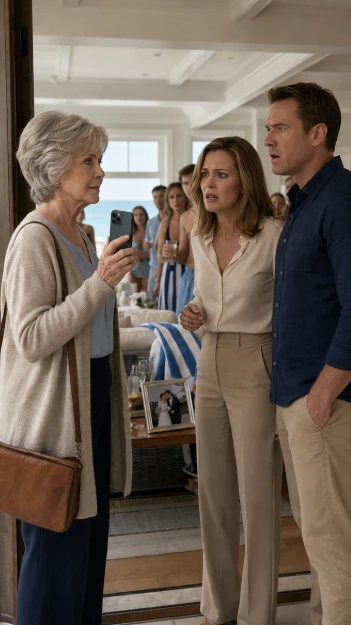
Conversation died first near the doorway, then farther into the living room as people noticed other people staring. One by one, heads turned toward me until the silence spread through the house more quickly than any announcement could have managed.
For a few seconds, I simply stood there.
There were strangers everywhere.
Not neighbors I had known for years. Not Robert’s childhood friends. Not people Henry and I had invited into our home over decades of birthdays, holidays, summer cookouts, and late-night card games.
Strangers. Dozens of them.
A young man I had never seen before was sitting in Henry’s chair with one ankle resting across his knee, laughing glass still raised halfway to his mouth. The laughter had vanished from his face, but he did not immediately stand.
Wet towels had been dropped across the sofa I had reupholstered myself after Robert left for college. One was twisted over the armrest, darkening the fabric beneath it.
Another lay on the floor beside the coffee table.
Cocktail glasses crowded almost every available surface. Some contained melting ice, others slices of fruit and bright-colored drinks that had left rings on the wood.
Someone had moved the small ceramic bowl Henry brought me from our twentieth-anniversary trip so there would be space for bottles.
Then I saw the wedding photograph.
For thirty years it had occupied the same corner of the side table beside Henry’s chair. In it, I was twenty-three and trying not to laugh because Henry had whispered something ridiculous just before the photograph was taken.
Now the frame had been shifted backward, nearly hidden behind a tray of empty glasses.
Something inside my chest tightened.
I looked farther into the room.
Children ran past the hallway, barefoot and damp, chasing one another through rooms whose floorboards Henry had repaired one plank at a time. One nearly collided with me before veering around without apology.
A woman wearing a beach cover-up leaned against the kitchen doorway with a drink in her hand. Another person had opened the cabinet where I kept the good serving dishes and left the door hanging open.
The entire house smelled wrong.
Not bad, exactly. Just wrong.
Alcohol, sunscreen, wet fabric, perfume, salt, food, and too many unfamiliar people had swallowed the quiet scent I had known for decades.
Robert had once said the house smelled like peace.
Standing there now, I wondered whether he remembered saying it.
Then Megan appeared.
She came from the direction of the kitchen holding herself with the stiff confidence of someone who had expected to control the entire evening. When she saw me, she stopped.
The irritation on her face appeared before she managed to arrange it into anything more polite.
“You’re early.”
I said nothing at first.
Her words settled between us with all the wrong assumptions packed inside them.
Early.
As though my presence required an appointed hour.
As though she had been granted a private interval in my home and I had violated it by arriving before she was finished using what belonged to me.
I looked at her, then at the crowded room behind her.
“I don’t need an invitation,” I said. “I live here.”
A few people nearby shifted uncomfortably. Someone lowered a glass to the table with exaggerated care.
Megan’s jaw tightened.
That was when I saw Robert.
He was farther inside the room, near the dining area, partly blocked by two people I did not recognize. He had been looking toward me since I entered, but when our eyes nearly met, he glanced away.
That small movement hurt more than the party itself.
I had spent the drive trying not to imagine deliberate betrayal. Perhaps Robert had misunderstood something. Perhaps Megan had told him I had agreed. Perhaps there was an explanation that would make all of this merely inconsiderate instead of calculated.
But a son who believed his mother had given permission would not be afraid to look at her.
Robert knew.
Maybe not every detail. Maybe not every guest. Maybe not the flowerbed crushed beneath tires and footsteps.
But he knew enough to understand why my arrival had silenced the room.
And still he remained where he was.
Megan looked from me toward him, and I saw something change in her expression. The surprise began to fade as she realized Robert was not moving.
Confidence returned in its place.
That was the pattern, wasn’t it?
She pushed because Robert yielded. She spoke because Robert stayed quiet. Every unchallenged inch became permission for the next one.
For years I had blamed Megan for taking too much space in our family. Only now did I fully understand how much space Robert had willingly surrendered to her.
One of the children shrieked somewhere upstairs, followed by running footsteps.
I flinched despite myself.
Megan noticed.
“There are a lot of people here,” she said, as though explaining something obvious to a confused guest.
I looked around once more.
There were enough people that I could not easily see the far side of my own living room. People stood beside furniture Henry and I had chosen. They leaned against walls where Robert’s childhood photographs had once hung before Megan persuaded him they looked “dated.”
I wondered how many of them had been told this was Robert and Megan’s place.
The thought came suddenly and with such clarity that I almost laughed.
Had Megan introduced herself as the owner?
Had she walked these people through the rooms describing her renovation ideas?
Had she pointed toward walls she intended to remove, bedrooms she intended to modernize, and decks she intended to enlarge?
Had she already begun performing a future in which I was conveniently absent?
I looked at Robert again.
This time he did glance up, but only for a second.
His face held the expression he had worn as a teenager whenever he had broken something and was waiting for Henry or me to discover it: guilt mixed with the hope that someone else would resolve the problem for him.
He was no longer seventeen.
I was no longer going to rescue him from the consequences of his silence.
Megan turned fully toward Robert.
She did not lower her voice enough for me to miss the words.
“There’s really no room for her.”
For a moment, I genuinely thought I had misunderstood.
The sentence was so outrageous that my mind rejected it before its meaning settled.
No room.
For me.
In my house.
The house Henry and I had paid for with forty-two years of work, postponed pleasures, repaired furniture, overtime, stiff fingers, sore backs, and every practical sacrifice two ordinary people make when they decide something matters enough to keep.
No room.
Around us, no one spoke.
Perhaps Megan meant there was no spare bedroom prepared. Perhaps she meant every bed had been claimed by one of these guests.
But the contempt beneath her words was too unmistakable for charitable interpretation.
She was not describing sleeping arrangements.
She was defining ownership.
Her meaning was simple: tonight belonged to them, and my presence complicated it.
I looked directly at her.
Then I looked at Robert.
I gave him one last chance without saying a word.
All he had to do was cross the room.
All he had to do was tell his wife that she had gone too far.
All he had to do was remember the mother who had dried his hair after summer storms, sat beside him through fevers, saved for his school trips, attended every graduation, listened through heartbreaks, and opened this house to him every summer of his childhood.
All he had to do was say, “She lives here.”
Robert lowered his eyes.
I felt the last fragile excuse I had been protecting for him collapse.
People often imagine betrayal as something loud. A slammed door. A cruel accusation. A public insult.
Sometimes it is none of those things.
Sometimes betrayal is a grown man standing twenty feet away from his mother while his wife tells a room full of strangers that there is no space for her in the home she owns.
And saying nothing.
The pain was immediate, but strangely clean.
For months I had been living with uncertainty. Had I overreacted at Christmas? Had Megan’s words meant something less ugly than they sounded? Had I been too harsh changing my estate plan without confronting Robert first?
His silence answered every question.
There was no anger in me then, or at least not the kind that makes people shout.
The anger had burned too long already. What remained was something colder and steadier.
Certainty.
I held Robert’s gaze when he finally looked up again.
He seemed to understand something from my expression, because his face changed slightly. His mouth opened as if he might speak.
But by then, whatever words he had found were late.
I turned back to Megan.
“I live here.”
My voice was quiet.
That seemed to unsettle her more than shouting would have.
She folded her arms.
Around us, several guests began pretending not to listen while very obviously listening. The man in Henry’s chair finally stood and placed his drink on the table.
I noticed that small act and felt an unexpected stab of gratitude toward a stranger whose name I would probably never learn.
At least someone in the room could recognize when he was sitting where he no longer belonged.
Robert took half a step forward.
“Mom—”
I raised my eyes to him, and he stopped.
I did not need an apology constructed under the pressure of witnesses. I did not need him suddenly courageous because he sensed consequences approaching.
What I had needed was his voice thirty seconds earlier.
He had chosen not to use it.
Some silences cannot be repaired by whatever comes after them.
Megan’s posture remained firm, but I knew her well enough to see the calculation beginning behind her eyes.
She was trying to decide whether I would make a scene.
That was what people like Megan expected when control slipped: shouting, tears, accusations. Noise could be dismissed afterward as emotion.
I gave her none of it.
Instead, I let my hand fall naturally toward my purse.
Robert noticed first.
His eyes followed the movement.
I opened the purse and reached inside.
For an instant, my fingers touched the folded edge of a tissue, my wallet, and then the cool surface of my phone.
I thought of the attorney’s office again.
The neat stack of documents.
The careful questions.
The moment I signed my name and removed Robert’s expectation from the future of this house.
At the time, the act had felt almost theoretical. Necessary, yes, but distant.
Tonight made it real.
They had planned a future inside my house without understanding that I had already rewritten that future months before.
I brought the phone out.
Megan’s arms loosened slightly.
The confidence in her face did not disappear all at once. It cracked in stages.
First came confusion.
Then suspicion.
Then the realization that I was not holding the phone like a woman about to take a photograph or call a friend for emotional support.
I knew exactly what I was doing.
Robert knew it too, or at least sensed it.
He straightened.
I unlocked the screen.
The house seemed even quieter now than when I first entered. The music still existed somewhere beneath the silence, but no one was dancing or talking over it anymore.
I opened my contacts.
My thumb moved without hesitation.
The name was already saved.
I had placed it there months ago for one reason: if the day ever came when I needed to protect my home from the people assuming they would someday control it, I would not waste time searching for help while they stood in front of me.
Megan watched the screen.
Her face had gone carefully blank, but that blankness was effort now.
“Who are you calling?”
Her voice was quieter than before.
That was the first sign she finally understood she might not be directing what happened next.
I looked up from the phone.
Robert was staring at me fully now.
For perhaps the first time since I entered, he was no longer avoiding my eyes.
Too late.
Megan’s gaze moved from my face to the phone and back again.
I thought about Christmas.
Her mother asking, “And Carol?”
Megan answering, “Eventually, it won’t be her decision.”
The arrogance of it still astonished me.
Not because she disliked me. Families survive dislike every day.
What mattered was that she had begun arranging my disappearance as though it were an administrative detail.
She had mistaken age for surrender. Widowhood for vulnerability. Love for weakness. And Robert’s expected inheritance for ownership.
I almost wished Henry were there.
Not because I needed him to defend me. That realization mattered.
For most of our marriage, Henry and I had protected each other instinctively. If he had heard Megan speak to me this way, I knew exactly how quickly his patience would have vanished.
But I did not need his voice now.
I had mine.
The house had always been a place where Henry and I stood together. Losing him had forced me to learn that standing alone did not mean standing helpless.
I glanced once around the room.
At the strangers waiting.
At the wet towels.
At the glasses crowding our tables.
At the space where our wedding photograph had been pushed aside.
At Henry’s now-empty chair.
Then I looked at Robert.
He knew, finally, that something irreversible had happened.
Perhaps he thought I was calling the police. Perhaps he suspected the attorney. Perhaps some older memory had returned to him and he remembered all those conversations about the house that he had refused to confront.
I did not explain.
He had spent too long letting silence do his speaking. Now he could sit inside mine.
Megan swallowed.
The motion was small, but I saw it.
A few minutes earlier she had looked at me as though my arrival were an inconvenience to be solved.
Now she looked like a woman suddenly wondering how much of the future she had built in her imagination actually belonged to her.
That was the answer I wanted her to discover for herself.
Nothing.
Not the walls.
Not the deck.
Not the upstairs rooms.
Not the flowerbeds.
Not Henry’s chair.
Not the view from the porch at sunrise.
And certainly not the right to decide when I would stop belonging there.
I held Megan’s eyes.
“Someone you should have known about before planning your future inside my house.”
Robert’s head snapped up.
Megan’s face lost the last of its certainty.
For one suspended moment, nobody moved.
I felt the phone steady in my hand and Henry’s house solid beneath my feet.
Then I pressed call.