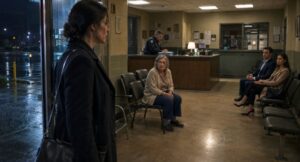
“Clara, I’m at the police station,” my mother whispered, and every trace of sleep left me before she finished the sentence.
Her breathing sounded shallow through the phone, while an unfamiliar man ordered someone to move away from the front desk.
“Why are you there?” I asked, already throwing the blanket aside and reaching for the jeans beside my bed.
Mom hesitated long enough that I heard a radio crackling near her. “Brooke hit me, and somehow they arrested me.”
My hand stopped above my boots. “Where are you hurt?”
“My shoulder hurts badly,” she said. “My wrist is worse, my ribs ache, and my eye keeps swelling.”
Someone in the background told her to finish the call. Mom immediately lowered her voice.
“Arthur told them I started everything,” she whispered. “He stood beside Brooke and agreed with every word.”
“Do not sign anything,” I said. “Do not explain yourself again, even if someone pressures you.”
A chair scraped loudly beside her. Then a woman’s voice cut through the room.
“She’s manipulating you again,” Brooke snapped. “That’s what she does.”
I recognized my sister-in-law instantly.
Mom went silent.
I could almost picture her shrinking into herself, trying to avoid another confrontation.
“Mom,” I said firmly. “Stay on the phone with me.”
“I’m here.”
“Are you restrained?”
Another pause followed.
“Yes.”
That answer sent a cold current through my chest.
“You’re injured, and they put you in restraints?”
“They said Brooke was afraid of me.”
I forced my breathing to remain steady.
Years of legal work had taught me that anger could destroy details.
Details were exactly what I needed.
“What time did everything happen?”
“A little after midnight.”
“Where?”
“At my house.”
“Who called police?”
“Arthur.”
“Did anyone photograph your injuries?”
“No.”
“Did anyone offer medical treatment?”
“No.”
That answer mattered more than almost anything else she had said.
“Did anyone ask how you got hurt?”
“One officer asked.”
“What did you tell him?”
“I said Brooke caused it.”
“And then?”
“He looked at Arthur.”
I closed my eyes briefly.
“What did Arthur say?”
“He said I was confused.”
The room around me seemed suddenly too quiet.
I grabbed my coat and headed for the stairs.
“What happened next?”
“They told me to cooperate.”
“Did Brooke have visible injuries?”
“Not that I saw.”
Mom’s voice cracked.
“She was crying, though.”
Crying could become evidence when people wanted it to.
Silence often became guilt when people wanted that instead.
I reached my front door.
“Mom, listen carefully.”
“I am.”
“I’m coming to Westbridge.”
Her breathing changed immediately.
Not relief exactly.
Something closer to permission.
“Please hurry.”
The call ended.
I stood in my doorway while freezing rain rattled against the porch railing.
For one second, I wanted to call Arthur.
I wanted to demand answers before leaving home.
I wanted to hear him explain why our mother was sitting injured inside a police station.
I did none of those things.
Arthur would have time to adjust his story if I warned him.
Brooke would have time to adjust hers too.
I needed their first version preserved exactly as they had given it.
I locked the door and crossed the driveway.
Ice had already formed along the edges of my windshield.
The weather report had warned about freezing rain across central Virginia.
The streets toward Westbridge looked almost polished beneath the streetlights.
I drove slower than I wanted.
Every red light felt personal.
Every empty intersection seemed to delay me deliberately.
My phone sat faceup beside the gearshift.
I resisted checking it every few seconds.
Instead, I reconstructed the timeline aloud.
“Argument after midnight,” I said.
“Arthur calls police.”
“Brooke claims Helena started it.”
“Helena reports injuries.”
“Officers restrain Helena.”
“No photographs.”
“No medical evaluation.”
“No documentation before transport.”
Saying the sequence aloud stripped emotion from it.
That helped.
I had spent years reviewing cases where the first version became sacred simply because police wrote it first.
Facts did not care which version reached paper earliest.
But people often did.
Before federal oversight work, I had served in military legal offices.
There, a misplaced time stamp could unravel an entire disciplinary case.
A missing photograph could become more important than ten confident statements.
Westbridge appeared ahead through the rain.
The town sat forty miles outside Richmond.
Its downtown carried old brick storefronts, chain restaurants, courthouse buildings, and a police station renovated during the previous decade.
I knew the building better than my family realized.
That knowledge had nothing to do with Mom.
Three months earlier, I had received an assignment involving Westbridge Police Department.
Complaints against the department had increased during the previous year.
Several involved inconsistent arrests after domestic disputes.
Others questioned reporting practices, medical referrals, and supervisor review.
The federal review remained confidential outside a narrow circle.
My family knew I worked in federal oversight.
They did not know which departments currently sat on my desk.
Westbridge did.
That coincidence had bothered me before tonight.
Now it frightened me.
I turned into the station parking lot.
Two patrol vehicles sat beneath bright security lights.
A third idled near the side entrance.
Rainwater streamed along the pavement.
I parked beside the visitor spaces and remained behind the wheel for several seconds.
My hands were steady.
My heartbeat was not.
Inside that building sat my mother.
Inside that same building sat people whose procedures I was already assigned to examine.
I stepped outside.
Cold rain struck my face immediately.
By the time I reached the entrance, water covered my coat shoulders.
The automatic doors opened with a dull mechanical hum.
Warm fluorescent light washed over me.
The front lobby was larger than I remembered from official photographs.
Plastic chairs lined one wall.
A television displayed weather alerts without sound.
A vending machine buzzed near the hallway.
Mom sat across the room.
Seeing her erased every prepared sentence from my mind.
Her right eye had swollen noticeably.
A dark reddish-purple mark spread beneath it.
Her cardigan hung torn near one shoulder.
She held her left wrist against her body.
Metal restraints remained around both wrists.
She looked smaller than she had ever looked inside her own kitchen.
Brooke sat several chairs away.
Arthur sat beside her.
Brooke leaned against his shoulder dramatically.
Her face was damp.
Her clothing looked undisturbed.
Arthur’s hand rested protectively over hers.
Neither noticed me immediately.
The desk officer did.
He looked up with obvious irritation.
“Lobby’s closed for general walk-ins until morning,” he said.
I kept walking.
“I’m here for Helena Mercer.”
His expression barely changed.
“You family?”
“Yes.”
“She’s being processed.”
“Has she received medical attention?”
The officer exhaled.
“You’ll need to wait.”
I looked directly at him.
“Has she received medical attention?”
Something in my voice finally made him focus.
His eyes narrowed.
Then recognition struck.
He straightened so quickly that his chair rolled backward.
“Ms. Mercer?”
Arthur turned at the sound of my name.
Brooke lifted her head.
The officer’s face lost color.
“Ma’am,” he said quietly. “I didn’t know she was your mother.”
Everything in the lobby changed after that sentence.
Not because he recognized me.
Because he admitted recognition should matter.
I looked toward Mom.
Then I looked back at him.
“Why would that change anything?”
The officer opened his mouth.
No answer came.
Brooke stood abruptly.
“Clara?”
Arthur rose beside her.
He looked exhausted rather than surprised.
“Why are you here?” he asked.
I stared at him.
“Mom called me.”
Arthur rubbed one hand across his mouth.
“She shouldn’t have done that.”
Mom flinched visibly.
That tiny reaction told me more than Arthur understood.
Brooke stepped forward.
“You don’t know what happened.”
“You’re right,” I said. “So tell me.”
Arthur shifted uncomfortably.
Brooke folded her arms.
“She attacked me.”
Mom looked up.
“That is not true.”
Brooke spun toward her.
“Stop lying.”
Mom’s shoulders tightened.
I moved between their lines of sight.
“Brooke, where are you injured?”
Her confidence flickered.
“She grabbed me.”
“Where?”
“My arms.”
“Which one?”
“Both.”
I looked at her sleeves.
No tears.
No dirt.
No obvious marks.
“Did medical staff examine you?”
Brooke glanced at Arthur.
“I didn’t need medical attention.”
I nodded.
“Did anyone photograph your arms?”
The desk officer suddenly found paperwork extremely interesting.
Brooke’s eyes sharpened.
“Why are you interrogating me?”
“I asked two questions.”
Arthur stepped closer.
“Clara, don’t turn this into one of your investigations.”
I looked at him.
“It already became one when police arrested our injured mother.”
“You weren’t there.”
“Neither was any officer before your call.”
Arthur’s jaw tightened.
Mom looked down.
Brooke laughed once.
It carried no humor.
“You always do this.”
“Do what?”
“You walk into a room and make everyone feel guilty.”
“I haven’t accused you of anything.”
“You don’t need to.”
The desk phone rang.
The officer grabbed it immediately.
He seemed grateful for an excuse to look away.
Brooke moved closer to Arthur.
“She was out of control,” Brooke said.
Mom’s head lifted.
“I asked you to leave my house.”
Brooke’s expression hardened.
“You screamed at us.”
“I raised my voice after you refused.”
Arthur finally faced Mom.
“You were being unreasonable.”
Mom stared at him.
Her disappointment seemed heavier than anger.
“It was my house.”
Nobody answered.
I pulled a chair beside her.
The restraints clinked when she shifted.
I examined her wrist without touching it.
Swelling had begun around the joint.
Her fingers looked stiff.
“Can you move them?”
“A little.”
“Any numbness?”
“Two fingers.”
I turned toward the desk.
“She needs medical evaluation now.”
The officer lifted one hand.
“I’ll get the arresting officer.”
“That was not my request.”
Brooke scoffed.
“She’s fine.”
I looked at her.
“Then you won’t object to a medical professional deciding that.”
Arthur whispered something to Brooke.
She ignored him.
A hallway door opened.
A younger patrol officer entered.
His badge read MILLS.
He carried a clipboard.
His gaze moved from me to Mom.
Then he looked toward the desk officer.
“What’s going on?”
The desk officer lowered his voice.
“That’s Clara Mercer.”
Mills stared blankly.
The desk officer added something quieter.
Recognition arrived differently this time.
Mills became defensive.
“We handled the call based on statements at the residence.”
“Which statements?” I asked.
“Ma’am, I can’t discuss an active case.”
“I’m Helena’s daughter.”
“That doesn’t change disclosure rules.”
“That part is correct.”
He seemed surprised.
I continued.
“My question was simpler.”
Mills frowned.
“What question?”
“Which injuries did you document before restraining her?”
His eyes moved toward Mom.
That movement gave me the answer.
“I noted her condition.”
“Where?”
“In my report.”
“Did you photograph her?”
“No.”
“Did you request medical personnel?”
“She declined.”
Mom looked up sharply.
“I never declined.”
Mills turned toward her.
“You said you wanted to go home.”
“That is not refusing treatment.”
He looked back at me.
“The scene was chaotic.”
“I understand.”
That answer seemed to unsettle him more than anger would have.
I took out my phone.
Arthur’s face tightened.
“What are you doing?”
“Taking notes.”
Brooke gave a short laugh.
“This is unbelievable.”
Mom whispered, “Clara.”
I turned.
Her eyes were wet.
“Please don’t make trouble because of me.”
The sentence broke something inside me.
I leaned closer.
“You did not create this situation.”
Mills cleared his throat.
“Ma’am, we have procedures.”
I looked at him.
“Then follow them.”
He stared at me.
“Start with medical care.”
Mills hesitated.
The desk officer reached for his radio.
That small movement marked the first shift.
Not surrender.
Not accountability.
Just uncertainty.
Sometimes uncertainty was enough to break a bad pattern.
Ten minutes later, a paramedic entered the lobby.
She introduced herself as Dana Ruiz.
Her expression changed when she saw Mom.
“How long has she been like this?”
Nobody answered immediately.
Dana crouched beside Mom.
“I’m going to check your wrist first.”
Mom nodded.
Dana examined the swelling carefully.
“Any dizziness?”
“Yes.”
“Nausea?”
“A little.”
“Blurred vision?”
“Earlier.”
Dana looked over her shoulder.
“She should be evaluated at the hospital.”
Officer Mills folded his arms.
“Is that necessary?”
Dana stared at him.
“With facial swelling and dizziness?”
Mills looked away.
“Yes,” Dana said. “It is.”
Brooke shifted in her chair.
Arthur whispered, “This is getting ridiculous.”
Mom heard him.
So did I.
She closed her eyes.
I stood.
“Arthur, come outside with me.”
He shook his head immediately.
“No.”
“I’m not asking to fight.”
“I said no.”
Brooke touched his arm.
“Don’t go anywhere with her.”
Arthur’s eyes remained on mine.
“What do you want?”
“The truth.”
“You already decided what the truth is.”
“I decided Mom needs treatment.”
“You always choose her.”
The words landed harder than I expected.
Mom opened her eyes.
Arthur realized too late that she had heard him.
He turned away.
Our family had never been simple.
Dad died when Arthur was twenty-six and I was twenty-three.
Mom had leaned heavily on both of us afterward.
Arthur resented that responsibility.
I handled it differently.
Neither response made us heroes.
But resentment had grown inside Arthur quietly.
Brooke had learned how to feed it.
Their marriage started warmly.
For a while, Mom adored her.
Then small conflicts accumulated.
Brooke criticized how Mom hosted holidays.
Mom questioned how Arthur spent money.
Arthur began avoiding Sunday dinners.
Brooke started interpreting every disagreement as disrespect.
Still, none of that explained tonight.
Dana placed Mom’s arm in a temporary support.
She asked police to remove the restraints.
Mills hesitated again.
“She’s technically in custody.”
Dana’s expression hardened.
“She needs imaging.”
I watched Mills carefully.
He looked toward the desk officer.
The desk officer looked toward the hallway.
Nobody seemed willing to decide.
Finally, a supervisor appeared.
Lieutenant Garner wore a wrinkled uniform shirt.
His expression suggested he had been called from another office.
“What’s the delay?”
Mills summarized quickly.
His version sounded clean.
Too clean.
“Domestic disturbance.”
“Conflicting statements.”
“Probable cause established.”
“Subject transported.”
“Medical complaint raised afterward.”
Mom shook her head.
“That is not what happened.”
Garner looked at her.
“Mrs. Mercer, you’ll have an opportunity to make a statement.”
“She already made one,” I said.
Garner turned.
“And you are?”
The desk officer answered before I could.
“Clara Mercer.”
Garner’s face changed.
Unlike Mills, he recognized the name immediately.
His eyes dropped toward the identification wallet in my hand.
Then he looked back at me.
“Ms. Mercer.”
“Lieutenant.”
A silence opened between us.
Arthur noticed it.
Brooke noticed it too.
“What is this?” Brooke asked.
Garner ignored her.
He stepped closer.
“I wasn’t aware you had a personal connection to this call.”
“Neither was I until 2:27 this morning.”
That answer seemed to confirm something he feared.
Garner rubbed his jaw.
“We should talk privately.”
“No.”
His eyebrows lifted.
“My mother is sitting here injured.”
“I understand.”
“Then anything relevant to her treatment can be discussed here.”
Garner looked toward Dana.
“Can she be transported?”
“Yes.”
“Remove the restraints.”
Mills looked surprised.
“Lieutenant?”
“Remove them.”
The cuffs opened.
Mom inhaled sharply as her hands separated.
The sound was almost silent.
Still, everyone heard it.
Dana helped her stand.
Mom swayed.
I caught her elbow.
Arthur took one step forward instinctively.
Brooke stopped him with a look.
That hurt Mom more than the movement itself.
I saw it in her face.
She steadied herself without Arthur.
“I’m okay,” she said.
Dana shook her head.
“No, ma’am.”
Mom gave a weak smile.
“You sound like my daughter.”
Dana glanced at me.
“Good.”
The paramedics escorted Mom toward the entrance.
I moved with them.
Garner followed.
“Ms. Mercer, before you leave.”
I stopped.
He lowered his voice.
“This needs to be handled carefully.”
I looked at him.
“Everything involving an arrest should be handled carefully.”
“That isn’t what I meant.”
“I know.”
Garner’s shoulders stiffened.
Behind him, Brooke watched us.
Her earlier confidence had faded.
Arthur looked confused.
Neither understood the conversation.
They were not supposed to.
The federal review had not yet been announced publicly.
Only senior command staff knew it was coming.
Some supervisors knew my name.
Most patrol officers did not.
I had planned to enter Westbridge officially the following week.
Tonight had erased that schedule.
Garner glanced toward the lobby.
“Are you planning to report this?”
I kept my voice neutral.
“I am already required to document it.”
His face tightened.
Arthur stepped closer.
“Document what?”
Nobody answered him.
Brooke looked from Garner to me.
“What exactly do you do now?”
I met her eyes.
“You know I work for the federal government.”
“That doesn’t answer my question.”
“No.”
Her mouth opened slightly.
Then the paramedic called my name.
I left.
The ride to Westbridge Regional Hospital took twelve minutes.
I followed the ambulance through wet streets.
Arthur did not follow.
Neither did Brooke.
That told me something too.
At the emergency department, Mom received imaging.
Her wrist had a small fracture.
Two ribs were badly bruised.
Her shoulder showed significant soft-tissue trauma.
Doctors found no internal bleeding.
The swelling around her eye remained concerning but stable.
A nurse photographed the visible injuries with Mom’s consent.
That single step should have happened earlier.
I sat beside the examination bed.
Mom stared toward the curtained doorway.
“You should call Arthur.”
“I will.”
“He’s still my son.”
“I know.”
“He’ll think you’re trying to destroy him.”
“I’m trying to establish what happened.”
She gave me a tired look.
“Those sound like the same thing when someone is afraid.”
I could not argue with that.
Mom looked at her supported wrist.
“I should have made them leave sooner.”
“What started the argument?”
Her face tightened.
“Money.”
I waited.
Mom swallowed.
“Arthur asked me to cosign another loan.”
That surprised me.
“How much?”
“Forty thousand.”
“For what?”
“He said they needed to consolidate debt.”
“Did Brooke ask too?”
“She did most of the talking.”
Mom looked embarrassed.
“They already borrowed from me last year.”
I remembered.
Arthur had called it temporary.
He never mentioned the amount.
“How much?”
“Twenty-five thousand.”
I stared at her.
“You never told me.”
“I didn’t want you judging him.”
“I wouldn’t have judged him.”
Mom raised one eyebrow.
I sighed.
“Fine.”
“You would have investigated him.”
Despite everything, she almost smiled.
The expression vanished quickly.
“I told them no tonight.”
“What happened next?”
“Brooke said I cared more about control than family.”
Mom looked toward the ceiling.
“Arthur told me Dad would have helped.”
That was cruel.
He knew exactly what that comparison would do.
“What did you say?”
“I told him Dad would never pressure me like that.”
Mom’s voice weakened.
“Brooke laughed.”
I felt anger rise again.
I kept my hands still.
“Then what?”
“She called me selfish.”
“Did you ask them to leave?”
“Yes.”
“Did they?”
“No.”
Mom inhaled carefully.
“My ribs hurt when I breathe deeply.”
“Take your time.”
“She walked toward the garage door.”
Mom closed her eyes.
“I thought she was leaving.”
The baseball bat had belonged to Dad.
He kept it near the garage after a string of neighborhood break-ins years earlier.
It was old and wooden.
Arthur knew exactly where it was.
Brooke did too.
“She came back holding it,” Mom said.
I remained silent.
“I told her to put it down.”
Mom’s fingers trembled.
“Arthur said, ‘Brooke, stop.’”
That detail mattered.
“He told her to stop before anything happened?”
“Yes.”
“Then he saw the bat.”
“Yes.”
Mom turned toward me.
“He knew.”
The room felt smaller.
“What happened after that?”
Mom looked away.
“She swung it toward me.”
Her voice became almost mechanical.
“I raised my arm.”
I did not ask her to describe more.
I did not need graphic detail.
Her injuries already explained enough.
“What did Arthur do?”
“Nothing.”
The answer barely reached me.
“Afterward?”
“He took the bat from Brooke.”
“Then?”
“He called 911.”
That surprised me.
“What did he tell dispatch?”
Mom stared at the blanket.
“I could hear him.”
“What did he say?”
“He said I had attacked Brooke.”
I closed my eyes.
There it was.
Not confusion.
Not a chaotic misunderstanding.
A decision.
“Did Brooke say anything?”
“She started crying.”
“Before police arrived?”
“Yes.”
“What did Arthur tell you?”
Mom’s face changed.
“He told me to calm down.”
A bitter laugh escaped her.
“I was sitting on the floor.”
I felt my throat tighten.
“What else?”
“He said this could still end quietly.”
That sentence mattered.
“How?”
“He said I should tell police we had all overreacted.”
“And if you refused?”
“He said they would believe Brooke.”
Mom turned toward me.
“He was right.”
For several seconds, neither of us spoke.
The monitor beside her bed beeped steadily.
A nurse passed behind the curtain.
Somewhere nearby, a child began crying.
Ordinary hospital sounds continued around something that felt impossible.
I opened my notebook.
Mom frowned.
“You’re working?”
“I’m preserving your statement.”
“I’m your mother.”
“I know.”
“That is why this hurts.”
She looked at me for a long moment.
Then she nodded.
“Write it down.”
At 4:18 a.m., my federal supervisor called.
Dana Pierce rarely called before sunrise.
Garner had clearly contacted someone.
“Clara,” Dana said. “Tell me you’re not at Westbridge.”
“I’m at the hospital now.”
A long silence followed.
“Is the arrested woman your mother?”
“Yes.”
“Are you okay?”
“No.”
“Can you separate yourself from the review?”
That question was necessary.
It still stung.
“I can separate myself from decisions involving her case.”
“That wasn’t my question.”
I understood.
Federal investigators lived and died by conflicts.
My personal connection changed everything.
“I can document what I directly observed.”
“Yes.”
“I can preserve evidence.”
“Yes.”
“I cannot lead conclusions involving my mother’s treatment.”
“Correct.”
I looked toward Mom.
She had closed her eyes.
“What happens to my assignment?”
“We adjust it.”
“Do I get removed?”
“From decisions directly tied to this incident.”
Dana paused.
“Not from the entire department review.”
That surprised me.
“Why?”
“Because your assignment predates tonight.”
She continued before I could respond.
“And because Westbridge already knows your identity.”
I leaned back.
“They knew more than I expected.”
“Apparently.”
“Garner recognized me.”
“I know.”
“Who called you?”
“The chief.”
That answer carried weight.
“Chief Benton?”
“Yes.”
“What did he say?”
“That there was an unexpected conflict involving one of our reviewers.”
“Did he mention Mom’s injuries?”
Another pause.
“No.”
That angered me more than it should have.
Of course it did.
Institutions often protected themselves first.
Dana’s voice softened.
“Clara, listen to me.”
“I’m listening.”
“Your mother deserves a clean investigation.”
“I agree.”
“That means you cannot become the prosecutor, witness, investigator, and daughter at once.”
“I know.”
“Good.”
She paused.
“But you are still allowed to be her daughter.”
That sentence nearly undid me.
I looked toward Mom again.
Her face looked exhausted.
“I’m staying with her.”
“You should.”
“What should I preserve?”
“Everything you lawfully can.”
“Body cameras.”
“Yes.”
“Dispatch recordings.”
“Yes.”
“Station video.”
“Yes.”
“Booking logs.”
“Yes.”
“Medical refusal documentation.”
Dana’s voice sharpened.
“Especially that.”
I wrote the list.
She added one final instruction.
“Do not argue with Westbridge officers.”
“I haven’t.”
“I know you.”
Despite myself, I smiled.
“I haven’t.”
“Good.”
She paused again.
“Let their records speak.”
At 5:02 a.m., Arthur finally arrived.
He came alone.
Mom saw him through the curtain first.
Her entire body tensed.
I stood.
Arthur stopped several feet away.
“How is she?”
I looked toward Mom.
“That depends on whether she wants you here.”
Arthur’s face hardened.
“She’s my mother too.”
Mom spoke softly.
“Then act like it.”
He froze.
I had never heard Mom say anything like that to him.
Neither had he.
“Mom.”
“No.”
She raised her good hand.
“Not yet.”
Arthur stared at the floor.
His eyes looked red.
“Brooke went home.”
“Of course she did,” Mom said.
“She was upset.”
“So was I.”
Arthur winced.
Mom continued.
“I was also injured.”
He looked toward her wrist support.
His face changed.
For the first time, something resembling shame appeared.
“I didn’t know it was broken.”
“You never asked.”
Arthur swallowed.
“I thought you were exaggerating.”
Mom’s eyes filled.
“You watched it happen.”
He looked away.
I remained near the wall.
This conversation belonged to them.
Arthur rubbed his hands together.
“Brooke didn’t mean for it to go that far.”
Mom stared at him.
“That sentence is worse than silence.”
Arthur looked at me.
“Clara, say something.”
“I’m listening.”
“You always have an opinion.”
“I have several.”
“Then say them.”
Mom shook her head.
“No.”
Arthur turned back toward her.
She breathed carefully.
“You don’t get to use your sister to make this easier.”
His shoulders fell.
The room remained silent.
Then Arthur whispered, “I was scared.”
“Of Brooke?”
“Of everything.”
“That is not an answer.”
He sat in the chair beside the curtain.
Mom did not invite him closer.
Arthur stared at his hands.
“We’re drowning financially.”
I said nothing.
Mom already knew.
“Brooke’s business failed,” he continued.
“The credit cards are maxed.”
Mom’s expression remained still.
“We’re behind on the mortgage.”
That was new.
“How far?” Mom asked.
“Three months.”
She closed her eyes.
Arthur’s voice became desperate.
“I thought you would help.”
“You thought I would surrender.”
“No.”
“Yes.”
Mom looked at him.
“You brought Brooke into my home after I said no.”
Arthur’s eyes filled.
“I didn’t know she would grab the bat.”
“You saw her holding it.”
“I thought she was trying to scare you.”
“And that was acceptable?”
“No.”
“Yet you stayed.”
Arthur pressed both hands against his forehead.
“I panicked.”
Mom’s voice hardened.
“You lied.”
He looked up.
“I was trying to protect my wife.”
“You protected her from what she did.”
Arthur had no answer.
The curtain shifted.
Dana Pierce stepped inside.
She had driven from Richmond.
Her dark coat still carried rain.
Arthur looked confused.
I stood immediately.
“Dana.”
She nodded to me.
Then she looked toward Mom.
“Mrs. Mercer?”
“Yes.”
“I’m Dana Pierce.”
Mom glanced at me.
Dana continued.
“I supervise Clara’s federal review work.”
Arthur’s head lifted sharply.
“Federal review?”
Dana looked at him.
“That is not a discussion I can have with you.”
He turned toward me.
“What review?”
I did not answer.
Understanding began forming across his face.
“Westbridge?”
Dana remained expressionless.
Arthur stood.
“Clara is investigating Westbridge Police?”
“Arthur,” I said.
His voice rose.
“Is that why everyone at the station acted weird around you?”
Mom stared at me too.
I took a slow breath.
“My current assignment includes a federal review of Westbridge Police Department.”
Nobody spoke.
Arthur looked stunned.
Mom looked confused.
Dana watched both carefully.
“You were already reviewing them?” Mom asked.
“Yes.”
“Before tonight?”
“Yes.”
“How long?”
“Three months.”
Arthur sank back into the chair.
“Oh, God.”
Mom looked toward the hallway.
Then she laughed once.
It sounded tired and sad.
“That officer said he didn’t know I was your mother.”
“Yes.”
“Now I understand.”
She looked at me again.
“No.”
“What?”
“You understand something worse.”
Her voice trembled.
“He thought I deserved different treatment only because of you.”
I had reached the same conclusion.
Hearing Mom say it made it sharper.
Dana stepped closer.
“That concern is exactly why Clara cannot control this incident review.”
Arthur looked between us.
“So what happens?”
Dana answered.
“An independent team handles your mother’s case.”
“And Westbridge?”
“The broader review continues.”
Arthur’s face went pale.
“Brooke is going to lose her mind.”
Mom looked at him.
“That is not the problem you should be worried about.”
At 6:10 a.m., Westbridge Police Chief Martin Benton arrived.
He did not enter with uniformed officers.
He came alone.
Benton was fifty-eight, broad-shouldered, and usually calm during official meetings.
Today he looked ten years older.
Dana met him in the hospital hallway.
I remained inside Mom’s room.
Through the glass panel, I watched them speak.
Benton gestured once.
Dana barely moved.
Then Benton looked through the glass and saw me.
His expression tightened.
He entered five minutes later.
“Mrs. Mercer.”
Mom looked at him.
“Chief.”
“I’m sorry you were injured.”
She waited.
Benton continued.
“And I’m sorry your treatment has raised serious concerns.”
Mom’s expression hardened.
“Raised concerns?”
He recognized the mistake.
“You’re right.”
He corrected himself.
“There are serious concerns.”
Mom nodded once.
Better.
Benton looked toward me.
“Clara, I want you to know I’ve ordered preservation of all relevant records.”
“That is appropriate.”
“Body camera files.”
“Good.”
“Dispatch audio.”
“Good.”
“Station surveillance.”
“Good.”
“Incident reports and edits.”
That last category mattered.
“Including revision history?”
“Yes.”
Dana watched him carefully.
Benton continued.
“Officer Mills and Sergeant Wade have been placed on administrative duty pending review.”
Mom looked surprised.
“What about the lieutenant?”
“Lieutenant Garner has been removed from supervisory decisions involving this matter.”
Dana spoke.
“That does not replace our process.”
“I understand.”
Benton nodded.
“I’m not trying to interfere.”
Then he looked at Mom.
“I’m trying to keep my department from making another mistake.”
Mom studied him.
“That depends on whether this was a mistake.”
Benton said nothing.
She continued.
“A mistake is writing the wrong date.”
Her voice remained soft.
“Choosing not to see an injured person is something else.”
Benton absorbed that without defending himself.
That earned him more respect than excuses would have.
At 7:05 a.m., the first preserved video arrived through proper federal channels.
Dana viewed it.
I did not.
That boundary hurt.
It was still necessary.
I sat with Mom while Dana stepped into a consultation room.
Arthur paced the hallway.
He kept checking his phone.
Brooke called him repeatedly.
He ignored the first two calls.
He answered the third.
I heard only his side.
“Not now.”
“No.”
“She’s still here.”
“Brooke, stop.”
“No, Clara is here too.”
A long silence followed.
Arthur’s face changed.
Then he said, “Yes.”
He looked toward me.
“She knows.”
Another pause.
“No.”
His voice lowered.
“You need a lawyer.”
Mom looked away.
Arthur ended the call.
His hands shook.
“Brooke says you’re doing this because you hate her.”
I almost laughed.
Instead, I said, “Brooke is not the center of a federal review.”
Arthur sat heavily.
“You don’t understand her.”
“Then help me.”
He stared at me.
“What does that mean?”
“Tell the truth when investigators ask.”
Arthur looked toward Mom.
“I already ruined everything.”
Mom answered quietly.
“No.”
He looked up.
“You can still decide what kind of man you are after ruining something.”
Arthur began crying then.
Not dramatically.
Not loudly.
He covered his face and bent forward.
Mom watched him.
She did not comfort him.
That was probably harder than comforting him.
Dana returned forty minutes later.
Her expression told me enough.
She addressed Mom first.
“Mrs. Mercer, the body-camera footage supports several parts of your account.”
Mom released a breath.
Arthur closed his eyes.
Dana continued.
“The review team will handle details.”
She looked toward Arthur.
“You may be contacted for a formal interview.”
He nodded.
“Okay.”
Dana looked back at Mom.
“You were visibly injured before officers placed you in restraints.”
Mom’s eyes filled.
“Did they see?”
“Yes.”
That single word changed the room.
Mom had spent hours wondering whether perhaps they somehow missed everything.
They had not.
Dana continued.
“An officer discussed your injuries on camera.”
I felt my stomach tighten.
“What did he say?” Mom asked.
Dana hesitated.
Then she answered carefully.
“He said they could deal with that after booking.”
Mom looked down.
Arthur whispered something I could not hear.
Dana continued.
“The footage also shows Brooke without visible injuries during the officers’ initial contact.”
Arthur’s face went pale.
Mom looked toward him.
“Did she tell them I attacked her?”
Dana nodded.
“Yes.”
“What did Arthur say?”
Dana looked at him.
Arthur answered himself.
“I backed her up.”
Mom closed her eyes.
Dana’s voice remained professional.
“The dispatch recording will also be reviewed.”
Arthur nodded.
“I understand.”
“No,” Mom said.
He looked at her.
“You’re beginning to.”
By noon, doctors discharged Mom.
She left with a wrist brace, medication, and follow-up instructions.
Arthur offered to drive her home.
She refused.
“I’m going with Clara.”
He nodded.
“Can I come later?”
Mom looked at him for a long time.
“Not today.”
Arthur accepted it.
That mattered.
Outside, the freezing rain had weakened into cold drizzle.
I helped Mom into my car.
She moved carefully.
Before closing the door, she looked toward the hospital entrance.
Arthur stood beneath the awning alone.
Brooke was nowhere nearby.
Mom watched him for several seconds.
Then she turned forward.
“Take me home.”
Her house looked exactly as it had before.
That felt wrong.
The porch light remained on.
A ceramic planter had tipped during the storm.
Arthur’s truck tracks still marked the driveway.
Inside, one kitchen chair lay sideways.
A broken mug remained near the counter.
I stopped Mom before she entered farther.
“Police released the scene?”
“Yes.”
“Then I’m photographing everything.”
She sighed.
“You really are impossible.”
“That sounds affectionate.”
“It isn’t.”
I took photographs anyway.
The garage door stood partly open.
Dad’s old baseball bat was gone.
Police had collected it.
Mom stared at the empty corner where it usually rested.
“He bought that at a yard sale.”
“I remember.”
“He never used it.”
“He liked threatening imaginary burglars.”
Mom smiled faintly.
“He was terrible at baseball.”
“Truly terrible.”
The smile disappeared.
“I hate that Brooke touched it.”
I understood.
Objects absorbed meaning from people.
Sometimes another person could ruin that meaning in seconds.
Mom sat at the kitchen table.
I made tea.
She watched me moving around her kitchen.
“You look like your father when you’re angry.”
“That is insulting.”
“He was handsome.”
“He was dramatic.”
“So are you.”
I placed the mug before her.
She wrapped her good hand around it.
For the first time since the phone call, she looked safe.
Not healed.
Not settled.
Safe.
My phone rang.
Dana.
I stepped into the living room.
“We have more,” she said.
“What?”
“The station surveillance.”
I waited.
“Your mother was brought in at 1:41.”
“And?”
“Officer Wade made comments about her injuries.”
“What kind?”
“I can’t give you everything yet.”
“Dana.”
She sighed.
“He asked Mills whether they should call EMS.”
My stomach tightened.
“And Mills?”
“He said booking could handle it.”
I stared through the window.
Rain slid slowly down the glass.
“What about Garner?”
“He arrived later.”
“Before I did?”
“Yes.”
That surprised me.
“Then why did he act newly informed?”
“Good question.”
I closed my eyes.
“Do we have an answer?”
“Not yet.”
“What else?”
“Wade recognized your last name during booking.”
I went still.
“What?”
“He asked whether Helena Mercer was related to you.”
“When?”
“Before you arrived.”
My grip tightened around the phone.
“And?”
“Mills said he didn’t know.”
Dana paused.
“Then Wade searched your name.”
The room seemed to tilt.
“He knew before I entered?”
“At least several minutes before.”
That changed the desk officer’s statement completely.
He had not simply recognized me when I walked inside.
He had already realized who Mom might be.
“Did their behavior change?”
“Yes.”
“How?”
“They began discussing whether to call a supervisor.”
I looked toward the kitchen.
Mom sat alone with her tea.
“So they only became concerned after connecting her to me.”
“That appears possible.”
Dana chose her words carefully.
“The independent team will make that determination.”
I understood.
“Anything about Brooke?”
“Yes.”
“What?”
“One body camera captured Arthur speaking privately with her.”
I waited.
Dana’s voice lowered.
“Arthur told Brooke they needed to keep their story straight.”
My heart sank.
“Mom was right.”
“It appears so.”
“Did Brooke respond?”
“Yes.”
“What did she say?”
Dana paused again.
“She told him not to change anything.”
I stared toward the floor.
The lie had not been accidental.
It had been managed.
Arthur had participated knowingly.
After the call, I returned to the kitchen.
Mom saw my face.
“What happened?”
I sat opposite her.
“I can’t share every investigative detail.”
She frowned.
“That means something bad.”
“It means evidence is being preserved.”
“Clara.”
I looked at her.
“Arthur may have knowingly reinforced Brooke’s story.”
Mom nodded slowly.
She did not look surprised.
That hurt more than shock would have.
“I knew.”
“How?”
“Because he would not look at me.”
She stared into her tea.
“When Arthur was nine, he broke your father’s fishing rod.”
I remembered the story.
“He blamed the neighbor kid.”
“Yes.”
“Dad knew immediately.”
Mom smiled sadly.
“Arthur could never look at us while lying.”
She looked toward the doorway.
“He still can’t.”
That afternoon, an independent state investigator interviewed Mom.
Federal reviewers observed through proper channels.
I stayed upstairs.
That distance felt unbearable.
Still, I respected it.
Mom spoke for nearly two hours.
When investigators left, she looked exhausted.
“Did I do okay?”
“You told the truth.”
“That wasn’t my question.”
I smiled.
“Yes.”
She leaned back.
“I kept wanting to ask what you would say.”
“I’m glad you didn’t.”
“So am I.”
Her phone buzzed.
Arthur.
She stared at his name.
Then she silenced the phone.
“Not yet,” she said.
The next morning, Brooke was interviewed.
I was not present.
Arthur was interviewed separately.
Their statements diverged within twenty minutes.
I learned that only later.
Brooke claimed Mom advanced toward her.
Arthur admitted Mom had been seated when Brooke returned from the garage.
Brooke claimed she feared immediate danger.
Arthur admitted Mom repeatedly asked them to leave.
Brooke claimed the bat was meant only to frighten.
Arthur admitted he warned her to put it down.
Each correction weakened the original allegation.
None repaired Mom’s trust.
Three days later, the local prosecutor dismissed the charge against Mom.
The decision arrived before breakfast.
Dana called first.
“Your mother is no longer facing prosecution.”
I sat down.
“Completely dismissed?”
“Yes.”
“Written confirmation?”
“Coming today.”
I closed my eyes.
“Thank you.”
“Don’t thank me.”
“I know.”
I heard papers shifting near her.
“There is more.”
I waited.
“The prosecutor referred Brooke’s conduct for additional review.”
“What about Arthur?”
“His statement is also being evaluated.”
My relief became complicated immediately.
“That will hurt Mom.”
“I know.”
“Can anything happen to the officers?”
“The administrative and federal reviews are separate.”
Dana paused.
“Clara, those processes will take time.”
“I understand.”
“Your mother’s case is resolved.”
“Her case is.”
Dana knew exactly what I meant.
“The department issue isn’t.”
“No.”
The official Westbridge review began publicly the following Monday.
News vans appeared outside city hall.
Local reporters asked whether federal investigators were examining arrest practices.
Nobody disclosed my family connection.
That separation mattered.
Dana became lead investigator for the incident involving Mom.
I remained assigned to broader historical patterns.
Our teams established strict information barriers.
I hated those barriers.
I also trusted them.
For six weeks, Westbridge Police Department opened files, logs, videos, and policy records.
Patterns emerged.
Some officers followed procedures carefully.
Others did not.
Several supervisors had tolerated shortcuts during domestic calls.
Medical assessments were inconsistent.
Documentation standards varied by shift.
None of those findings existed because Mom was my mother.
That distinction became essential.
Her experience was one example inside something larger.
Knowing that gave her strange comfort.
“I wasn’t imagining it,” she told me one evening.
“No.”
“It happened to other people.”
“Yes.”
She looked saddened.
“That is worse.”
She was right.
Chief Benton began changing procedures before the final report.
Every detained person reporting an injury required documented medical screening.
Supervisors had to review conflicting domestic statements before booking whenever practical.
Visible injuries required photographs unless a person declined.
Refusals required written documentation.
Body-camera checks became mandatory after serious complaints.
Some officers resented the changes.
Others welcomed them.
Officer Mills resigned before his administrative review ended.
Sergeant Wade received discipline for failing to escalate Mom’s medical condition.
Lieutenant Garner lost his supervisory position.
Chief Benton remained.
He accepted the findings publicly.
That choice did not erase what happened.
It still mattered.
Brooke eventually faced charges related to the incident.
Arthur faced consequences for his false statement.
Neither case ended dramatically.
There were hearings.
Lawyers negotiated.
Documents moved slowly.
Real accountability rarely resembled television.
Brooke entered a plea agreement after several months.
Arthur accepted responsibility for providing false information.
He avoided jail.
He did not avoid consequences.
His marriage collapsed before winter.
That outcome brought Mom no satisfaction.
She never wanted Brooke destroyed.
She wanted the truth acknowledged.
Arthur moved into a small apartment near Richmond.
For months, Mom refused his calls.
I never pressured her.
Then Thanksgiving approached.
She called me two days before the holiday.
“Do you think people can become decent again?”
I considered the question.
“Sometimes.”
“That wasn’t very comforting.”
“You asked me.”
She sighed.
“Arthur wants to come for dinner.”
“What do you want?”
“I don’t know.”
“Then don’t decide for his comfort.”
She grew quiet.
“That sounds like something Dana would say.”
“She charges more.”
Mom laughed.
It was the first easy laugh I had heard from her in months.
On Thanksgiving morning, Arthur arrived carrying a grocery-store pie.
He stood outside for nearly five minutes.
Mom watched him through the front window.
Finally, she opened the door.
Arthur did not step inside.
“Can I come in?”
Mom looked at him.
“You may.”
His shoulders dropped.
He entered carefully.
The house seemed to remember him.
Arthur placed the pie on the counter.
“I brought pumpkin.”
Mom glanced at the label.
“You hate pumpkin.”
“I know.”
“Then why?”
“You like it.”
She looked away quickly.
Arthur saw the movement.
He swallowed.
“I’m sorry.”
Mom stayed silent.
He continued.
“Not because everything went badly.”
Mom looked back.
“Good.”
“I’m sorry because I chose Brooke’s version over what I saw.”
His voice shook.
“I’m sorry because protecting myself became more important than protecting you.”
Mom’s eyes filled.
Arthur continued.
“I cannot undo that.”
“No.”
“I know.”
She leaned against the counter.
“I loved you before Brooke.”
“I know.”
“I loved you while you lied.”
Arthur lowered his head.
“That made it worse.”
“I know.”
Mom wiped one cheek.
“And I love you now.”
Arthur looked up.
She raised her hand before he could move.
“That does not mean everything is repaired.”
He nodded quickly.
“I understand.”
“You do not get my trust because you apologized.”
“I know.”
“You rebuild it.”
“I will.”
Mom looked at him for several seconds.
“Then start with the potatoes.”
Arthur blinked.
“What?”
She pointed toward the pantry.
“You heard me.”
He laughed through tears.
“Yes, ma’am.”
That afternoon did not heal our family.
It did something more believable.
It gave us somewhere to begin.
Brooke never returned to Mom’s house.
Mom never asked her to.
Arthur finalized his divorce the following spring.
He continued counseling.
He repaid part of the money Mom had loaned him.
Every payment arrived without excuses.
Sometimes progress looked painfully ordinary.
That made it trustworthy.
The federal review of Westbridge concluded eleven months after Mom’s arrest.
The final report contained hundreds of pages.
It discussed policies, supervision, training, documentation, medical response, and accountability.
Mom’s name appeared only where necessary.
She read none of it at first.
Then one evening, she asked me to bring a copy.
“Are you sure?”
“Yes.”
I placed the report on her kitchen table.
She stared at the cover.
“That thing is huge.”
“Government writing.”
“Do people actually read these?”
“Sometimes we threaten them.”
She smiled.
Then she opened it.
For nearly an hour, she read quietly.
Her finger moved beneath certain paragraphs.
She paused over the section discussing injury assessment.
“This came from what happened to me?”
“Partly.”
“Only partly?”
“We found similar problems elsewhere.”
She nodded slowly.
“Good.”
I frowned.
“Good?”
“I don’t want the whole department changing just because I’m your mother.”
The words echoed that first night.
I understood immediately.
“You want it changed because the policy was wrong.”
“Yes.”
She closed the report.
“That officer said he didn’t know I was your mother.”
“I remember.”
“I hated that sentence.”
“So did I.”
Mom looked toward her wrists.
The fracture had healed months earlier.
A faint stiffness remained.
“People should not need an important daughter to be treated carefully.”
“No.”
She smiled faintly.
“Fortunately, I have one anyway.”
I laughed.
“That sounded dangerously sentimental.”
“Don’t get used to it.”
The city adopted most recommendations.
Westbridge created civilian complaint tracking.
Supervisors received additional training.
Medical response rules became clearer.
Internal audits increased.
The changes were not revolutionary.
They were practical.
That made them harder to dismiss.
Chief Benton called Mom personally after the reforms passed.
She put him on speaker.
“Mrs. Mercer,” he said, “I wanted you to hear this from me.”
“I’m listening.”
“We failed you that night.”
Mom looked at me.
Benton continued.
“There were individual failures and supervisory failures.”
His voice remained steady.
“We cannot change what happened.”
“No.”
“We can change what happens next.”
Mom’s eyes softened slightly.
“That is what I wanted.”
Benton paused.
“I’m sorry it required what happened to you.”
“So am I.”
They ended the call.
Mom remained quiet afterward.
Then she said, “That was better.”
“Than what?”
“Raised concerns.”
I laughed.
She did too.
A year after the arrest, Mom invited Arthur to dinner again.
This time, he arrived early.
He fixed the loose cabinet hinge Dad had ignored for fifteen years.
Mom supervised from a chair.
“You’re doing it wrong.”
Arthur looked over his shoulder.
“I haven’t started.”
“Exactly.”
I sat at the table with coffee.
Some family traditions survived everything.
Arthur finished the hinge.
Mom tested it twice.
“Acceptable.”
“High praise.”
He sat across from her.
The space between them no longer felt dangerous.
It still carried history.
Maybe it always would.
After dinner, Arthur reached into his jacket.
He placed an envelope before Mom.
“What is this?”
“The rest of what I owe you.”
Mom frowned.
“You don’t have to pay everything today.”
“I know.”
“Then why?”
“Because I kept thinking money started that night.”
Mom shook her head.
“Money exposed what was already there.”
Arthur absorbed that.
“Yes.”
She pushed the envelope back.
He looked confused.
“I want you to keep half.”
“Mom.”
“Listen.”
He did.
“Use it to finish paying your attorney.”
Arthur looked ashamed.
“That feels wrong.”
“It is not forgiveness.”
She pointed toward him.
“It is me choosing what happens with my money.”
He nodded.
“That sounds like you.”
“It should.”
He took the envelope.
Mom kept the other half.
No one cried.
That somehow made the moment stronger.
Later, Arthur left.
I helped Mom clean the kitchen.
Rain tapped lightly against the windows.
Nothing like the storm from that night.
Still, we both noticed it.
Mom handed me a plate.
“You know what I remember most?”
“What?”
“Not the station.”
I waited.
“Not Brooke.”
She dried her hands.
“Not even Arthur lying.”
“What, then?”
“The phone call.”
I looked at her.
“You answered so fast.”
“I almost didn’t.”
Her eyebrows lifted.
“Really?”
“I was asleep.”
“That would have been unfortunate.”
“I answered.”
“You did.”
She leaned against the counter.
“I remember thinking I sounded ridiculous.”
“You sounded injured.”
“I thought you might think I had misunderstood.”
“I didn’t.”
“No.”
Mom looked down.
“You believed me before you saw anything.”
I considered that.
“I believed you were telling me what you experienced.”
“That is different.”
“Yes.”
She smiled.
“It was enough.”
We finished the dishes.
Then we sat at the kitchen table.
Dad’s old spot remained empty.
Arthur’s repaired cabinet closed properly.
The federal report sat on a shelf nearby.
Mom placed both hands around a warm coffee mug.
Her healed wrist moved slowly but freely.
For a moment, I remembered metal restraints against that same skin.
Mom noticed where I was looking.
“You can stop investigating my hands.”
“I wasn’t.”
“You absolutely were.”
I smiled.
“Occupational hazard.”
She shook her head.
Then she reached across the table and covered my hand with hers.
No officers stood nearby.
No radios crackled.
No one demanded explanations.
The house was quiet.
Her grip was warm.
This time, nothing held her wrists.