It looks like an ordinary sentence. Three letters are missing. The answer seems as though it should be obvious.
But The 1% Club turned that seemingly simple task into a surprisingly difficult test of logic, with only 10 per cent of people said to have spotted the word needed to complete the sentence.
Contestants were shown:
“Was it a *** or a cat I saw?”

They had only a limited amount of time to work out which three-letter word belonged in the gap.
The trick was not really about vocabulary at all. It was about looking at the entire sentence rather than concentrating on the blank.
Can you spot the missing word?
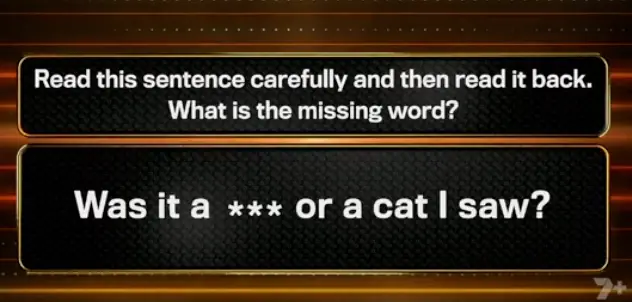
At first, several answers might appear possible. But once the sentence is completed with “car”, everything falls into place:
“Was it a car or a cat I saw?”
Read carefully, and the sentence has a remarkable property: ignoring spaces and punctuation, it reads the same forwards and backwards.

It is a palindrome.
That is what makes the puzzle so deceptive. Contestants were not simply being asked to find a word that made grammatical sense. They needed to recognise the unusual structure of the complete sentence.
With the clock counting down, that extra layer of thinking made a question that looked almost effortless considerably harder.
The 1% Club puzzle that keeps catching people out

It is far from the only challenge on The 1% Club to leave contestants second-guessing themselves.
The show, hosted by Lee Mack, is built around logic, reasoning and problem-solving rather than conventional general-knowledge questions. Many of its puzzles are deliberately designed to trigger an instinctive answer — before forcing players to stop and reconsider what they have actually been asked.
One famous example involves a bat and a ball.
The standard version of the puzzle asks:
“A bat and a ball cost £1.10 in total. The bat costs £1 more than the ball. How much does the ball cost?”
The answer is 5p.
That can feel wrong at first, because 10p is the answer many people instinctively reach for.
But if the ball cost 10p, the bat would cost £1.10. Together, that would make £1.20, not £1.10.
Instead:
- Ball: 5p
- Bat: £1.05
- Total: £1.10
The bat is therefore exactly £1 more expensive than the ball.
Why the wording matters
That is the essence of The 1% Club: the obvious answer is often not the correct one.
The palindrome puzzle encourages players to focus on the missing three-letter word. The bat-and-ball problem encourages them to perform a calculation too quickly.
In both cases, the solution only becomes clear when the question is examined from a different angle.
And that is precisely why these apparently simple puzzles can be so frustrating. The difficulty is not necessarily finding the answer — it is resisting the answer your brain wants to give you first.