Five words. A handful of digits. And one apparently simple question.
It sounds like the sort of challenge that should take only a few seconds.
But this The 1% Club puzzle is a perfect example of why the show can make even straightforward-looking questions suddenly feel much harder once the clock starts ticking.
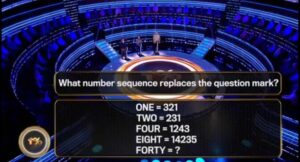
Players are shown:
ONE = 321
TWO = 231
FOUR = 1243
EIGHT = 14235
FORTY = ?
The challenge is simple: what number sequence should replace the question mark?
@1percentclubitv Solve the puzzle… 🧩 #The1PercentClub #quiztime #quiztok ♬ original sound – The 1% Club
There is no complicated equation to calculate and no specialist trivia required.
Yet the numbers seem almost completely random at first glance.
And that is where the trap begins.
Give yourself 30 seconds before scrolling down to the solution.
The Numbers Aren’t Really The Most Important Part
The natural reaction is to focus on the digits.
Why does ONE become 321?
Could 321 somehow represent the numerical value of the word?
Does TWO being 231 reveal some mathematical relationship?
And why does FOUR produce four digits while EIGHT produces five?
You might start counting letters, looking at the numerical values of ONE, TWO, FOUR and EIGHT, or searching for some relationship between 1, 2, 4, 8 and 40.
But none of those approaches gets to the real trick.
The clue is hiding in the letters themselves.
More specifically, you need to pay attention to where each letter would appear if the letters inside each word were arranged in a particular way.
Once that clicks, 321 suddenly stops looking random.
ONE Is The Perfect Place To Start

Ignore every other line for a moment and concentrate on:
ONE = 321
Label the letters according to where they originally appear:
O = position 1
N = position 2
E = position 3
Now ask yourself what relationship between O, N and E could produce the digits 3, 2 and 1.
There’s a very ordinary rule that does exactly that.
And once you identify it, you can test it against TWO.
If your rule also produces 231, you’re probably on the right track.
TWO Confirms Whether You’ve Really Cracked It

The second example is crucial because it eliminates plenty of tempting false patterns.
TWO = 231
The three letters are T, W and O.
Whatever is happening must assign:
T → 2
W → 3
O → 1
Still see it?
Now look at FOUR:
FOUR = 1243
And EIGHT:
EIGHT = 14235
The exact same principle works every time.
There is no multiplication.
There is no hidden number sequence.
There isn’t even any arithmetic involved.
This is fundamentally a letter puzzle disguised as a number puzzle.
And that distinction is what makes the final line so satisfying.
FORTY Could Be The Biggest Clue Of All
Now return to the unanswered word:
FORTY = ?
The five letters are:
F – O – R – T – Y
You need to assign each one a digit using exactly the same rule that transformed ONE into 321 and EIGHT into 14235.
At this point, the answer may suddenly jump out.
If it hasn’t, try thinking less like a mathematician and more like someone arranging words in a dictionary.
That’s your final clue.
The Answer: 12345
The hidden rule is alphabetical order.
Each digit tells you the alphabetical ranking of that letter within the word.
Take ONE.
Its letters are:
O – N – E
Put those three letters into alphabetical order:
E – N – O
That means:
- E is alphabetically 1st
- N is 2nd
- O is 3rd
But the original word is O-N-E, so its letters carry the rankings:
3 – 2 – 1
Therefore:
ONE = 321
Now test TWO.
The letters are T-W-O.
Alphabetically they become:
O – T – W
So O ranks 1st, T ranks 2nd and W ranks 3rd.
In the original order T-W-O, that gives:
2 – 3 – 1
Therefore:
TWO = 231
The same trick explains the longer examples.
For FOUR, alphabetical order is:
F – O – R – U
Returning those rankings to the original F-O-U-R produces:
1 – 2 – 4 – 3
So:
FOUR = 1243
For EIGHT, alphabetical order is:
E – G – H – I – T
The original word E-I-G-H-T therefore becomes:
1 – 4 – 2 – 3 – 5
Giving:
EIGHT = 14235
And then comes the beautifully simple final twist.
FORTY is already in alphabetical order:
F – O – R – T – Y
So F is 1st, O is 2nd, R is 3rd, T is 4th and Y is 5th.
Which means:
FORTY = 12345
No equation. No complicated calculation.
The real challenge was realizing that the numbers weren’t asking you to do maths at all — they were telling you where the letters sit alphabetically inside each word.