Chapter 1 – The Slap at the Anniversary Table
The first slap came before dessert.
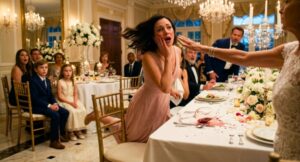
Our fifteenth wedding anniversary dinner had been designed to look perfect. White roses floated in crystal bowls. Candles burned along the mahogany table. Every member of the Carter family wore something expensive enough to suggest harmony.
My husband, Grantham, sat at the head of the table in a navy suit. He spent the entire evening smiling at guests and avoiding my eyes.
Emma, our eight-year-old daughter, sat beside me in a navy velvet dress. Noah, ten, sat across from her with his hands folded around a glass of water.
Willamina Brooks stood near the anniversary cake wearing a white sleeveless dress. She was Grantham’s older sister. For fifteen years she had treated our marriage like a temporary mistake she would eventually correct.
That night she stopped pretending.
She leaned across the table and slapped me so hard my head snapped sideways. A crystal glass tipped over. Wine spread across the tablecloth. Every guest froze.
“Know your place in this family,” she said.
My cheek burned. I heard Emma gasp. Noah whispered, “Mom?”
I slowly set down my fork. Then I looked at Grantham. He lowered his eyes. No protest. No defense. No surprise. That silence told me more than Willamina’s hand ever could.
I stood. Willamina smiled because she believed I would cry. Instead I slapped her back. Hard.
The entire table gasped. Her face twisted with rage. She lunged. I shoved her away. She crashed backward into the three-tier anniversary cake. White frosting exploded across her hair, face, and dress. Sugar flowers scattered across the floor. Guests leaped from their chairs.
Emma screamed. Noah stood in shock.
Grantham finally moved—not when I was struck, but when his sister fell. He grabbed my wrist. “That’s enough!”
I tore free. Then I removed my wedding ring. Fifteen years. Two children. One house. A thousand compromises. I dropped it onto his dinner plate. The metallic clang silenced the room.
I took Emma’s hand with my left and Noah’s with my right. We walked toward the door. No one stopped us.
Willamina sat on the floor beneath broken cake tiers, staring at me through streaks of frosting. Grantham rushed after us. He reached toward my shoulder. I turned sharply. “Touch me again and you’ll explain it to the police.”
He froze. Then I opened my handbag and removed the sealed envelope. His eyes locked onto it. Every drop of color left his face. “You found it?” he whispered.
I did not answer. Because the envelope contained more than proof of an affair. It contained a custody petition, forged medical records, a transfer agreement signed in my name, and a plan to remove me from my children before sunrise. The anniversary dinner was supposed to be the night they finished everything.
Before I left the dining room I looked back once. Grantham remained beside the table. He did not follow the children. He did not ask whether Emma had been frightened or whether Noah had seen enough. He bent toward Willamina and helped wipe frosting from her face.
That single movement settled the final question I had spent years avoiding. When forced to choose between the family he was born into and the family he created, he did not hesitate. He only hesitated when witnesses were watching.
Lena met us three blocks from the mansion. I had texted her a single word before dinner: READY. She had been sitting inside a dark SUV with an emergency custody packet, copies of the envelope, and a domestic-violence advocate.
I hated that the plan required the children to walk through the front door before we could leave. But if I disappeared before the dinner, Grantham would file first and say I had abducted them during a breakdown. Lena had warned me that family courts often move fastest when children appear missing and one parent arrives with polished documents. So we created a record before leaving: the threatening envelope, the planned witnesses, my text messages, the children’s location, the exact route to Lena’s house. Every step documented.
Inside the SUV Emma clung to me. Noah stared out the window. Neither asked why their father remained behind. Children sometimes understand betrayal before adults find language for it.
At Lena’s house I removed the pink dress and found a bruise around my wrist where Grantham grabbed me. The advocate photographed it. Then she photographed my cheek. I hated the camera. I hated how quickly pain became evidence.
Lena said quietly, “You do not have to perform calmness for me.” That sentence broke something open. For years every tear had been used against me. Every raised voice became proof. Every moment of exhaustion became material for Willamina’s story. I had learned to cry without sound. That night I finally let the sound come.
The children heard. Emma entered the room and placed my wedding ring—which she had picked up from the dining-room floor—on the table beside me. “I thought you wanted it,” she said.
I looked at the small silver circle. Then at my daughter. “No,” I answered. “I wanted what it was supposed to mean.”
She did not fully understand. But she nodded. The ring stayed on Lena’s table until police collected it with the dinner footage.
Chapter 2 – The Wife They Called Unstable The Carter family never attacked directly at first. They used concern.
Willamina questioned my parenting in front of relatives. Grantham apologized for me when I had done nothing wrong. His mother told guests I became overwhelmed easily. Every ordinary disagreement became evidence of instability.
When I asked why money was missing from our joint account, Grantham said I was confused. When I found messages between him and Willamina discussing the children’s schedules, he said I was paranoid. When I wanted my own attorney to review a property transfer, Willamina called me ungrateful.
They spent years teaching the family how to doubt me before I ever accused them of anything.
The sealed envelope arrived three days before the anniversary. No return address. Inside were copies of a temporary custody petition naming Grantham as the more stable parent, a psychiatric affidavit claiming I suffered delusions, a transfer agreement giving Willamina control over Carter family shares during my incapacity, and a private-school form listing her as Emma and Noah’s emergency guardian.
At the bottom was a handwritten note: THE ORIGINALS ARE IN HIS STUDY. DON’T CONFRONT HIM ALONE.
I did not know who sent it. But I knew the signatures were not mine. The psychiatrist, Dr. Calvin Price, had never examined me. Still, his report described me in intimate detail—my childhood anxiety, a miscarriage from years earlier, one panic attack after Noah was hospitalized. Real events arranged into a false diagnosis. The report said I posed a risk of emotional harm to the children. The language was careful. Not violent. Not dangerous. Unstable. That word was enough to open doors. Enough to turn a mother into a case file. Enough to make a husband’s silence look protective.
My father’s proxy had always irritated Willamina. She believed Carter blood should control Carter hospitals. My father disagreed. He had built rural clinics before selling his interests to the trust, and he feared the family would eventually trade care for profit. His will gave me authority to block any merger closing more than three clinics without independent review. At the time I thought the clause was ceremonial. Grantham treated it like a personal insult.
The first merger proposal arrived after our twelfth anniversary. Willamina presented it during Christmas dinner. No lawyers. No public-health analysis. Only a thick folder and pressure from fourteen relatives. Grantham squeezed my knee under the table. “Sign tonight. It shows unity.”
I refused. Two weeks later he withdrew thirty thousand dollars from our joint savings and told me I had approved it. When I challenged him he produced an email from my account. I had not sent it. That was the first digital forgery. I changed my password. He called it paranoia.
The next year an anonymous complaint reached the school claiming I left Emma unattended during a panic attack. The event never happened. Willamina offered to “help” by becoming an emergency guardian. I refused again. The complaint disappeared. Later Rachel found the draft inside Grantham’s files.
The family had been testing institutions. Would the school accept Willamina’s version? Would doctors repeat Grantham’s description? Would relatives support emergency custody? Every successful lie gave them confidence. The anniversary dinner was not their first attempt. It was the final rehearsal becoming action.
Chapter 3 – Why Grantham Needed Me Gone The Carter family trust controlled a chain of rehabilitation hospitals across three states. Grantham held twenty percent. Willamina controlled fifteen. The remaining shares belonged to older relatives. My father invested in the company before his death and left his voting proxy to me. That proxy gave me the deciding vote in any sale.
For two years Willamina had pushed a merger with Vale Medical Holdings. The deal would pay the family hundreds of millions. It would also close rural clinics and transfer patient data to a company under federal investigation. I refused. Grantham told me business decisions should not become emotional. I told him ethics were not emotion. That was when our marriage changed completely.
The custody petition and psychiatric affidavit were part of the merger plan. If I were declared temporarily unfit, Grantham could control my proxy as spouse. Willamina could approve the sale. The children would become leverage. I would sign to keep access to them. Or they would declare me too unstable to participate.
The anniversary dinner was not a celebration. It was a pressure event. Relatives, trustees, and family attorneys had been invited so they could later describe my behavior. Willamina’s slap was not entirely impulsive. She wanted a reaction. My returning slap would become evidence. My leaving with the children would be called abduction. Grantham’s silence was part of the trap. But he had not expected me to have the envelope.
Rachel had worked for Grantham for six years. She knew his calendar better than I did. She scheduled the secret meetings with Dr. Price, though she had been told they concerned a hospital executive. She created folders labeled MENTAL CAPACITY REVIEW and FAMILY CONTINUITY. At first she believed Grantham was preparing for an older relative’s illness. Then she saw my name.
Her first act of resistance was small. She delayed sending Dr. Price my therapy records. Then she copied the invoice. Then she began recording conversations from her desk. Fear made her careful. Grantham paid for her mother’s nursing care through the company insurance plan. If Rachel lost her job, her mother could lose treatment. Willamina knew that. During one meeting she said, “Rachel understands loyalty because she has someone depending on her.” It sounded like praise. It was a warning.
Rachel spent months deciding whether evidence outweighed risk. The night she found the draft abandonment letter she stopped debating. It included a statement that I had left the children because of worsening mental illness. A notary line had already been completed. The date was blank. Rachel understood they could make me disappear legally even if I remained physically present. She copied the file. Placed it in the envelope. Then drove past my house three times before leaving it at Lena’s office instead. She feared Grantham’s cameras. The handwritten note used her left hand so no one would recognize the writing.
When she handed me the flash drive she said, “I kept waiting for something so terrible that helping you would become obvious.” “What changed?” “I realized preparation was already terrible.”
That distinction changed how I later understood conspiracies. We expect danger to announce itself with violence. Sometimes the danger is a calendar, a blank signature line, and adults speaking calmly about the day another person will lose her children.
Chapter 4 – The Person Who Sent It The anonymous sender contacted me the morning after the dinner. Her name was Rachel Ford. She worked as Grantham’s legal assistant. We met at a coffee shop outside town. She looked exhausted.
“I copied everything,” she said. “Why?” “Because they were going to file Monday.”
She gave me a flash drive. Emails. Draft motions. Medical invoices. Audio recordings.
One file contained Willamina’s voice: “Hit her pride in public. She always reacts when the children are watching.” Grantham answered: “She might leave.” “That helps us.”
Another recording: “If she takes the children, we request emergency custody before midnight.”
My hands shook. Rachel continued. “There’s more.”
Grantham had been having an affair—not with a stranger, but with Dr. Price’s daughter, Ashley. Ashley worked inside Vale Medical Holdings and helped coordinate the merger. The affair was not the central betrayal. It was part of the business arrangement. If the merger passed and I lost the proxy, Grantham planned to divorce me after securing custody. Ashley would enter the family publicly after the court declared me unstable. Willamina had already chosen a date for their engagement announcement—three months after mine.
The child advocate’s name was Dr. Miriam Cole. She refused to begin with the dinner. She asked Emma about school, favorite books, breakfast, and where she felt safest. She asked Noah who helped with homework and who apologized after arguments. Only after the children understood the room did she ask about the phrases Grantham and Willamina taught them.
Noah remembered a “practice game.” Grantham described situations and asked Noah which parent behaved more safely. Mom cries. Dad stays calm. Mom questions doctors. Dad trusts professionals. Mom refuses family plans. Dad protects tradition. Every answer was designed. When Noah chose me once, Grantham stopped the game and said, “Think carefully. Judges care about honesty.” Noah believed a judge was already watching.
Emma remembered Willamina promising a puppy if she said she preferred sleeping at Aunt Willamina’s house. Emma wanted the puppy. She repeated the sentence once. Then felt guilty and told Noah. The children made a secret agreement not to answer future questions. That silence later appeared in Dr. Price’s affidavit as “fearful withdrawal around maternal topics.” Even their resistance had been rewritten.
Dr. Cole documented each coaching method. She also documented something painful. Both children still loved Grantham. Emma missed the way he sang badly in the car. Noah remembered building model planes with him. Their affection did not weaken the evidence. It made the betrayal more complete. Grantham had used trust created during good moments to make them participate in harm.
Dr. Cole explained to me: “Children can love a parent and still need protection from that parent.” I repeated that sentence many times in the years after trial.
Chapter 5 – The Children He Tried to Coach Emma and Noah had heard more than I realized. After the anniversary dinner we stayed with my friend Lena Ortiz, a family-law attorney. She arranged an emergency protective order before Grantham could file his petition. Then a child advocate interviewed Emma and Noah separately.
Noah said his father repeatedly asked whether I shouted, forgot things, or cried. Emma said Willamina taught her a sentence: “Mom gets scary when she’s confused.” The advocate asked whether I had ever scared her. Emma shook her head. “Sometimes Mom cries in the bathroom.” “Why?” “Dad says mean things.”
The children had been coached. But they had not been fully convinced.
Noah also revealed that Grantham took him into the study one night. He showed him a document and said, “If Mom gets sick, Aunt Willamina will help us.” Noah asked whether I was dying. Grantham said, “Not exactly.” That conversation destroyed the claim that the custody plan was a sudden emergency. It had been prepared for months. The children were not witnesses by choice. They had been turned into pieces of the case against me.
The warrant team entered the Carter house at 6:14 in the morning. Grantham was still wearing the same navy trousers from the anniversary dinner. Willamina arrived before police finished the first room. She demanded access. An officer told her the property was sealed. She called the family attorney. The attorney arrived carrying a motion already drafted to block seizure of “confidential medical planning documents.” The phrase revealed knowledge before investigators announced what they sought.
Police photographed every shelf before moving anything. Inside Grantham’s desk they found a second envelope addressed to the judge assigned to emergency family cases. It contained the forged affidavit, photographs from the anniversary dinner, and a prepared statement from Willamina. The statement described my “unprovoked attack.” The timestamp showed it had been created two days before the dinner. Willamina had written her account before I slapped her.
The investigators also recovered a hidden camera facing our kitchen table. Months of conversations had been recorded. Clips favorable to Grantham were placed in a folder marked EXHIBITS. Longer files showed context. He provoked arguments. Repeated false statements. Refused to let me leave rooms. Then saved only my raised voice. The selective editing was the architecture of the entire plan.
Chapter 6 – The Originals in the Study Police could not search the study based only on copies. Rachel agreed to cooperate. She wore a recorder during a meeting with Grantham and Willamina. They discussed destroying the original affidavit and replacing it with a new version dated after the anniversary dinner.
Willamina said: “Her slap gave us everything.” Grantham answered: “Not if she has the envelope.”
Rachel asked what envelope. Silence. Then Grantham said: “Find out what she knows.”
That recording supported a warrant. Investigators searched the Carter house. Inside the study safe they found the original forged custody petition, blank medical forms signed by Dr. Price, a copy of my signature, a merger bonus agreement promising Willamina twenty million dollars, a hidden account funded by Vale Medical Holdings, and a draft letter supposedly written by me. It said I was leaving voluntarily because I could no longer care for the children. My life had been reduced to a document waiting for a date.
The study also contained photographs of me taken without consent—crying in the driveway, leaving therapy, sitting alone in a parked car. Ordinary moments framed to look like collapse. Grantham had not only planned to take my children. He had been collecting a version of me that could survive after the real woman was removed.
The guests resisted becoming witnesses. The Carter name opened hospital wings, funded scholarships, and paid campaign donations. Several people suddenly could not remember where they sat. One claimed the chandelier blocked his view. Another said the music was too loud to hear Willamina.
Then Lena obtained the catering map. Seat assignments had been printed. Security cameras showed each guest. Phone metadata placed their recordings. Memory became less flexible when surrounded by timestamps.
Evelyn Mercer’s testimony changed after prosecutors showed her an email from Willamina: WE MAY NEED YOU TO CONFIRM JOSELYN APPEARED DISORIENTED. Evelyn had replied: OF COURSE. FAMILY FIRST.
On the stand she cried. “I thought they wanted support.” The prosecutor answered: “You agreed to support a conclusion before seeing behavior.”
That sentence reached beyond our case. People often believed manipulation required elaborate lies. Sometimes it only required recruiting witnesses to interpret everything in advance. The dinner guests had been given a lens. When I remained quiet I looked withdrawn. When I spoke I looked aggressive. When I left I looked unstable. There was no safe behavior inside a story written before I entered the room. The envelope gave me one thing they had not planned for: knowledge of the script.
Chapter 7 – The Dinner Becomes Evidence Every guest at the anniversary dinner received a subpoena. Most claimed they saw only a family argument. Then phone videos surfaced. One showed Willamina pouring wine into my glass repeatedly before the slap. Another showed Grantham moving the children closer to the table just before the confrontation. A third captured Willamina whispering to him: “Now.” Then she struck me.
The dinner had been staged. The cake collapse became public entertainment. The videos of the setup became evidence.
The prosecutor reconstructed the sequence. Willamina provoked. Grantham remained silent. I reacted. They planned to file within hours. The sealed envelope disrupted the timing. My threat to call police forced Grantham to pause. Rachel’s flash drive preserved the rest.
One guest, an elderly trustee named Evelyn Mercer, admitted Willamina had asked her weeks earlier whether she would testify that I seemed emotionally unstable. Evelyn declined. She never warned me. On the stand she said she thought it was family gossip. The prosecutor asked: “When did gossip become a custody affidavit?” Evelyn lowered her eyes. Silence had not made her neutral. It had made the plan easier.
The courtroom was full every day. News outlets called it the Anniversary Cake Trial. I hated the name. A dessert had become easier to discuss than forged custody documents. The judge eventually prohibited cameras from focusing repeatedly on the cake footage. The case was not entertainment.
My cross-examination lasted six hours. Willamina’s attorney asked why I wore an elegant dress if I feared danger. Why I brought the children. Why I smiled in early photographs. Why I ate dinner. Each question suggested fear had one correct appearance. I answered: “I was collecting proof inside a plan I did not fully understand.”
He asked why I slapped her. “Because she struck me and I reacted.” “Violently.” “Yes.” “Then you agree you can be violent.” “I agree I committed one act. I do not agree that act proves a psychiatric condition invented before it happened.”
The jury watched carefully. Honesty protected me more than perfection could.
When Grantham testified he described himself as trapped between wife and sister. The prosecutor showed financial transfers he personally authorized. The affair messages. The custody calendar. His signature on the fake school forms. “You were not between them,” she said. “You were working with one against the other.”
For the first time he looked directly at me—not with love, but with resentment that I had survived the version of me he created.
Chapter 8 – The Trial of the Carter Family The trial lasted nine weeks. Charges included conspiracy, forgery, attempted custody fraud, medical-record falsification, wire fraud, witness intimidation, and obstruction.
Willamina’s attorney called me violent. He played the video of my slap. I watched myself strike her. Then shove her into the cake. “Was that appropriate?” he asked. “No.” “You lost control.” “For seconds.” “Then Dr. Price was right.” “No. Anger after being assaulted is not a psychiatric diagnosis.”
The prosecutor displayed the affidavit. It had been written six weeks before the dinner. The supposed diagnosis came before the behavior used to justify it. Dr. Price admitted under cross-examination that he never met me. He relied entirely on Grantham and Willamina.
Ashley testified under a plea agreement. She admitted the affair, the merger plan, the fake medical narrative, and the future engagement.
Grantham took the stand. He said he feared losing the children. The prosecutor asked: “To whom?” He looked at me. No answer. “Your wife had no record of neglect, abuse, addiction, or dangerous behavior. What exactly were you protecting them from?” Silence.
Then Rachel’s recording played: HER SLAP GAVE US EVERYTHING.
The jury understood. Not a family argument. A manufactured event. Not an unstable wife. A targeted shareholder. Not concerned relatives. People trying to turn a mother’s reaction into a legal weapon.
The verdicts came on a rainy Thursday. Emma and Noah were not in court. I wanted them at school. The jury forewoman read guilty again and again. Willamina stared forward. Grantham closed his eyes. Dr. Price shook his head as if professional authority should have protected him from ordinary law.
Outside, reporters shouted questions. Did justice feel good? Would I forgive Grantham? Was the slap worth it? I said only: “My children are safe. The documents are public. That is enough for today.”
Justice did not feel like celebration. It felt like an end to immediate danger. Grief arrived later. I grieved the husband who once held Noah through a fever. The brother-in-law dinners that had contained genuine laughter. The family photographs not entirely false. Harm does not erase every good memory. It changes what those memories can mean.
The ring auction occurred six months later. An anonymous buyer paid far more than its value. Years afterward I learned Rachel bought it. She donated it to the Clear Consent Project with a note: LET THE SYMBOL PAY FOR THE DAMAGE DONE IN ITS NAME. We kept the money. Not the ring. It was melted and remade into small plain bands given to women opening independent bank accounts after coercive marriages. No inscriptions. No promises. Only metal changed into tools of beginning.
Chapter 9 – The Verdicts and the Ring Willamina was convicted on every major count. She received twenty-four years. Grantham received eighteen. Dr. Price lost his license and received eleven. Ashley received four under cooperation.
The merger collapsed. Vale Medical Holdings entered federal investigation. The rural clinics remained open under an independent nonprofit trust. My voting proxy was restored. I placed it into neutral governance so no spouse or family member could ever use it again.
At sentencing Grantham looked at me. “I loved you.” I answered: “You loved access to what I controlled.” He lowered his head.
The wedding ring remained inside an evidence bag until the trial ended. The prosecutor offered to return it. I said no. It was auctioned with other seized property. The money funded legal aid for victims of family coercion.
Emma asked whether that meant the marriage never mattered. I told her the truth. “The marriage mattered. That is why the betrayal hurt.”
Noah asked whether his father was evil. I answered carefully. “He made repeated choices that harmed us.” I refused to turn complexity into confusion. Love could have existed. So could crime. One did not erase the other.
Emma did not read every page in one sitting. She stopped after the affidavit. Returned two months later for the school forms. Then waited nearly a year before reading Grantham’s messages with Ashley. No deadline governed understanding. No court required her to process family history on schedule.
Noah never read the envelope. At twenty-eight he said: “I know what happened. I don’t need their words inside my head.” His choice was as valid as Emma’s.
The Clear Consent Project adopted a similar rule. Survivors controlled access to their records whenever law allowed. Some wanted every page. Some wanted summaries. Some wanted sealed archives. Transparency did not mean compulsory exposure.
The project’s first major reform involved emergency custody hearings. Courts had often issued orders based on one parent’s affidavit before the other knew a filing existed. We created an independent-review pilot for cases involving incapacity claims and financial conflicts. The reviewing lawyer asked five questions: Who benefits from the diagnosis? Who paid the evaluator? Was the accused parent examined? Were the children interviewed privately? What irreversible action happens if the order is granted?
The pilot stopped a forged petition in its first month. A father claimed the mother suffered psychosis. The evaluator was his business partner. The order would have transferred voting shares through custody control. The pattern looked painfully familiar. The judge refused emergency relief and ordered neutral assessment. No children removed. No public collapse. The system recognized the script.
Chapter 10 – The Envelope Emma Opened Years Later Emma was twenty-one when she asked to read the sealed envelope. Noah had already chosen not to. We sat together at the dining table in our smaller home. No chandelier. No white roses. No family audience.
She opened the copies slowly. The custody petition. The false psychiatric affidavit. The transfer agreement. The emergency guardian form. She stopped. “Dad knew all of this?” “Yes.” “Did he love us?” “I believe he felt love.” “That’s not what I asked.”
I understood. “He chose control over your safety.”
Emma closed the envelope. Then asked why I stayed through so many warning signs. “I kept thinking silence was patience.” “Was it?” “No. It became permission.”
She held my hand. The anniversary dinner remained a painful memory. But it no longer defined us.
Emma became a child advocate. Noah became a teacher. Neither entered the Carter business. They chose lives without inherited obligation.
I founded the Clear Consent Project. It trained courts, doctors, schools, and banks to recognize coordinated family coercion. No psychiatric affidavit accepted without independent examination. No emergency guardianship controlled by a financially interested relative. No custody filing built solely from statements supplied by one side.
One case involved a woman whose husband prepared a false incapacity report to seize her restaurant. The court flagged the conflict. The report collapsed. No anniversary trap. No public slap. No children coached. Earlier protection. That was the ending I wanted.
Second Epilogue – The Files That Taught the Courts to Listen The Clear Consent Project began with one office, three attorneys, and a borrowed conference room. Within five years it handled hundreds of cases involving false incapacity claims, manipulated custody petitions, family-business pressure, medical records written by professionals who never met the people they described, and children coached into repeating adult language.
Patterns emerged. A financially interested relative supplied the history. A doctor repeated it. A lawyer converted it into urgency. A judge saw only one side before issuing temporary control.
The project created a conflict map: Who benefits if the person is declared unstable? Who paid for the report? Who supplied the facts? Was the subject interviewed privately? Were the children interviewed away from interested adults? Was there an upcoming transaction, inheritance, merger, or divorce? The questions became mandatory in several states.
In one case a husband filed an emergency petition claiming his wife had become delusional after childbirth. The filing arrived one day before she was scheduled to vote against selling the family company. The court paused. Independent doctors found no psychosis. The sale failed. The children remained safe while the marriage dispute moved through ordinary legal channels instead of an emergency trap. No staged dinner. No family audience. The process slowed down before power changed hands.
In another case a grandmother sought guardianship over her adult daughter, claiming severe anxiety. The daughter’s bank account contained a trust distribution the grandmother wanted to manage. Independent counsel exposed the conflict. The petition was withdrawn.
Not every case involved obvious villains. Sometimes families genuinely feared illness. The project did not teach judges to reject concern. It taught them to separate concern from benefit. One elderly man truly suffered dementia while his son also stood to inherit millions. A neutral guardian was appointed. The son remained involved in care but did not control money alone. Precision protected the vulnerable person without pretending love erased conflict.
Emma’s work with children changed interview practices. She taught advocates that coached children often repeat adult language without understanding it. “Mom gets scary when she’s confused.” “Aunt Willamina keeps us safe.” “Dad says Mom forgets.” Professionals learned to ask for experiences instead of labels. What happened? Who said that? What did you see? What did you feel? The difference uncovered truth.
Noah, though he avoided legal work, contributed in another way. As a teacher he developed classroom materials about emotional safety and adult conflict. Children learned they were not responsible for keeping families together. They were not messengers. Not witnesses on command. Not protectors of adult secrets. One student disclosed that her father repeatedly asked her to report on her mother’s behavior during a custody case. The school contacted an advocate. The coaching stopped. No courtroom drama. A child released from an adult role.
Grantham’s letters remained in storage until his death. Then Emma asked whether I wanted them destroyed. I said yes. She asked if I was sure. I said: “I do not owe history every message he chose to send.” The archive kept legal evidence. Not personal pressure. That boundary influenced survivor-record policy. Courts needed records. Researchers needed systems. The public did not need unlimited access to private pain.
The original anniversary video remained sealed. The cake collapse became legend online, but the full footage was never released. People saw a few seconds from guests’ phones. They did not see Emma shaking afterward. Noah refusing dinner for weeks. Me sitting in a locked bathroom because the sound of crystal made me panic. Public entertainment ended where private recovery began.
At the project’s twentieth anniversary Rachel Ford spoke publicly for the first time. She described the cost of becoming a whistleblower—lost work, threats, isolation. People called her brave. She said: “I was terrified. Bravery is what people named the paperwork after it worked.” The room became quiet. She later led a secure reporting program for legal staff, accountants, nurses, and assistants who discovered family fraud. Witnesses received independent counsel before speaking. No employer-controlled lawyer. No promise of immunity without explanation. No expectation that truth-telling would be simple.
The program exposed a hospital executive using false psychiatric notes against his business partner. It exposed a trust attorney forging beneficiary waivers. It exposed a school administrator helping one parent manufacture custody evidence. Small insiders saw systems from within. The project gave them a safe route out.
Ashley completed her sentence and requested a meeting with Emma and Noah. Noah refused. Emma agreed once. Ashley apologized for helping build the medical narrative. She did not ask to be forgiven. Emma asked: “Did you believe Mom was unstable?” Ashley answered: “At first, no. Later, I needed to.” That honesty mattered. Complicity often grows through chosen belief. Ashley needed me to be dangerous so her relationship with Grantham could feel less cruel. The meeting ended without reconciliation. Still, Ashley later testified before a medical ethics board. Her testimony helped create stronger rules for third-party psychiatric affidavits. Accountability created public value without requiring personal closeness.
Dr. Price died after losing every license and title that once made his words powerful. His reports became teaching examples—not because every diagnosis he made was false, but because he allowed an interested family to write the conclusion before the evaluation. Medical schools adopted a rule: No incapacity opinion without direct examination except under narrowly defined emergency circumstances. Conflicts had to be disclosed. Collateral sources had to be identified. Contradictory evidence had to be documented. The word unstable lost some of its unchecked power.
At sixty-five I stepped away from the Clear Consent Project. A younger director named Lena Brooks took over. She had survived a different family-coercion case and disagreed with me often. That was healthy. I refused a permanent veto. Organizations built against control cannot depend forever on one founder’s authority. The project grew without me. That was success.
Years later I attended one final board meeting as a guest. A case involved a woman who slapped her brother during a confrontation over forged property documents. Some staff worried the violence made her ineligible for support. I said nothing until asked. Then I answered: “Address the assault honestly. Do not let one reaction erase the sequence that produced the case.” The organization held both truths. She accepted responsibility for the slap. The fraud investigation continued. No perfect victim required. That principle came directly from the anniversary table. I had struck Willamina. It was wrong. It did not make the conspiracy imaginary. Complexity did not have to collapse into one moral label.
Near the end of my life Emma asked what I regretted most. I expected to say the years I stayed. Instead I answered: “Looking at Grantham after Willamina slapped me and still hoping he would become someone else.” That moment lasted one second. Inside it lived fifteen years of denial. His lowered eyes ended the marriage before the ring reached the plate. Emma understood. She had watched him too.
After I died she placed no wedding photograph at the memorial. She displayed the sealed envelope. Closed. Beside it, a small silver fork from the anniversary table. Not the ring. Not the cake photograph. The fork I set down before standing. A tiny object marking the moment passivity ended. No one else knew its meaning. That was fine. Not every symbol needed explanation.
The final Clear Consent training hall eventually carried three sentences: WHO BENEFITS? WHO CONTROLS THE STORY? WHO HAS NOT BEEN HEARD ALONE?
Those questions traveled farther than our family name. A judge asked them before signing an emergency order. A doctor asked them before writing an affidavit. A teacher asked them before repeating a child’s words. A bank officer asked them before approving a transfer. Each question created time. Time created space. Space allowed truth to arrive before control became law.
That was the real ending. Not the slap. Not the cake. Not the ring. The pause before the next family lost everything to a story written by the person who stood to gain.
THE END